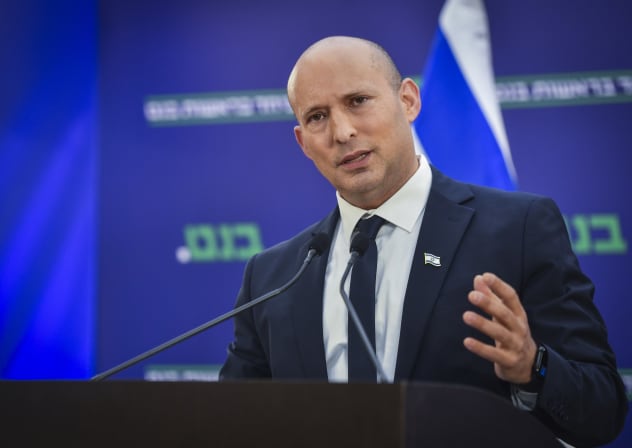
Deputy Foreign Minister Danny Ayalon stars in a video released by his ministry
on Thursday, in which he presents a historical narrative meant to help wage the
public diplomacy battle.
The video, titled
The Truth About the West Bank,
was made in cooperation with the StandWithUs student NGO, by filmmaker Shlomo
Blass of Rogatka Ltd, and director Ashley Lazarus.
In his day job, Blass
works as the TV director for the Latma political satire website, which is best
known for the
We Con the World video that lampooned the Turkish participants in
the 2010 Gaza protest flotilla.
Blass also produced an online video
called “Israel’s Critical Security Needs for a Viable Peace.” Created for the
Jerusalem Center for Public Affairs, it describes strategic arguments to keep
the West Bank, and racked up hundreds of thousands of hits following Prime
Minister Binyamin Netanyahu’s public disagreement with US President Barack Obama
over making the June 4, 1967, lines the baseline for a peace deal.
RELATED:Ayalon thanks European states for helping stop 'flightilla' Ministers speak of opportunity to improve Turkey ties Blass
told
The Jerusalem Post last week that the videos are important because these
days “people don’t have the time to read long books and essays, and these clips
do people a good service. If you can break down the arguments and make them
interesting but still true, and put it forth quickly, it’s a real service for
people.”
The video bears a striking similarity to a video released by the YESHA
council of Jewish settlements in May dealing with the same subject,
entitled "The Territories: Who Do They Belong To?" The video has the
same graphics and the script is almost exactly the same word for
word.
That video was also produced by Shlomo
Blass.
"The ministry saw it [the YESHA video] and
said they wanted to do something similar to that, so we made some
adaptations to it so that I would work for an audience that wasn't
familiar with the same things as an Israeli audience," Blass said last
week.
South African-born, Jerusalem-based director Ashley Lazarus, who
has directed many commercials and documentaries in a career spanning decades,
said that
The Truth About the West Bank represented an opportunity for him to
use his talent to aid Israeli public diplomacy.
“I come from outside
Israel and I see the nightmare of publicity that is put against Israel and how
very little counter-information is fed to the Jewry of the world... Suddenly the
Foreign Ministry said here’s a chance to do something, and we’re open to counter
these misperceptions in a contemporary way.
“Whichever angle you’re
coming from in journalism, Israel faces enormous prejudice and criticism that is
fueled by unbelievable PR and press-manipulation. It’s not a level playing
field, and that’s why I got involved and I had to put my money where my mouth
is,” Lazarus said.
When asked if the clip could be perceived as
propaganda in that it features the deputy foreign minister, Lazarus said, “Stop
right there, what is the legal point of view on the issues? The film can of
course be perceived as propaganda, it’s still representing an official body of
Israel and anyone who is prejudiced will jump all over it. But if you present it
honestly and it’s based on fact, you might have some chance and some people
might say this [the issue] is worth reconsidering.”
The six-minute video
begins with a soundtrack of smooth jazz. Then Ayalon appears in front of an
animated backdrop, and begins tackling the “very simple question” of from whom
Israel conquered the West Bank.
He mentions how there was never an Arab
state in the West Bank known as “Palestine.”
“Actually, was there ever [a
state of Palestine]?” he then asks.
Ayalon then breaks down the timeline
from the Balfour Declaration in 1917 through Six Day War, along the way
discussing UN Security Council Resolution 242 that followed the 1967 war. It
talks about how Jordan had “no legal justification” for holding the West Bank
following the War of Independence, and how Israel’s giving up its claim to the
East Bank of the Jordan River, promised under the Balfour Declaration, shows
that “I guess you can’t say the Jewish people haven’t accepted some painful
compromises already.”
Ayalon goes on to say there was never an
international border on the Green Line and that a new legal definition is needed
for the West Bank, arguing it should be considered a disputed area, like Western
Sahara, Tunbs Island (controlled by Iran but claimed by the United Emirates) and
Kashmir, among others.
“Israel’s presence in the West Bank is the result
of a war of self-defense and should not be seen as occupied territory; because
there was no sovereign body there before, it should be called disputed,” Ayalon
says.
“Please, let’s stop using the terms ‘occupied territories’ and ‘’67
borders,’ they’re simply not politically correct,” Ayalon says.
The
Foreign Ministry said on Thursday that the “concise, easy to follow video” is
meant to explain “where the terms ‘West Bank’ ‘occupied territories’ and ‘’67
borders’ originated and how they are incorrectly used and
applied.”
Ayalon’s office said that the video was meant to put forward
Israel’s “long-standing but neglected position” ahead of the Palestinians’
attempt to have a unilaterally declared state recognized at the UN in
September.
“For too many years, our public diplomacy has been mainly
based on a ‘peace narrative,’ where Israeli officials talk about how much we are
willing to concede for peace, while the Palestinian public diplomacy is all
about supposed rights and international law,” Ayalon said.
“It is time
for Israel to return to a ‘rights-based diplomacy’ and talk about the facts,
rights, history and international law which are little known but give a
dramatically different viewpoint to what is currently accepted.”
His
office went for the online video format because “Israel’s case is harder to make
in an era where context, background and history are less important than an image
or a headline. Social media in general and YouTube in particular are major
battlegrounds in the clash of narratives and public diplomacy. It is vital that
a strong rights-based Israeli presence is seen and heard, especially for the
YouTube demographics who are more interested in easy to digest
explanations.”
The video will eventually be translated into a number of
languages including Arabic, Spanish, French, Russian and German, and will be
shown in “hundreds of schools and educational centers worldwide as part of their
curriculum on the Israeli-Palestinian conflict,” Ayalon’s office said.