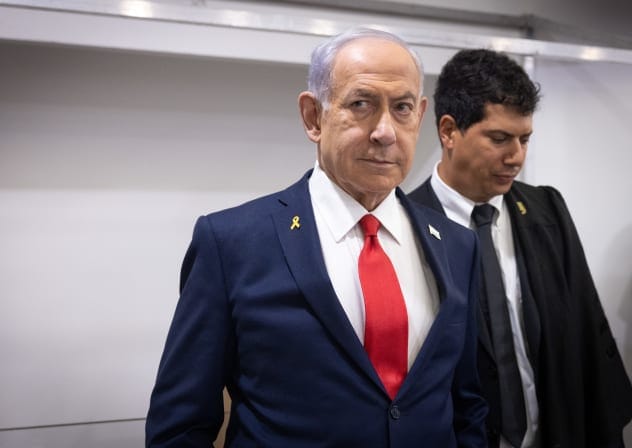
Prime Minister Binyamin Netanyahu preempted headlines suggesting early elections
when he told his supporters at his Likud leadership race victory speech at the
Tel Aviv Fairgrounds early Wednesday that “there is still time” before Israel
will head to the polls.
Netanyahu easily defeated Likud activist Moshe Feiglin, winning 48,490 votes (76.79 percent) compared to Feiglin's 14,660 (23.21%). Despite fears of a low turnout, 63,150 of the eligible 125,300 Likud members (50.4%) exercised their right to vote.
Speaking to a crowd full of Likud
activists and most of the party’s ministers and MKs after 1 a.m., Netanyahu
expressed his satisfaction with the turnout and hinted that the next general
election will be closer to the set date of October 22, 2013 than many people
think.
“It is not a foregone conclusion that so many people would leave
work and school to vote when it is not in the context of a national election for
the Knesset,” he said, adding, “by the way, there is still time” before such an
election would take place.
Wednesday’s front page newspaper headlines
that had already been sent to print when the prime minister spoke reported that
“Netanyahu is considering elections in October [2013].”
Quoting senior
Likud ministers, the newspapers suggested that Netanyahu would prefer to advance
the election in order to take advantage of his current popularity, avoid
extortion from coalition partners in passing the next state budget, and preempt
pressure from US President Barack Obama, who could be strengthened if he is
reelected in November.
Speaking to The Jerusalem Post, Netanyahu’s
associates confirmed only one of those three goals. They said it was indeed
important to avoid extortion in passing the budget.
But they added that
the knowledge that Netanyahu could catch them off guard at any time by advancing
a general election was enough of a deterrent to keep coalition partners in
line.
By law, the failure to pass a state budget results in elections
being initiated automatically.
Passing a budget in an election year has
proven difficult in the past, but Finance Minister Yuval Steinitz expressed
confidence that his government could do it.
“We will do everything
possible to ensure the government lasts out its days,” Welfare and Social
Services minister Moshe Kahlon said. “It is important that we finish the
important work we are doing and give Israelis some
stability.”
Netanyahu’s Likud rival, Vice Premier Silvan Shalom, was
noticeably absent from the prime minister’s victory party.
By advancing
the race by a year and a half, Netanyahu prevented Shalom from running and left
him with only Feiglin as his competition.
In the last Likud primary in
2007, Netanyahu won 73.2% of the vote and Feiglin 23.4%.
Netanyahu
succeeded in raising his total while Feiglin’s support fell
slightly.
Nevertheless, Feiglin claimed victory, noting that nearly a
quarter of Likud members advanced his agenda of Jewish leadership for Israel. He
said he would use his power in the party to ensure that the next Likud Knesset
slate would be loyal to the land of Israel.
“We overcame nearly
insurmountable challenges in facing off against a sitting prime minister,”
Feiglin said. “Others were too afraid to run against him. Our accomplishment is
great.”
Feiglin’s associates boasted that despite perceptions that most
of his support came from over the Green Line, only 3,000 of his 14,660 votes
came from Judea and Samaria. They pointed out numerous communities in pre-1967
Israel in which Feiglin defeated Netanyahu, most notably Beit
Shemesh.
There were communities in Judea and Samaria in which Feiglin won
nearly all the votes. In many large cities, Netanyahu beat Feiglin by a huge
majority.
Speaking at a Jerusalem press conference with UN Secretary-
General Ban Ki-Moon, Netanyahu said he was proud that so many people came out to
vote on a night when the popular show Big Brother was on. He rejected the notion
that the election results showed that his party had swung to the
right.
“The party is moving,” he said. “It moved in my direction.”