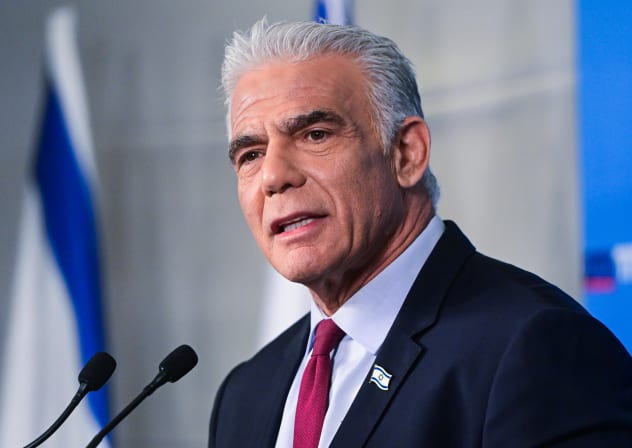
Yesh Atid party leader Yair Lapid, speaking from the Ariel University Center on
Tuesday night, said his party “won’t sit in a government that won’t return” to
the peace table, in his first major speech of election season on diplomacy and
security issues.
Lapid criticized the Right for only coming to the
negotiating table with “a gun” and the Left for only coming with “an olive
branch,” saying there must be a balanced approach.
He did not completely
define what that meant, but he did imply that Israel must be ready to make
sacrifices.
Lapid indicated that his primary goal was maintaining a
Jewish majority, which could only be done by negotiating peace with the
Palestinians based on the “two states for two peoples” vision, and not based on
unilateral withdrawals or ignoring the Palestinians.
On the other hand,
he did specify that he would not withdraw from any of the settlement blocs, from
the Gush bloc to Ariel, the site of the speech.

Citing Ariel as a red
line and delivering his speech from there was significant, as while it is a
large settlement it is also one of the settlements situated most deeply into the
West Bank – and media reports have indicated in the past that some Israeli
leaders did not view Ariel as a red line.
Lapid also said he had two
“iron rules.” He would not recognize Palestinians’ right of return for their
refugees. He claimed that part of his basis was that international law does not
allow people to pass on the right of return to land to their
descendants.
On Jerusalem, Lapid said that he would not divide the
capital and would maintain sovereignty.
The language he used on this
issue went further than the ambiguous refusal to divide it, which some
politicians use as a code for leaving open the possibility of a city split by
sovereignty, but not by a fence or concrete border.
However, he did not
explicitly negate sharing some part of Jerusalem with the
Palestinians.
He did add that Jerusalem is the “heart” of the country and
that “the return to Zion” was speaking of a “return to the Tower of David” in
Jerusalem, and not to “the Azrieli Tower” in Tel Aviv.
Lapid’s chief
criticism of Prime Minister Binyamin Netanyahu on the peace process appeared to
be that he had “wasted four years” by not going to the table with a serious
“intent” to make an agreement.
He excoriated Netanyahu for using the
“there is no peace partner” argument as a cover for not taking the process
seriously.
Lapid quoted former prime minister Yitzhak Rabin who said that
we may not like the Palestinians, but we are stuck with negotiating with them,
and cannot try to “make peace with the Norwegians” and achieve peace.
He
also spoke directly to the settlers, saying that he recognized them as having an
important role as a “bridge between past and future,” but, likely referring to
protests against withdrawals, also said that they must accept government
decisions “even if they disagree.” On Iran, Lapid chastised Netanyahu for
overemphasizing the military option. He said that while the option must “remain
on the table,” the focus must be on the goal of stopping Iran from making a
nuclear weapon.
The Yesh Atid party leader implied that since Israel
could only set Iran back, but not fully stop it, Israel must work harder than it
has in the past to rally world support.
He added that “we must not do the
world’s work, we must convince the world that it needs to act on behalf of all
of us.” Some commentators have argued that only greater sanctions or a US strike
can fully stop Iran’s weapons program.
While Lapid did not formally
endorse this view, it appeared to be the direction in which he was
going.
Lapid said that while peace with the Palestinians was a
“strategic” interest for Israel and “not merely tactical,” another advantage to
peace would be the world’s increased willingness to listen to Israel on
Iran.
Several hundred people and media packed the Raab Hall at Ariel,
with protesters trying to disrupt Lapid’s speech on both sides of the aisle.
Right-wing protesters held signs saying “Lapid will throw me out of my house,”
while a group of Meretz Youth volunteers held a demonstration outside of the
auditorium. They then entered and threw fake bills with Lapid’s face on them on
stage, implying he was a sell-out.
The Meretz spokesman did not know
about the incident when asked, and said that the group of activists from Meretz
Youth “carry out a lot of activities – both ones organized with us and ones that
they organize on their own.”
Leading up to the speech, Lapid has been
unveiling the names of many leading members of his Knesset list, holding
multiple press conferences each week.
Meanwhile, Ma’ariv journalist Ofer
Shelach quit his job on Tuesday. Media reports indicated he would be joining
forces with Lapid, which the Yesh Atid spokeswoman did not deny, but she also
refused to confirm it for the time being.
The spokeswoman also confirmed
that Shelach had a heavy influence on Lapid’s policy speech in Ariel.
Ben
Hartman contributed to this report.