Jordan group translates Babylonian Talmud to Arabic
03/28/2012 22:54
Israeli experts: Tractates often used to show Jewish "intolerance."
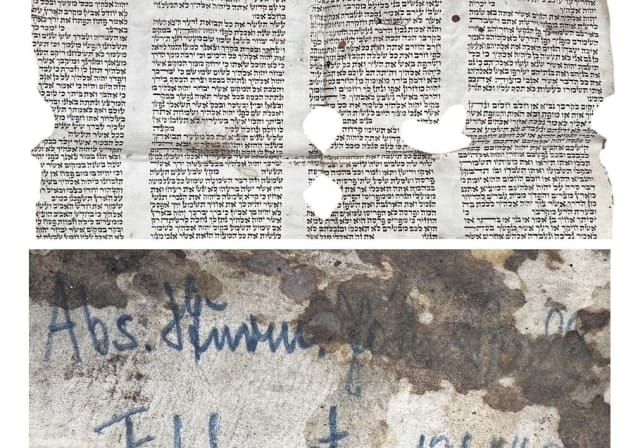
Talmud [illustrative] Photo: Thinkstock/Imagebank
A think tank on Middle East affairs in Jordan has for the first time published a
translation of the Babylonian Talmud in Arabic.
Middle East Studies
Center based in Amman produced the 20-volume work, which took six years to
complete and is the labor of 95 translators, language experts and
editors.
The center’s director Jawad Ahmad refused to speak about the
project with The Jerusalem Post and a member of the staff said that Ahmad would
not speak with the Israeli press.
Information on the project available on
the think tank’s website describes the Babylonian Talmud as “the most important
work of historical Judaism and its religious teachings and theories of Jewish
groups.” The center took on the Arabic translation of the Babylonian Talmud, it
says, to understand the religious and philosophical roots and thought of the
Orthodox Jewish mentality and will “open broad horizons for academic researchers
to understand Jewish religious thought and to understand its ramifications
throughout history.”
According to Dr. Mordechai Kedar, director of a new
center for Middle East and Islamic Studies at Bar-Ilan University and an expert
in Arabic literature and Middle East affairs, the Talmud is usually portrayed
very negatively in the Muslim and Arab world.
“I doubt this new
translation was done out of the goodness of their heart,” he told The Jerusalem
Post. “The Muslim world generally looks upon the Talmud as a kind of prototype
for the Protocols of the Elders of Zion,” Kedar said in reference to the early
20th century fabrication purporting to contain Jewish plans for world
domination.
The difference, Kedar explained, is that Jews do not deny the
authenticity of the Talmud and therefore those looking for evidence in Jewish
culture of hatred of Arabs, Muslims and non-Jews can take selective quotations
and passages from the text to show how Jews denigrate and disparage these
groups.
Dr. Esther Webman, an expert in Muslim-Jewish Relations and Arab
anti-Semitism at Tel Aviv University’s Moshe Dayan Center for Middle Eastern and
African Studies, largely concurred with this analysis.
“The Talmud in the
Muslim world is considered to be the main source of Jewish iniquity,” she said.
“They highlight aspects of it which are not so flattering and put it at the
forefront of their presentation of it. Essentially, they use the Talmud as a
tool to accuse Jews of certain habits and traits, so it is portrayed as the
epitome of the Jewish and the Zionist mentality.
“It is part and parcel
of the expansion of anti-Semitism into the Arab world,” Webman
said.
According to Kedar, Islamic scholars are generally unfamiliar with
Jewish sources, but academics in the Muslim world use the Talmud to “explain”
Jewish behavior.
“Israel is a puzzle for the Muslim world,” Kedar said.
“It’s a small country made by refugees who built a successful Western-style
state, with high GDP per capita, which has won wars and where Arabs enjoy a much
better lifestyle than most other places.
“They don’t understand how this
can work; it looks like some kind of satanic enterprise to them when most Arab
states are more or less failures, so they want to understand the cultural and
religious roots of their enemy, to maybe solve this puzzle one day and perhaps
in the end defeat Israel.”
The 37 tractates of the Babylonian Talmud,
based on the six orders of the earlier Mishna, is the recorded format of
Judaism’s oral law, which Orthodox Jewish thought holds God conveyed to Moses
along with the written law, the Five Books of Moses.
Expounding on the
earlier work of the Mishna which was compiled in the second century CE, the
Babylonian Talmud, redacted in the fifth century CE, is a compilation of the
thoughts, discussions and debates of the Jewish sages at the religious academies
of Mesopotamia on all aspects of Jewish law, also containing esoteric and
homiletic commentaries on the Torah and moral behavior.