Australian Jews debate media role in abuse cases
03/14/2013 04:37
Victims advocate complains of being called an "informer," says pressure to cover-up prevalent.
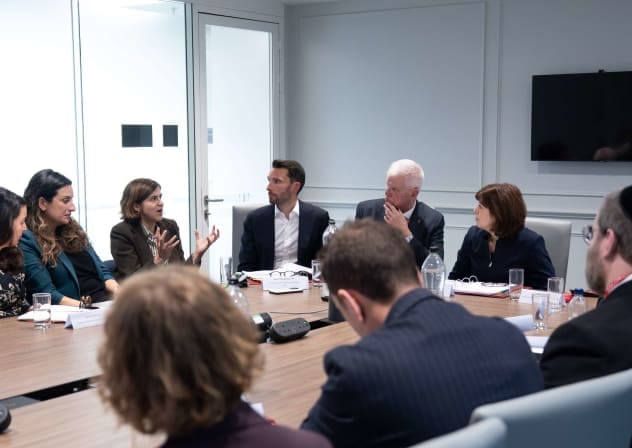
Rabbinic court [file photo] Photo: Ariel Jerozolimski
A confrontation between a rabbi’s wife and the brother-in-law of sexual abuse
victims’ advocate Manny Waks last week highlighted a divide between two views
within Australian Jewry over the proper role of the media in cases of sexual
abuse.
Waks, who heads the Tzedek advocacy organization, claimed on
Facebook on Monday that Peninah Feldman, the wife of local Chabad Rabbi Pinchas
Feldman, had verbally attacked his brother-in-law Dovy Rapoport on March 6 over
Waks’s tendency to turn to the media to publicize abuse cases.
Feldman
allegedly told Rapoport that Waks was a “moser,” a Talmudic term for a
“collaborator” who informs on Jews to non-Jewish authorities. The word has
extremely negative connotations within Orthodox Judaism and there is a prayer
recited daily against such people.
“This incident confirms what so many
of us have known for a long time; that this type of attitude is fairly prevalent
among many within the ultra-Orthodox community,” Waks wrote on his Facebook
page. “It also demonstrates, yet again, the ongoing harassment and intimidation
many victims and their families are subjected to, including by those in
leadership positions.”
Waks thanked Feldman for “sharing with the public
views that are generally kept behind closed doors.”
One witness, who
spoke with The Jerusalem Post on condition of anonymity, said that it was an
“unprovoked attack.”
“I was shocked and horrified by Rebbetzin Feldman’s
comments. The rebbetzin referred to Manny Waks as a ‘moser’ and his family as
lacking respect for anyone.”
In February, Rabbi Feldman was the subject
of accusations that he was aware of abuse occurring at the Yeshiva Centre school
in Sydney a quarter of a century ago and did not report it to
authorities.
The American-born Feldman, who was sent to Australia by the
Lubavitcher rebbe in 1964, replied to the allegations, saying that he
“endorse[s] the unequivocal rabbinical rulings encouraging victims of abuse to
report to the police and I will continue to support the efforts of law
enforcement agencies in investigating and taking action against these heinous
crimes.”
In a statement issued in response to queries by members of the
local Jewish press, Peninah Feldman said she did not “intend to publicly explain
details of a private conversation that may embarrass or cause pain to certain
individuals, including some who may have tragically been the victims of child
abuse.”
She “unequivocally” stood by rulings by Jewish scholars endorsing
the reporting of abuse, she said, adding that “reporting child sexual abuse and
in fact any form of physical violence to the relevant government authorities is
not mesira [‘informing’].”
She asserted, however, reflecting a split in
approaches to abuse within Australian Jewry, that the police “have indicated
that media speculation could jeopardize their investigations and interfere with
the course of justice.”
In what appeared to be a jab at Waks, Feldman
said that “constant leaking to the media in the midst of a sensitive police
investigation only hinders the ability of victims to come forward with their
deep personal pain, for fear of publicity. In my opinion, such publicity runs
the risk of protecting the perpetrators more than it does the
victims.”
Waks, who went public as a victim of abuse in 2011, disagrees.
The Yeshiva Centre, he told the Post on Wednesday, was undergoing a “serious
investigation” involving “multiple perpetrators, many victims and allegations of
coverups as well.”
Feldman’s statement, Waks said, was an attempt to
“diminish” his credibility, “because I am the one leading this public campaign,
including sharing certain stories and cases with the media – obviously in
cooperation with the victims.”
“It was a clear attack on me and my
integrity,” he said.
While acknowledging that publicity was not always
the best course, Waks said that after he came forward with his own story and
began Tzedek’s current media campaign, “all of a sudden dozens of people went to
the police.”
“Every time there is a case of an additional victim who
speaks out anonymously and the media covers the story, more victims have gone
forward to the police,” he said. “There is no doubt in our minds that this is
the correct way to address” the problem of abuse.
In a statement that
Waks sent to the media, he also claimed that last Wednesday’s confrontation with
Peninah Feldman “brings into question all other previous positive statements
made by the Sydney Yeshiva Centre, especially those made by her husband and
yeshiva head, Rabbi Pinchas Feldman.”
“Tzedek is currently examining all
of its options,” the statement read, including going to a rabbinic court, should
any of the witnesses to the event prove amenable.
Waks further called
Feldman’s statements “another crude attempt by the rebbetzin to portray the
victims, victim groups and many others who have publicly spoken about their
experience of abuse in a negative light.”
Tzedek announced that it has
cut ties with the Sydney Yeshiva Centre until the matter is resolved and a
retraction and apology issued.
One person familiar with the matter, who
spoke with the Post on condition of anonymity, said that there is an “internal
debate in the Jewish community. There is a clear halachic ruling that it is not
mesira to go to the police.”
“The discussion,” the source said, centers
around whether or not it is “helpful to go to the media every five minutes
before investigations have run their course.”
Waks, he said, “gives names
to the media” even before the police have completed investigations, and this
“tips people off that the police are interested in them.”
The current set
of abuse allegations in Australia come after the British Jewish community was
rocked by a hidden microphone recording of leading UK Rabbi Ephraim Padwa
telling a former victim not to go to the police.
In January, following
the Padwa incident, David Morris, who heads the Israeli victims advocacy
organization Magen, told the Post that there is “a deep set culture of
non-reporting and cover-up” within certain Jewish communities.
The
Executive Council of Australian Jewry sent a letter to the Australian government
in December 2012, responding to statements made by Waks regarding this alleged
culture of coverup.
“Mr. Waks’s allegations both of child sex abuse and
the covering up by various institutions of that conduct must of course be
treated seriously,” the council wrote.
However, “caution needs to be
exercised in drawing generalized conclusions about entire communities from
allegations that concern specific individuals and specific organizations, and
especially from those allegations that are yet to be proven, or even
investigated,” the council continued.
JTA contributed to this report.