Yesh Atid MK: Plight of agunot is solvable
02/21/2013 03:24
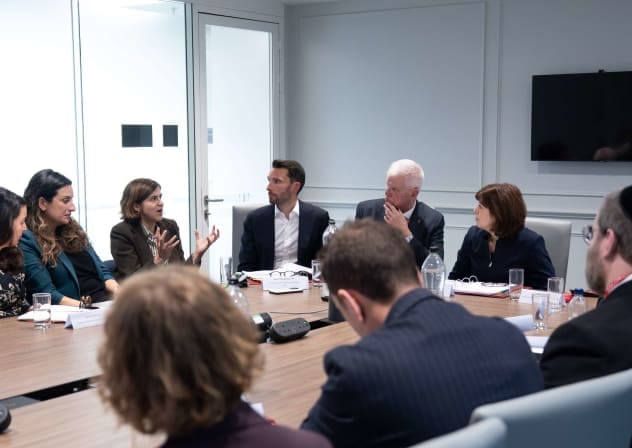
MK Aliza Lavie initiates Knesset session “chained women” whose husbands refuse to give them a bill of divorce.
Yesh Atid MK Aliza Lavie Photo: Yesh Atid
The Knesset held a special session on Wednesday morning to discuss the issue of
agunot, or “chained women” whose husbands refuse to give them a bill of divorce,
thereby preventing them from getting remarried.
The conference was an
initiative of Yesh Atid MK Aliza Lavie and the International Coalition for Aguna
Rights, ahead of International Aguna Day, which takes place as it does every
year on the Fast of Esther, which is marked this year on
Thursday.
Women’s rights groups state that there are thousands of women
in Israel whose husbands refuse to grant them a “get,” or bill of divorce, with
hundreds of new cases every year.
The conference was attended by several
MKs, including Eliahu Ben-Dahan of Bayit Yehudi, a rabbi and former director of
the rabbinical courts, and Shai Moshe Piron, also a rabbi and No. 2 in Yesh
Atid.
Speaking during the session, Lavie attacked the religious
establishment and institutions which she said were “sold for a political price
and held today [in the hands of] unfitting people.”
Lavie added that “the
plight of ‘chained women’ is solvable” but requires “halachic courage,” in order
to overcome the problem. She said the 19th Knesset can solve both the issue of
chained women in particular and problems pertaining to the relationship between
religion and state in general.
In Jewish law, a woman must obtain a get
from her husband before she is able to marry again and have children. Without
this bill of divorce, she is essentially trapped unless she agrees to her
husband’s terms or turns to the rabbinical courts to order him to give the get,
which they are generally reluctant to do.
A woman can also refuse to
accept a get and thereby prevent her husband from getting remarried until her
terms are met, but rabbinical courts can also give dispensation to a man to
remarry without a divorce – an outlet which is not available to
women.
Attendees at the session heard from Sherri Ziskind, whose husband
refused to grant her a get, who said that one of the rabbinical judges dealing
with her case had once told her that during his 40 years in the position he had
never obligated a husband to grant a bill of divorce.
Ziskind also
alleged that she had been taken aside at one stage and told that if she paid
$135,000 she would receive her get within a day. Other women in attendance who
had or are still having such difficulties mentioned similar
incidents.
Ben-Dahan said that such cases should be referred to the
police, while emphasizing his work as director of the rabbinical courts, noting
that he has established an official Knesset lobby for the rights of women whose
husbands refuse to give them a get.
The Bayit Yehudi MK added that
divorce proceedings in the rabbinical courts should be heard by one judge
instead of three in order to expedite the process. He also noted that he had
already introduced a bill to the Knesset to create agreements with foreign
countries allowing men who flee the country in order to avoid giving a get to be
extradited back to Israel. The bill would also increase the possible sentence a
rabbinical court can hand down for a man refusing to give a get from five to 10
years in prison.
Piron noted that the problem would not be solved if it
was a “struggle only of women,” saying that he wanted to see “many more men
participating in the struggle.”
Shirin Musa, a Muslim woman born in
Pakistan and an advocate for the divorce rights of women of all religions, also
attended the hearing, saying that the problem of chained women is common to many
faiths.
“This is not just a problem in Judaism, the problem exists in
Christianity, Islam and Hinduism,” she said. “I’m here to learn from Israeli
women... it doesn’t matter which religion you belong to, the suffering is the
same and therefore we need to fight this phenomenon.”