An Iranian attack on Israel would be tantamount to attacking the United States,
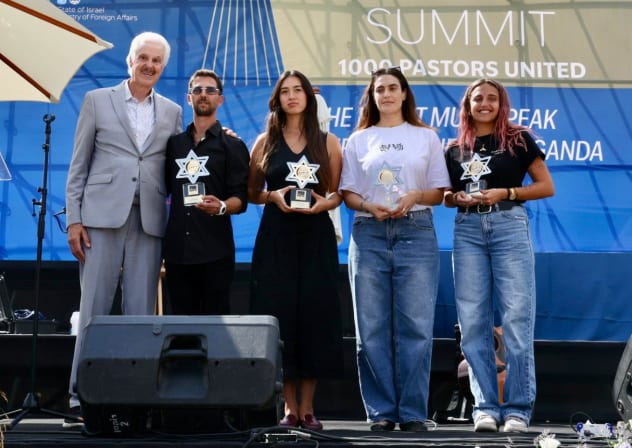
US Senator Daniel Inouye (D-HI) told an auditorium full of high school students
in Jerusalem on Monday.
Inouye, introduced to the students by former
AIPAC president Robert Asher as the best friend Israel has in Congress, said he
discussed the Iranian threat in a meeting earlier in the day with Prime Minister
Binyamin Netanyahu.
RELATED: US: Iran uranium enrichment a 'further escalation' Daley out, Jack Lew in as Obama's top aide
“We in the US are deeply concerned with the
activities in Iran,” said Inouye, who is America’s senior senator, having served
continuously since 1963. “If the Iranians should ever develop a nuclear device
or bomb, that could mean the end of the world as we know it in the Middle East.
It would have an impact on all countries, not just Israel. As a result, our
position is that if you attack Israel, you are attacking the United
States.”
Inouye is the president pro tempore of the US Senate, making him
third in line to succeed the US president, following the vice president and
speaker of the house. He is also chairman of the powerful senate appropriations
committee, and is here leading a delegation from that committee that also
includes Thad Cochran (R-MS) and Barbara Mikulski (D-MD).
Asked to
explain the close US-Israel relationship, Inouye said that “if one looks at most
of this world, especially the Middle East, one country stands out as a
foundation of stability and as a pillar of democracy. And at a time like this,
when you have revolution in Yemen, Bahrain, Syria, Egypt, Tunisia and Jordan,
thank God we have Israel.”
Inouye, who lost an arm while fighting in
Europe during World War II, and was later decorated with a Congressional Medal
of Honor for his service, traced his interest in Jews and Judaism to his
rehabilitation in a military hospital in New Jersey in 1945.
Inouye said
that in the next bed over was another soldier recuperating from his wounds. When
Inouye asked the man about his wounds, the “blonde, blue-eyed officer” said it
happened after he liberated a prison camp “where there were ovens, and people
cooked in the ovens, and bodies stacked up” like kindling wood.
“I asked
him what kind of prison it was, was it for murderers?” Inouye retold the tale in
his deep, bass voice.
“‘No,’ he said, ‘they were Jews.’ I asked what
crime they committed, and his answer changed my life. He said, ‘Well you know,
Dan, people don’t like Jews.’” Inouye said this left a lasting impression on
him, and that a few years later, when the honor society at his law school,
George Washington University, refused to accept two students because they were
Jewish, he said he told the group that if the Jews were blackballed, “then kick
me out, too.”
Inouye dated his concrete connection to Israel back to
1951, when he was a salesman in Hawaii for Israel bonds. He quipped that he was
the first person in his state to buy an Israeli bond, and still has it framed in
his office, along with a mezuzah on the door and “menorahs all over the
place.”
“There was a time I considered conversion,” he said.
“But
I decided not to because my mother was such a devout Christian, she might not
get over it.”
Asked where he thought Israel-US relations would be a
century from now, Inouye said it was difficult to predict relations 100 years
down the line. As proof, he said, just look at America’s close alliance with
Great Britain, once its colonial masters, and with Japan, once the US’s worst
enemy.
But, he said, “In the case of Israel, because of the unusual
situation in this area, the relationship will be strengthened because of our
mutual interests. As long as the mutual interest remains, I’d say we will remain
good friends.”
|