Saturday, March 13, 2010 27 Adar, 5770
Make JPOST.COM your Home Page
Jerusalem
37 °C
New York
7 °C
London
5 °C
Home
|
Headlines
|
Iranian Threat
|
Jewish World
|
Opinion
|
Business
|
Real Estate
|
Local Israel
|
Blogs
|
Arts & Culture
|
Français
|
Classifieds
Israel
|
Middle East
|
International
|
Health & Sci-Tech
|
Features
|
Travel
|
Cafe Oleh
|
Magazine
|
Sports
|
Israel Guide
|
Subscribe
|
Services
Archives
JP Toolbar
Christian World
Youth Magazines
RSS Feeds
News Ticker
More Services
JPost Store
Israel Hotels
Vacation Rentals
Philanthropy
Green Israel
Car Rentals
Learn Hebrew
JPost Mall
Sderot Dove
JP Travel Guide
Links
Christian World
Advertise on JPost
Media Kit
לימוד אנגלית
Breaking News
JPost.com
Middle East
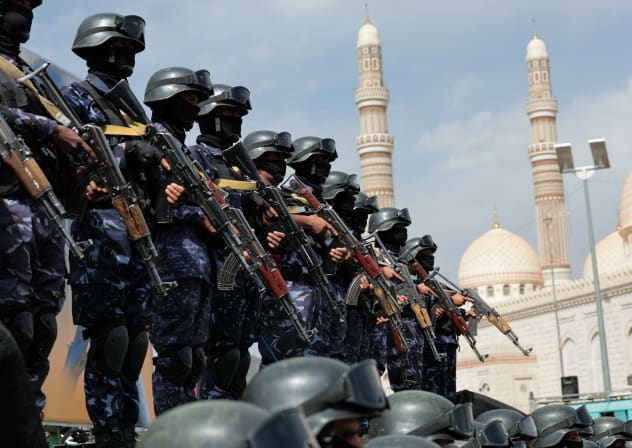
Photo by: AP
Background: Fighting the new plague in the land of Egypt
BY ZVI MAZEL
08/02/2010 22:42
Every Egyptian government since Nasser fought the Muslim Brotherhood, which remains true to its extremist religious roots, at one time or another.
On Monday morning, Egyptian security forces pounced on the leaders of the Muslim Brotherhood in a nationwide sweep, arresting 14 people including the movement’s No. 2, Mahmoud Ezzat, and Essam el-Erian and Abdul-Rahman el-Bir, members of the group’s Guidance Council.
There was nothing out of the ordinary in the move. Egyptian authorities routinely round up and arrest Muslim Brothers since they belong to an organization that is officially banned.
Some 10,000 Brothers were prosecuted over the last 20 years; 5,000 are in administrative detention, and several leaders have been sentenced to long stretches in jail. Every Egyptian government since Nasser has been fighting the Brotherhood at one time or another. The Brotherhood has remained faithful to the extremist religious doctrine of the man who founded it in Egypt in 1928, Hassan el-Banna, and of its greatest theologian, Sayed Qotob.
Qotob has radicalized Banna’s doctrine, calling for the restoration of the Caliphate and the creation for a single Muslim nation under Sharia law, and allowing the killing of Muslims and non-Muslims to achieve this goal. Qotob’s principles constitute the religious and ideological basis for Osama bin-Laden and his ilk.
Anwar Sadat freed thousands of Brothers who had been thrown into camps by Nasser. Some of them celebrated their freedom by forming even more extremist movements, aspiring to set up Islamic rule in Egypt and eventually killing him. Mubarak’s long reign has seen the influence of the movement grow, and the country is experiencing an unprecedented religious revival. In the ’80s and ’90s, millions of Egyptians who had been working in Saudi Arabia and in the Gulf Emirates were driven back to Egypt by the drop in oil prices and the economic crisis, and they reinforced the trend.
When, pressured by the United States, Mubarak let the Brothers run in the 2005 general election as “independents,” no fewer than 88 of them were elected to the parliament – a fifth of the total number – making for a very vocal opposition.
The government tries to curb the movement’s activities by making frequent arrests. Some of those arrested are released almost immediately – only to be rearrested a few weeks later.
Some are kept in jail by administrative orders. Others are tried and sentenced. In 2009 it was the financial institutions providing the Brothers with funds which were targeted; 40 were closed down and their directors arrested.
What is interesting about the latest arrests is that they come barely a month after the organization elected a new supreme leader, Muhammad Badie, a veteran hardliner, and a new Guidance Council made of staunch conservatives.
Egyptian authorities are trying to prevent the Supreme Leader and his team from asserting their authority and making their mark. They have forbidden Badie and the members of the Guidance Council to travel abroad to gather support and funds, and they closely monitor their movements inside the country.
They are making an all-out effort to cripple the organization ahead of the forthcoming general elections, due to be held at the end of the year. The younger generations, who had hoped for greater openness and some reforms that would have allowed the movement to take part in the democratic process, are still trying to come to terms with their defeat. They fear that the rigid stance adopted by their leaders will prevent them for repeating their electoral success.
The author is a former Israeli ambassador to Egypt and a fellow of the Jerusalem Center for Public Affairs.
Rate this article
Talkback
Add a Talkback
Report Abuse
Read all Talkbacks
Send
Large
Small
Print
Most Talkbacked
‘Stage 3’ of moratorium next week
Exclusive: Police to begin pressing charges against settlement-freeze violators.
Talkbacks (
31
)
12/03/2010 03:29
Biden wants direct talks by summer
Despite R. Shlomo tension, J'lem confident ‘proximity’ talks to go as planned.
Talkbacks (
24
)
12/03/2010 03:29
Column One: The march of the ...
Whether the Left recognizes the significance of its actions or not, it is ...
Talkbacks (
21
)
12/03/2010 17:48
muslim brotherhood
egypt
islamist
fundamental islam
extreme religious
hosni mubarak
caliphate
sharia law
Web
JPost.com