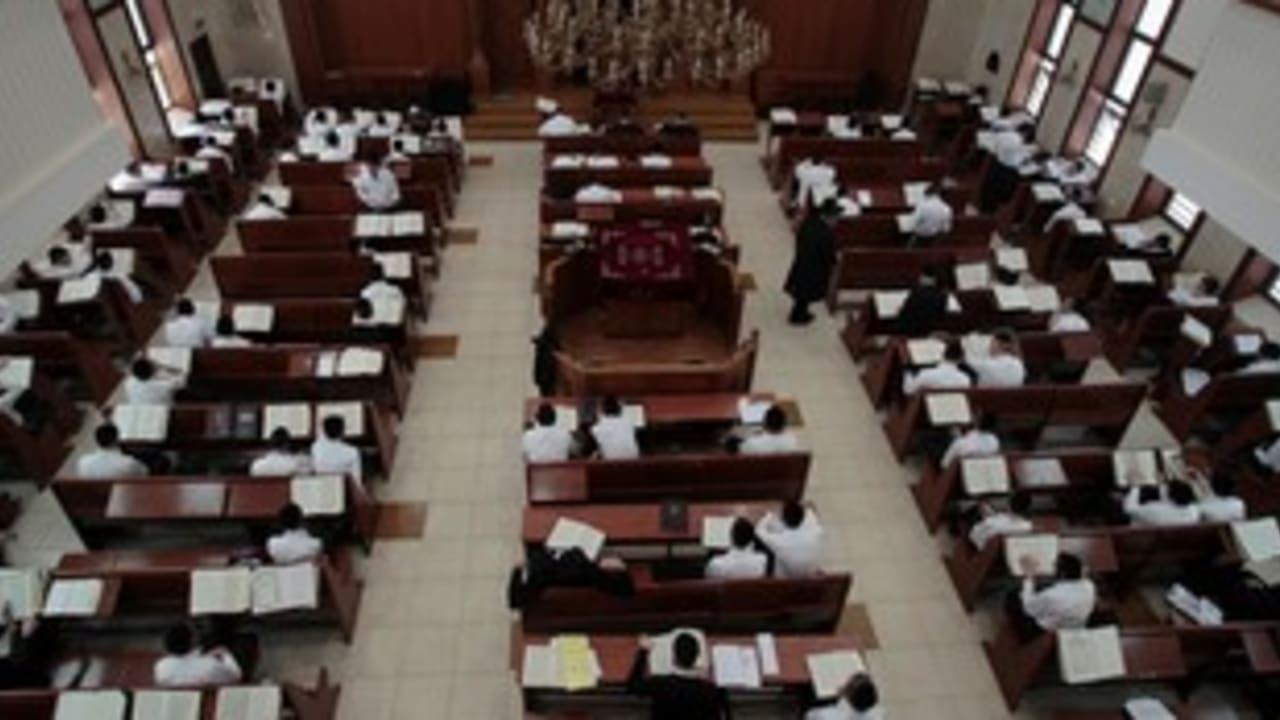
Israeli Jews are becoming more religious, according to a study published
Thursday.
The survey, entitled “A Portrait of Israeli Jews: Beliefs,
Observance, and Values of Israeli Jews,” was the work of the Israel Democracy
Institute (IDI) in conjunction with the Avi Chai Foundation, and examined local
levels of Jewish religiosity in 2009, compared to those over the past 20
years.
According to the study, conducted in 2009 and involving
face-to-face interviews with 2,803 local Jews above the age of 20, Jewish
Israelis’ affinity for their religion and its traditions has increased notably
since 1999.
“In 2009, we can say that Israeli Jews are interested in the
role of religion in the State of Israel and in the significance of a ‘Jewish
State,’ and express positive attitudes toward expression of religion and
tradition in the public realm,” the report says.
“However, they seek to
preserve freedom of personal choice, especially with regard to Shabbat
observance in public.”
The two previous studies conducted by the
institutes in 1991 and 1999 showed that between those years, a marked decline
was recorded in the attachment to Jewish tradition and religion, most likely due
to the mass immigration of Jews from the former Soviet Union in those
years.
The reversal of the trend between 1999 and 2009, the study says,
reflects both that the immigrants from the former Soviet Union have integrated
into society and that the modern Orthodox and haredi (ultra- Orthodox)
communities are increasing in democratic weight.
“The results of the
survey are evidence that Israeli Jews are committed to two significant values:
preserving Jewish tradition on the one hand, and upholding individual freedom of
choice on the other,” said Dr.
Eli Silver, director of Avi Chai–Israel.
“This fascinating combination is a source of tension, but it is also the basis
of a broad Israeli-Jewish consensus that facilitates coexistence in the 21st
century.”
In addition to finding that Israeli society as a whole has
become more religious, the IDI study stated that both the modern Orthodox and
haredi communities “observe religious precepts more stringently than they did in
the past.”
This trend was not present among those who identified as
“secular but not anti-religious” and “secular and anti-religious”; neither group
has become more religious since the 1990s.
A majority of respondents (85
percent) said it was “important to celebrate Jewish festivals in the traditional
manner.”
According to the study, 90% celebrate the Passover Seder, 67%
are careful not to eat hametz (leaven) during Passover, 68% fast on Yom Kippur
and 36% listen to the megilla on Purim.
The study also addressed the
controversial issue of civil marriage, the subject of recent debate, with 51% of
respondents saying they absolutely agreed, agreed or possibly agreed that the
option of civil marriage – not under the auspices of the Chief Rabbinate –
should be established in Israel.
Support for conducting public life
according to tradition is also on the rise, with 61% of respondents saying they
were in favor, compared with 44% in 1991.
However, 68% said that weekday
activities, such as going to cinemas, cafes and restaurants, should be available
on Shabbat, and 59% said they were in favor of public transportation on
Shabbat.
Regarding the status of women, the study indicated significant
differences of opinion on gender roles. Sixty-seven percent of haredim believe
that the husband should work and support the family while the wife stays home to
take care of the children, while only 35% of the modern Orthodox feel that
way.
Only 18%-20% of the secular community are of that opinion.
In
addition, 73% of local Jews feel that Israeli and Diaspora Jews share a common
destiny, while 61% feel that the Conservative and Reform movements should have
equal status with the Orthodox.