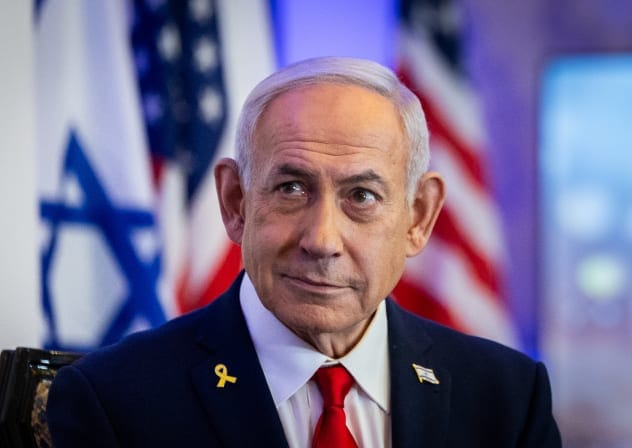
As the dust settles in the wake of Prime Minister Binyamin Netanyahu’s dramatic
altercation with President Barack Obama, one is now able to evaluate the
repercussions.
Obama’s ambush of Netanyahu was utterly
counterproductive.
Coming just a few weeks after the PA union with the
genocidal Hamas, and recognizing the futility of the effort he had invested to
placate Obama a few days earlier, Netanyahu realized that he was obliged to end
the Alice in Wonderland charade and defend Israel’s needs by tell the truth –
even if that entailed a public disagreement.
The prime minister’s
forthright but dignified response not only refuted the depiction of him as a
weak, indecisive leader but, contrary to what much of the media suggested, his
standing with Israelis skyrocketed.
However, it was a calculated gamble.
Had the Democrats not supported Netanyahu so enthusiastically, he would have
been accused of undermining the longstanding Congressional bipartisan backing
for Israel – a crucial factor in maintaining public support for the Jewish
state.
Clearly, his strategy succeeded.
Indeed, former UN
ambassador John Bolton described Netanyahu’s reception by Congress as heralding
“a significant new political dynamic in the US.”
Although Obama
regrettably refused to endorse the crucial Bush administration commitment to
reject the “right of return” for Palestinian refugees, he did at least backtrack
significantly by “clarifying” to AIPAC that he was not proposing a return to the
indefensible 1949 armistice lines.
The president’s acolytes skimmed over
Obama’s disastrous evasion of the refugee issue, but insisted that Netanyahu had
deliberately distorted his initial remarks. They failed to appreciate that the
’67 lines were never actually recognized borders, but merely armistice lines.
Moreover, Obama’s initial remarks were inconsistent with UN Resolution 242, and
the Bush undertaking to endorse Israel’s inclusion of major settlement blocs.
Obama also ignored the fact that Mahmoud Abbas had repeatedly insisted that
territorial swaps would be minimal, and that in the event of failing to achieve
“mutual agreement” on swaps, the indefensible ’67 borders would become the
fallback. Nor, it would appear, did his advisers comprehend the significant
security threats to Israel that Obama presented when calling for a contiguous
Palestinian state (which would effectively require splitting Israel in half) and
rejecting a long-term Israeli military presence in the Jordan
Valley.
After the stellar reception by Congress – and despite shrill
denunciations by Tzipi Livni, whose reputation subsequently plunged to an
all-time low, after accusing Netanyahu of undermining the relationship with the
US – Netanyahu’s government is, for the time being, in a strong
position.
Moreover, no American president can afford to abandon Israel in
the face of the tremendous support it enjoys in Congress and among the American
people. Even in the course of confronting Netanyahu, Obama re-affirmed the
extension of military aid to Israel, and his opposition to unilateral
recognition of a Palestinian state.
NEVERTHELESS, WE face perilous days.
Israel remains isolated and, aside from the United States, Canada and Australia,
the world automatically blames us rather than the intransigent Palestinians for
the failure to move toward peace.
Netanyahu is well aware that in the
American system, the president and not the legislature directs foreign policy.
He must also realize that unless the Republicans get their act together, Obama
will probably be reelected.
There is also little doubt that the Obama
administration remains fixated on a Third World approach toward Israel, as
manifested by the abrogation of the former Bush administration
commitments.
But the good news is that when pressured by his colleagues
and party, Obama has displayed considerable flexibility and
backtracked.
A serious two-pronged effort is therefore required to
reinforce our position. Under ideal circumstances, we should have a unity
government – which is unlikely so long as Livni leads Kadima. Yet, even failing
that, the Obama administration now appreciates that Israelis solidly support
their prime minister. At the same time, we must maintain and strengthen public
support for Israel in the US.
A very strong factor in Israel’s favor is
AIPAC – a professional organization which operates without fanfare and ensures
that Israel advocacy is effectively promoted in Congress at a bipartisan
level.
Its success was highlighted by the unprecedented congressional
endorsement Netanyahu received, despite confronting the leader of the most
powerful nation.
However, I personally sense a growing unease among
Jewish leaders and opinion makers – even among the ranks of the traditionally
pro-Israel leadership.
A senior Jewish leader told me that “for the
pro-Israel Jewish liberal, the ultimate nightmare was always a direct
confrontation over the Jewish state with a liberal president. This has now come
home to roost, and is far more traumatic for us than the confrontations between
the Shamir government and president George Bush Sr. who headed a Republican
administration.”
Even a pro-Israel Jewish journalist like Jeffrey
Goldberg protested hysterically that Netanyahu was “hectoring” his president,
and behaving like rogue president Chavez of Venezuela. The former, disgraced NY
attorney general Eliot Spitzer, trying to make a political comeback, accused
Netanyahu of “blowing it” by picking a ”stupid,” “needless” and “wrong” dispute
with the president. JJ Goldberg of the leftleaning Forward newspaper warned
Netanyahu not to force American Jews to choose between him and their
president.
More disconcerting, Gary Rosenblatt, editor of the influential
New York-based Jewish Week, accused Netanyahu of “losing it.” He claimed that
his response at the initial press release was “an absolute hasbara disaster for
Jerusalem,” making him the “Mideast’s Mr. No” because he failed to state then
(as he did subsequently at AIPAC) that Obama “has shown his commitment to
Israel’s security both in word and in deed.”
Rosenblatt implied – in my
opinion mistakenly – that Netanyahu’s remarks were primarily directed toward his
domestic constituency. He did concede that Obama’s remarks on borders and
refugees were problematic, but did not warrant recourse to open criticism, and
maintained that Netanyahu should have concentrated on the positive
remarks.
In the same vein, Abe Foxman of the ADL and David Harris of the
American Jewish Committee initially praised the positive aspects of the
president’s speech, despite sharing concerns about his other remarks. The
Conference of Presidents of Major Jewish Organizations was singularly
silent.
I am confident that Netanyahu will be vindicated. American Jewish
leaders are now beginning to appreciate that they cannot continuously grovel to
Obama while Israel is constantly in the firing line and the administration fawns
to the intransigent Arabs who refuse to compromise on anything.
Israel
must continue speaking the truth without polarizing the American public or
Congress.
Should Netanyahu revert to his previous position of pretending
that all is well, and fail to forcefully defend our crucial security
requirements, the ramifications will be disastrous. He must remain firm while
employing his diplomatic talents to maintain an ongoing relationship with the US
administration. There is little doubt that as of now, our prime minister is
performing well, reflects the national consensus, and has the backing of the
vast majority of the nation.
ileibler@netvision.net.il