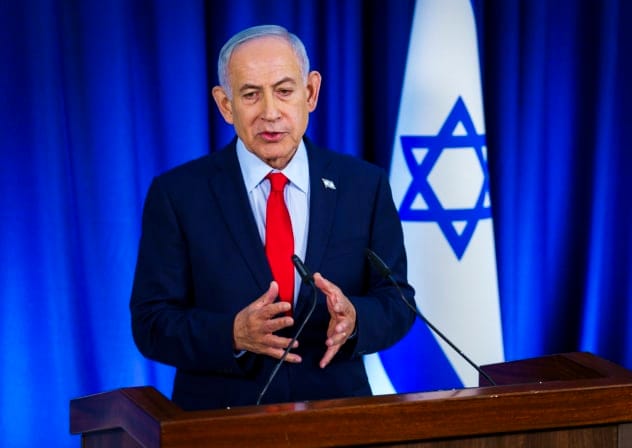
Warmth, supportive laughter and applause – from the first sentence to the last.
More than two dozen standing ovations. Smiles and handshakes and embraces before
and afterward.
A solitary heckler apart, the prime minister won the kind
of adulatory reception in Congress 10 days ago that he could not dream of
receiving in any sizable political forum in Israel. He wouldn’t feel that kind
of love at a big gathering of his own Likud Party, never mind his parliament,
where he is lucky if he can get through a few sentences without hostile
interruption.
And he did so with a speech that was quite vague on what
his government is prepared to do to advance Palestinian statehood, and long and
detailed in explaining his concerns about the hostility all around Israel, his
reservations about our ostensible Palestinian peace partner, and his consequent
objections to some of the formulations that had been unveiled five days earlier
in President Barack Obama’s landmark Middle East policy speech at the State
Department.
His rhetoric was far too sophisticated as to bluntly oppose
Obama’s ideas. It was less obviously confrontational than some of the remarks
Netanyahu had made when sitting alongside the president in the Oval Office four
days earlier. But it was, nonetheless, plainly a speech pushing back against
core aspects of Obama’s stated policy.
And since it garnered that
spectacular response from the legislators of America, that must count for quite
a lot, no? Presumably, the Palestinians will have been given pause in their
campaign for unilateral support for statehood. Presumably, some of Israel’s less
receptive international critics, notably in the Middle East Quartet, may feel
the need to ease their pressures a little. Presumably, the president will have
to do some rethinking...
Not a bit of it.
The Palestinians never
doubted the scale of congressional support for Netanyahu. They’ve always
known, moreover, that the US will almost certainly veto any efforts they make to
win binding support for unilateral Palestinian statehood at the Security
Council. That’s why they developed their strategy for seeking approval from the
General Assembly; there, backing for their plan to establish a state without
legitimizing Israel is automatic, big and though nonbinding, creates momentum,
and the US has no veto power.
Neither will the members of the Quartet,
for their part, have paid much heed to Netanyahu’s glorious day in Congress. The
UN, Russia and the European Union have long since endorsed “Palestine” in
principle. Where Europe in particular has been wavering is over whether
to do so in the General Assembly in September despite that patently absent
Palestinian reconciliation with the country next door, or whether to abstain or
vote no, insisting, as the US insists, that the path to statehood must run via
negotiations with Israel.
Many in Europe have considerable sympathy for
the concerns that Netanyahu set out last week. Many in Europe are disappointed
in Palestinian Authority President Mahmoud Abbas – for failing to reverse Yasser
Arafat’s distortion of history and delegitimization of Jewish sovereignty, for
staying away from the negotiating table, for Fatah’s new partnership with
Hamas. But many, too, are disappointed by what they regard as Netanyahu’s
grudging approach to compromise, his disinclination to swing further to the
center and away from the hawks, and his ongoing settlement construction, no
matter how reduced in scale. There are few signs that Netanyahu’s speech swayed
them.
As for the president, he was gone by the time Netanyahu made his
appearance before the joint congressional meeting. Obama had flown off to
Europe where, the next day, he reiterated all the key elements of his new vision
during a press conference alongside British Prime Minister David Cameron. And
Cameron, arguably the pivotal figure in how Europe reacts to the September
Palestinian statehood gambit – with Germany perceived to be siding somewhat with
Israel and France, somewhat, with the Palestinians – was careful not to make any firm
commitment as to how Britain might act.
“We don’t believe the time for
making a decision about the UN resolution – there isn’t even one there at the
moment – is right yet,” Cameron said. “We want to discuss this within the
European Union and try and maximize the leverage and pressure that the European
Union can bring, frankly, on both sides to get this vital [negotiating] process
moving.”
So, well-spoken Prime Minister Netanyahu. Seriously. You
brilliantly detailed the complex challenges facing Israel. But what, precisely,
are you going to do about them?
OBAMA IS already on the case. The president’s
European journey, in fact, constituted the next stage of his bid to avert what
is being widely described in diplomatic circles now as the “looming train wreck”
of the General Assembly. And if there are those, in Netanyahu’s circle and
beyond, who regard Congress’s enthusiastic reception as constituting some kind
of warning for a president at such open odds with the prime minister, a signal
that Obama needs to change tack, then the president’s strategy has clearly been
unaffected.
As I mentioned here last week, the administration is pursuing
an approach that indicates a certain double standard: It has chosen not to press
Abbas specifically to abandon the unconscionable demand for a “right of return”
– the crucial Palestinian concession to Jewish sovereignty, without which there
can be no viable two-state solution – because it does not want to “box in” the
PA president, weaken him and lose him. This despite the fact that the entire
Israeli-Palestinian conflict has been perpetuated precisely because the
Palestinians and those who spoke for them have never been prepared to come to
terms with Israel’s right to exist. Moreover, Abbas, far from demonstrating that
he is the man to finally reverse that rejectionism, has now entered a cynical
partnership with the most avowed rejectionists, the Islamic extremists of Hamas,
to create a veneer of unity in order to hoodwink the willfully blind among the
international community that the Palestinians are all sitting happily together
awaiting endorsement for statehood.
At the same time, in sharp contrast
to its kid-glove treatment of Abbas, the administration has chosen to press
Netanyahu specifically to withdraw to an amended version of the 1967 lines – the
crucial Israeli concession to Palestinian sovereignty – with no evident concern
as to whether this might box him in, weaken him or lose him. The
administration, then, is markedly more concerned about “losing” Abbas than it is
about “losing” Netanyahu.
Analysts have often tried in the past couple of
years to figure out who is steering the president down his Israeli-Palestinian
blind alleys – who it was that pushed him, first, to so obsessively focus on the
settlements and now, to unveil a half-drawn vision of negotiation in which the
required Israeli concession is spelled out and the required Palestinian
concession merely intimated. But it is clearer now than ever that this is
Obama’s own mindset. He is not being directed by the whisperings of this or that
senior aide in his ear. He and he alone, by all accounts, chose to tack on the
Israel- Palestine section of his speech, just a day before it was delivered, and
had his secretary of state telephone Netanyahu to announce, rather than to
coordinate it.
This is a president quite certain that he is acting in
Israel’s best interests, committed to protecting a Jewish, democratic, pre- 1967
Israel, and not largely empathetic to Israeli security, historical or religious
claims beyond those lines. This is a president who, as a candidate during his
visit to Israel in 2008, told me that “Israel may seek ’67- plus and justify it
in terms of the buffer that they need for security purposes. They’ve got to
consider whether getting that buffer is worth the antagonism of the other
party.” This is the president who last week described the matters of borders and
security – the future, that is, of Judea and Samaria – as “perhaps less
emotional issues.” This is a president reasonably anticipating reelection and
unmoved by congressional ovations for Netanyahu. This is a president who
apparently continues to believe that he understands Israel’s interests better
than the current Israeli prime minister does, and that he gauges Palestinian and
Arab attitudes to Israel, and thus the potential path to reconciliation, more
accurately than Netanyahu does.
But this is also a president who
appreciates that the Arab upheaval is producing a “1948 moment” – an empowerment
of regional opponents not to Israel’s presence beyond the 1967 lines but to
Israel’s presence, period. This is also a president who recognizes that much of
Europe is far more empathetic to the Palestinians than the United States has
hitherto been. Anxious to encourage Europe not to vote for “Palestine” in
September, this is also a president, finally, who is convinced that the way to
achieve this goal requires sounding tough on Israel and gentle on the
Palestinians.
WHY DOES Europe matter? Because, in the UN context, it is
the barometer of international legitimacy. Where Israel is concerned, there will
always be majority support from the Islamic states and their supporters for
hostile positions, and a minority defense from the likes of the US, Australia,
Canada, certain Eastern European states, small Pacific island states and far too
few others.
Europe holds the middle ground. Europe’s position in
September will determine whether a General Assembly vote for Palestine generates
a vastly intensified boycott and sanctions effort and creates a sense of
legitimacy for violence against Israel, or whether the vote becomes as
irrelevant as previous such campaigns for statehood.
That is why Obama’s
strategy is now one of negotiation with Europe, in order to reach agreed
parameters – to be formally endorsed by the Quartet, perhaps, or even put to the
Security Council – that will lead to “responsible” nations abstaining or voting
against “Palestine” at the General Assembly or that will derail the Palestinian
GA gambit altogether.
Israel, troubled by Obama’s outlook, may well say
no to such parameters, if they are indeed set out; doubtless the Palestinians
will too. But there are no Israeli-Palestinian negotiations in prospect anyway,
and this way, runs the administration’s thinking, another 18 months or so will
have been “bought,” with the “train wreck” minimized.
Another 18 months,
in the Obama overview, to get past the Palestinian elections and hope to see the
Islamists marginalized, to get past the American elections, and hopefully get
past some Israeli elections as well. The world will have set out its agenda,
pressuring both sides, and protecting the negotiation option for a happier
day.
No specific peace proposal Netanyahu could have set out in his
speech to Congress would have been treated seriously by the Palestinians. Let’s
make this clear: The Palestinians long ago abandoned the negotiating track. This
was plain from Prime Minister Salam Fayyad’s written agenda for statehood – a
work plan that featured no emphasis on reconciliation with Israel. It was
evident in Abbas’s refusal to come to the table for nine of the 10 months in
which Netanyahu froze settlement construction last year. It is obvious from the
Fatah-Hamas agreement. It is explicit in the strategic decision to turn to the
UN General Assembly.
But the more Israel can credibly demonstrate that it
wants to enable Palestinian statehood if only the Palestinians are ever prepared
to genuinely come to terms with Israel, the greater Israel’s capacity to retain
international support and to deflect the intensifying international temptation
to endorse the Palestinians’ nonnegotiated approach.
Abbas’s deal with
Hamas, his dishonest
New York Times op-ed, his radicalized language about
refugees – all of these damage his credibility in the US, in Europe and beyond.
But Netanyahu’s credibility is damaged too – because he has still not tackled
illegal West Bank outposts (unless Thursday’s action at Alei Ayin marks a shift
in policy), opposes any formal compensation program for residents of isolated
settlements who want to relocate, has done nothing to build homes for any such
relocating settlers, and because, despite his carefully vague hints of readiness
for far-reaching territorial compromise, he is still allocating resources to
settlements in all parts of Judea and Samaria.
However aggrieved we may
rightly be at the distortions and the hypocrisies that prevail when Israel is
being judged internationally, they are only getting worse and they carry
concrete, practical implications. Since we feel strongly that we seek peace with
a partner who doesn’t, since we feel strongly that our narrative is accurate and
compelling, since we feel strongly that our readiness to meet a genuine partner
more than halfway is heartfelt, we should be doing everything we can to make it
difficult for the international community to be fooled into thinking otherwise.
And vague generalities won’t work.
FOR ALL that Netanyahu raged against
Obama’s vision, and for all the acute concerns about its flaws, the president’s
effort to draw Europe away from a “yes” vote for Palestine is certainly in
Israel’s interest. And Israel is deluding itself if it fails to internalize how
far Europe has tilted toward “Palestine.”
Only a little over three months
ago, on February 18, the Security Council voted 14- 1 in support of a resolution
that demanded that “Israel, as the occupying power, immediately and completely
ceases all settlement activities in the occupied Palestinian territory,
including East Jerusalem, and that it fully respect its legal obligations in
this regard.” The sole dissenting vote, of course, was that of the US –
the veto.
Germany, France and the United Kingdom did not merely vote for
the resolution, however. They also delivered a joint statement to the Council
via Sir Mark Lyall Grant, the British Permanent Representative to the UN. The
language of that statement is indicative of the challenge that Israel faces at
the UN, gives a very broad hint as to where European sympathies lie, underlines
the problematics of an Israeli approach that does not specify our security and
territorial needs and other red lines, and explains why Obama sees an imperative
to try to negotiate agreed parameters with Europe.
“Thanks to work
commended by the international community as a whole,” the European trio’s UN
statement declared in its closing sentences, “the Palestinian Authority has
developed the capacity to run a democratic and peaceful State, founded on the
rule of law and living in peace and security with Israel. Further delay will
reduce, rather than increase, the prospects for a solution. We therefore look to
both parties to return to negotiations as soon as possible on that basis. Our
goal remains an agreement on all final status issues and the welcoming of
Palestine as a full Member of the United Nations by September 2011. We will
contribute to achieving that goal in any and every way that we can.”
That
phraseology certainly keeps all options open for September. But it already
contains a degree of endorsement for “Palestine,” an unfounded assertion that
Israel and the US would certainly contest about such a state’s peaceful nature,
and a reference to the need for negotiation that is offset by a recommitment to
the September deadline.
An overwhelming GA vote in favor of Palestine may
well be unavoidable. A UNGA vote in support of Palestine backed by “responsible”
European nations would be a blow to Israel of a whole different order.
It
would be seen as legitimizing a radically intensified boycott and sanctions
effort. It would be interpreted by extremists here as providing something
of a green light for violence and terrorism against Israel. It would bolster
momentum for legal warfare against Israel, including via the International
Criminal Court in The Hague. (If the Palestinians are seen as a state, not
merely by predictably sympathetic nations but by “fair-minded” nations too, the
ICC would be more likely to seek to acquire jurisdiction for prosecuting alleged
Israeli crimes in the West Bank, including as relates to settlements.) And it
would emphatically bolster mass, unarmed “Arab Spring”-style protests – the kind
Israel failed to face down on a small scale two weeks ago, and the kind it may
well already begin to encounter on a larger scale from Sunday.
None of
this is to say that Netanyahu failed Israel with that virtuoso performance
before Congress last Tuesday. That speech – with its emphasis on the Jewish
connection to Judea and Samaria, and on Palestinian statehood not hinging on
Israeli compromise but on Arab recognition of Israeli legitimacy – set out
contextual basics with passion, dexterity, clarity and flair.
But it did
not free the prime minister of the obligation to use astute diplomacy to head
off the September “train wreck.” It did not free him of the obligation to show,
not just to tell, that Israel is ready for peace, and that it is the
Palestinians who are not.
Obama and his hierarchy should have consulted
more effectively with Netanyahu and his hierarchy ahead of the State Department
bombshell speech. Obama should by now have better internalized the likely
counterproductive fallout when he takes positions that press Israel more
dramatically and more tangibly than the Palestinians – he merely hardens the
Palestinian stance and reduces Israel’s confidence in his
administration.
But Netanyahu should have long since given the
international community more to work with. He and opposition leader Tzipi Livni
should have long since put aside their narrow interests and built a mainstream
unity coalition that could formulate widely consensual policies.
The
Palestinians don’t want to interact with Israel? So be it. But let Israel
interact with the international community, detailing Israel’s needs, setting out
a vision, and taking credible practical steps on the ground in support of that
vision.
That way, when “responsible” nations take sides, as they will be
asked to do just a few months from now, on a pernicious Palestinian effort to
achieve global support for their state without being required to abandon
policies that call for the destruction of ours, those key nations can credibly
appreciate what is at stake: that our concern is not with a Palestinian state,
but rather with a Palestinian state that endangers Israel.