Inside Out: Foreign policy in shadow of Holocaust
By JONATHAN ROSEN
04/18/2012 21:54
Fear of genocidal anti-Semitism must not blind the gov't to the dangers of allowing that fear to dictate Israeli policy.
Anti-Israel protesters Photo: Reuters
Holocaust Remembrance Day presents Israelis with an opportunity to rise above
their mundane pursuits and trivial concerns to honor the memory of the victims
and survivors of the Nazi death machine. No less importantly, this day is an
occasion for Israeli citizens, both as individuals and as members of broader
communities, to reflect on the enduring mesh of personal, national and universal
lessons that are to be drawn from the Holocaust.
As they revisit the
harrowing accounts of the persecution, brutality and acts of murder that were
committed by the Nazis and their collaborators, many Israelis naturally take
comfort in the fact that they live in a Jewish country and are protected by the
strongest military force in the region. After all, that is the primary Zionist
lesson of the Holocaust: Jews will only be truly safe in a country of their own,
with a powerful army of its own.
One of the central assumptions behind
the original Zionist ideal was that the only way to eliminate the scourge of
anti-Semitism would be to end the Jewish Diaspora by creating a Jewish state.
The prospective Jewish state was envisioned as an entity that would allow Jews
to lead a more “natural” life as individuals and as a people, and would remove
them from the presence of the Gentiles, thus reducing hatred for
Jews.
Regrettably, one has only to look at the spread of virulent
anti-Semitism across the Arab world in recent years, a development that is
particularly startling given the near complete absence of any Jewish population
there in most cases, to see that that underlying assessment held by the Zionist
visionaries was sadly mistaken. Anti- Semitic sentiment has deep cultural and
religious roots in Europe and the Middle East, and the presence of actual Jews
or the lack thereof has done little to change that sorry state of
affairs.
Repeated statements made by Iranian President Mahmoud
Ahmadinejad about the need to wipe Israel “off the map,” as well as similar
statements made by Palestinian and other Arab figures over the years, have been
construed by many Israelis as expressions of the very same genocidal
anti-Semitism that manifested itself in the Holocaust. The waves of suicide
bombers during the second intifada were often perceived as the executors of a
genocidal hatred of Jews.
Their goal – to kill as many Jews as possible,
irrespective of age, gender and personal traits – was viewed by many as
substantively identical to the Nazis’ goal, even if the scope was far reduced.
The same has been said about Palestinian rockets that are aimed deliberately at
civilian Israeli targets, the undeniable purpose of which is to kill Israeli
Jews as such.
Fear of genocidal anti-Semitism has and continues to play a
central role in shaping political thought and discourse in Israel, most
saliently so under right-wing governments.
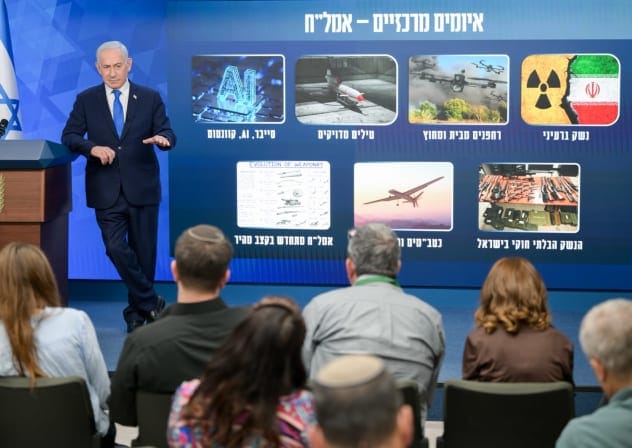
One need only look at Prime
Minister Binyamin Netanyahu’s repeated references to the Holocaust in discussing
the Iranian nuclear program to see an excellent example of that. Similarly, the
Netanyahu government’s preoccupation with Palestinian and Arab recognition of
the Israel as a Jewish state reflects in many ways similar concerns.
One
question that needs to be asked is whether this fear of genocidal anti-Semitism,
however empirically justified it may be, has not come to occupy too dominant a
place in Israeli political thought and discourse at the expense of other issues.
In considering a military strike against the Iranian nuclear facilities, other
factors, such as the cost in lives and money of Iranian retaliation, Israel’s
diplomatic situation in the world and the impact on the global economy on the
day after, must also be taken into account.
The same applies to the
evaluation of the costs and benefits of past and future territorial withdrawals.
Israel’s security concerns and existential fears cannot be the only criteria
used in making that assessment, while issue the financial, diplomatic, ethical
and existential costs to the Jewish and democratic State of Israel that stem
from maintaining an ongoing occupation of the West Bank must also be factored
into that calculation.
It would grossly excessive to suggest that Prime
Minister Netanyahu is oblivious to the other factors in either equation. It
would, however, seem hardly an overstatement to say that he places enormous
emphasis on the lessons of the Holocaust in his foreign policy decision-making
process, giving them dominance over and even eclipsing some of the other factors
that ought to be taken into account as well.
While the creation of the
Jewish state may have failed to stamp out the bane of anti-Semitism, the
existence of Israel and its powerful army provide Jews with formidable
protection from the dangers posed by that enduring hatred. Vigilance and
wariness are most certainly warranted when Israel assesses ways of containing if
not resolving the Israeli-Arab conflict, as well as ways of reducing the risks
posed by the Iranian regime and its nuclear ambitions.
That said, fear of
genocidal anti- Semitism must not blind the government to the dangers of
allowing that fear to dictate Israel’s policies.
The author is a veteran
Israeli writer and translator.