Encountering Peace: Two states for two peoples
10/02/2012 21:27
Fulfillment of UN Charter principles requires the establishment of a just and lasting peace in the Middle East, which should include the application of the following principles:
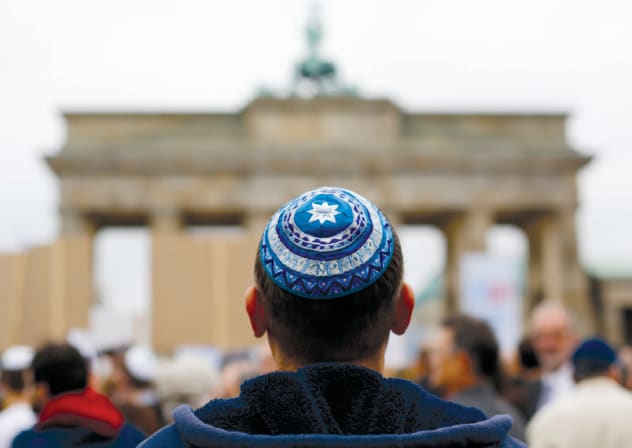
The Jerusalem Post Photo: Scott Eells/Bloomberg
In his United Nations speech, Palestinian President Mahmoud Abbas called on the
Security Council to “to urgently adopt a resolution comprising the basis and
foundations for a solution to the Palestinian-Israeli conflict that would serve
as a binding reference and guide for all if the vision of two states, Israel and
Palestine, is to survive and if peace is to prevail in the land of peace.” In
November 2009 I drafted a proposal for a Security Council resolution which I
shared with the leaders of Israel, the PLO and the United States. The following
is that draft:
EXPRESSING ITS continuing concern with the grave situation in the
Middle East, emphasizing the inadmissibility of the acquisition of territory by
war and the need to work for a just and lasting peace in which every state in
the area can live in security, affirms that the fulfillment of UN Charter
principles requires the establishment of a just and lasting peace in the Middle
East, which should include the application of both the following principles:
1.
The establishment of the state of Palestine on the basis of the June 4, 1967
borders, in the areas of the West Bank and Gaza including East
Jerusalem.
2. Termination of all claims or states of belligerency and
respect for and acknowledgement of the sovereignty, territorial integrity and
political independence of the State of Israel and the state of Palestine in the
area and their right to live in peace within secure and recognized boundaries
free from threats or acts of force.
3. The governments of the State of
Israel and the state of Palestine will enter into immediate negotiations between
them on the exact borders between them based on the June 4, 1967 borders with
agreed upon territorial exchanges of equal size and quality. The guiding
principle in the determination of the borders is that the state of Palestine
will be composed of 22 percent of the territory between the Jordan River and the
Mediterranean Sea and the remaining 78% of the territory will be the State of
Israel.
4. This settlement will establish Palestine as the Palestinian
homeland, just as Israel is the homeland for the Jewish people. Both States are
free to maintain their own immigration policies allowing for the return of
nationals to each state respectively. The issue concerning the rights of
Palestinian refugees will be dealt with in negotiations between the parties
seeking to reach a just and agreed upon solution that will put an end to the
decades of suffering of the Palestinian refugees.
5. The issue of the
rights of Jewish refugees from Arab and Islamic countries will be dealt with in
the framework of bilateral negotiations between Israel and the second parties
directly involved.
6. Accepting this resolution: Israel must immediately
demonstrate support for the creation of a prosperous and successful Palestinian
state by removing unauthorized outposts, and ending settlement
expansion. The government of the state of Palestine must demonstrate that
their State will create opportunity for all its citizens and govern justly and
must show that a Palestinian state will accept its responsibility and have the
capability to be a source of stability and peace for its own citizens, for the
people of Israel and for the whole region.
7. In Accordance with the
Principles laid down in UN Resolution 181 from November 29, 1947, both states
will respect the rights of national minorities within their borders and grant
them full equality under the law and in practice.
9. The Security Council
recognizes the city of Jerusalem as the capitals of both states and calls on the
Governments of the two states to negotiate the modalities for application of
such in the city.
10. The Security Council recognizes the importance of
the holy sites in Jerusalem to all three religions and proposes that they be
placed under an international guardianship guaranteeing free and open access to
all people who respect the sanctity of the sites or any other acceptable
arrangement reached by agreement of the parties.
11. The Security Council
empowers the Quartet to work with the governments of the State of Israel and the
state of Palestine to conclude negotiations on the permanent borders of the two
states within one year, including the modalities for the city of Jerusalem. The
Quartet will report back to the Security Council on progress of those
negotiations on a quarterly basis.
12. In accordance with Chapter VI and
Chapter VII of the United Nations Charter, the Security Council announces its
readiness to deploy peace-keeping troops to the state of Palestine to assist and
to facilitate the withdrawal of Israeli security forces from the territories of
the state of Palestine.
The Security Council calls on the General
Assembly to act in discharge of its functions under Article 4 of the Charter and
rule 125 of its rules of procedure, to: decide that the state of Palestine is a
peace-loving state which accepts the obligations contained in the Charter and is
able and willing to carry out those obligations; and decide to admit the state
of Palestine to membership in the United Nations.
THE TWO-states solution
was determined by the United Nations in UNGA Resolution 181 from November 29,
1947. This proposed Security Council resolution aims to put the entire
international community behind the path towards ending the conflict, ending the
Israeli occupation and creating a peaceful Palestinian state next to Israel on
22% of the land between the River and the Sea (far less than proposed in
1947).
Israel will finally achieve permanent recognized borders on 78% of
the land between the river and the sea.
Jerusalem will finally be
recognized and accepted as the capital of Israel when it is also recognized and
accepted as the capital of Palestine.
As Abbas said in his UN speech: “We
continue to sincerely extend our hands to the Israeli people to make peace. We
realize that ultimately the two peoples must live and co-exist, each in their
respective State… The core components of a just solution to the
Palestinian-Israeli conflict do not require effort to discover, but rather what
is needed is the will to implement them. And marathon negotiations are not
required to determine them, but rather what is needed is the sincere intention
reach peace. And those components are by no means a mysterious puzzle or
intractable riddle, but rather are the clearest and most logical in the
world.”
The writer is the Co-Chairman of IPCRI, the Israel Palestine
Center for Research and Information, a columnist for The Jerusalem Post, a radio
host on All for Peace Radio and the initiator and negotiator of the secret back
channel for the release of Gilad Schalit.