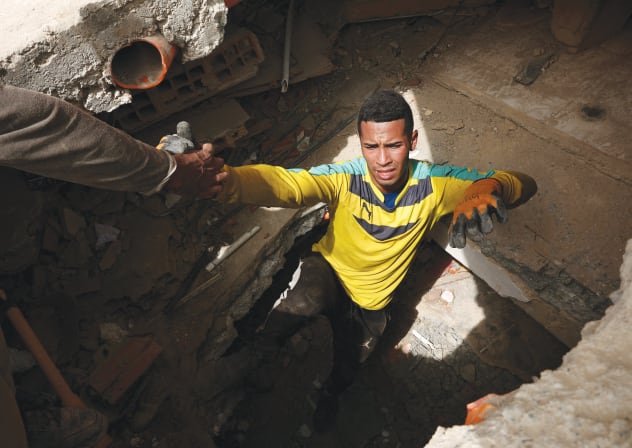
After the Israeli army destroyed homes in the illegal Migron outpost, the level
of tag mechir (price tag) responses escalated. “Tag mechir” is a policy of
making others, usually Arabs, pay the price when the government acts to close an
unauthorized settlement. Following the home demolitions in Migron, two mosques
were vandalized, as was, for the first time, an IDF base.
The official
leadership of the settler movement and the political leadership of the Habayit
Hayehudi party criticized the actions and pointed out the perpetrators were a
fringe group, not representative of the hundreds of thousands of law-abiding
citizens living in Judah and Samaria.
While the statements were sincere
and accurate, they ignored the education that the teenagers who openly support
“tag mechir” receive in schools affiliated with the Religious Zionist
system.
In many ways the criticized actions flow directly from what these
adolescents have been taught. The roots of their behavior can be found in a
number of ideas, some taught in a more widespread fashion than others,
promulgated by broad sections of the dati leumi (Religious Zionist)
world.
Thus even those who do not support revenge or violence may
actually contribute to it.
One of these ideas is that Jews are
intrinsically superior beings of a higher order than non-Jews.
This axiom
leads to the conclusion that a Jewish life is worth more than that of a non-Jew.
The Arabs in particular are viewed as intractable enemies of the Jews and often
equated with Amalek, whom the Jews were commanded to wipe out.
According
to this view, Islam is the source of hatred to Jews, and in fact the
Israeli-Arab (the term “Palestinian” is avoided) conflict is fundamentally a war
between religions.
In this school of thought the commandment to settle
the land of Israel falls into the category of “yei’hareig ve’al ya’avor” (be
willing to be killed rather than transgress). It is placed on the level of the
most serious sins, such as idolatry, murder and incest, although no early
sources mention it. Any Israeli government that supports territorial compromise
automatically loses legitimacy. The army and the police who are used to remove
people from their homes are considered to be enemies.
From this
perspective, a Jewish state has no responsibility for non-Jewish citizens.
Leftist Jews – the term includes the political leadership, the Israeli media,
and people who live in Tel Aviv – are Hellenists and barely Jewish.
YOUNG
PEOPLE are attracted to absolutes, black and white: all Arabs are potential
terrorists; there is no need to respond to their human needs because they should
not be living on our land.
The actual process of resettling them in Arab
countries will somehow happen.
Knowing that God’s will is clear and that
settling the land will bring the Messiah removes any need to make pragmatic
compromises. All problems come from diverging from the path of building in all
areas of the full Israel. There is no need for political alliances and the
support of the United States. When the Jews follow the commandments they have no
reason to fear enemies.
During demonstrations in recent years the primary
participants are teenagers, with the majority often being women. The high
schools encourage their attendance; those who resist arrest are heroes. The
message communicated is that demonstrating is more important than learning,
certainly for girls.
While adults are inhibited from acting totally on
their principles and are constrained by family and other obligations, many young
people are prepared to act. What can be more appealing than a rebellion that is
religiously sanctified? Highly educated parents do not object to their
sixteenyear old children dropping out of school and living on a hilltop because
they admire the idealism and commitment of their daughters and sons.
When
some of these youngsters act on these beliefs and show no restraint, the adult
community is suddenly shocked. Adults understand that there is a larger society
that does not share these assumptions and compromises have to be
made.
Yet it is not certain that this message has been transmitted. If
other views have not been taught as equally legitimate, adult compromise will be
viewed by adolescents as weakness.
MY DESCRIPTION does not apply to all
Religious Zionist schools or rabbis. The percentage that fully articulate the
positions I have described is not a majority, but it is not insignificant. This
growing phenomenon of “tag mechir” should be a wake-up call to the majority that
opposes radical behavior. While admiring the youngsters’ idealism, we must
remember that living in a democratic state requires teaching tolerance of other
views. More importantly, normative Judaism has not been rooted in hatred or
revenge. Symptomatically, David the warrior king does not build the temple, his
peaceful son Shlomo does. This should lead to the understanding that Judaism and
Halachah have always been based on the interaction of many principles. Land is
important and has been neglected because of the nineteen hundred years of exile,
but it is not more important than people.
If I were not aware of some of
what is being taught, I would have dismissed the jejune analysis as a caricature
of the complex and profound teachings of Judaism. But I am worried that this is
what many students are hearing and that this version of Judaism motivates their
behavior. Seeing consequences is a key element leading to change.
The
writer is the president of the Religious Zionists of America. He is the senior
mashgiach ruchani (spiritual supervisor) at Yeshiva University.