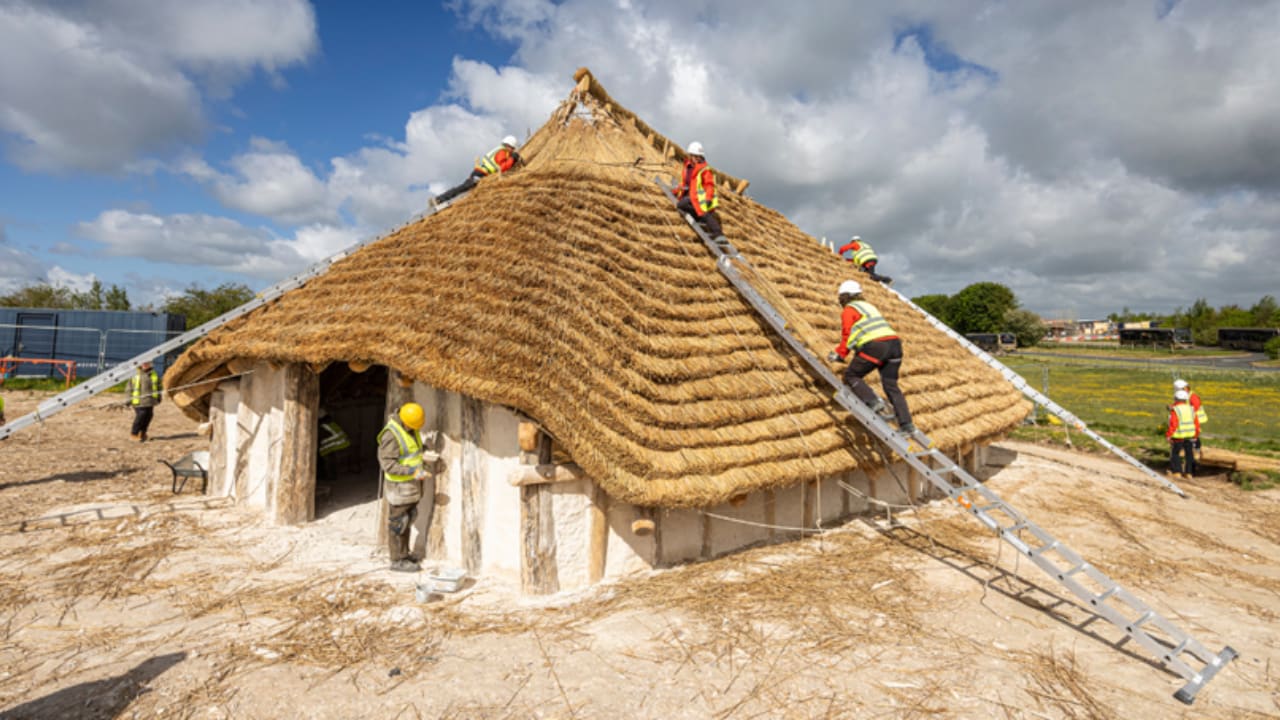
The reconstruction of a 4,500-year-old Neolithic building at Stonehenge was unveiled on Friday by the British charity group English Heritage.
Standing at seven meters tall, the Kusuma Neolithic Hall was modeled after a large prehistoric structure found by archaeologists some two miles away from the historic site of Stonehenge.
The hall is being reconstructed using historically authentic methods and locally sourced materials, English Heritage said in its statement, noting that the building is also in the final stages of its construction.
For nine months, over 100 volunteers - under the guidance of archaeologist Luke Winter - have carefully used historically accurate tools and materials, including thatch, coppiced timber, and chalk daub, to recreate Neolithic building techniques.
It is expected to be completed and open to the public by summer, before becoming in September a “living-history learning space for school groups,” the statement added.

Making a positive difference, providing a memorable experience
The entire one million pound project is being funded by the Kusuma Trust, which “grants to causes, organizations and people that are making a positive difference to society,” according to the trust’s website.
Upon completion, the hall will be able to hold groups of up to 30 students at once, in order to transport them back to prehistory as they “gather around the hearth,” getting to handle replicas of Neolithic tools, and try cooking and various crafts from the time period.
“The Kusuma Neolithic Hall is such an exciting project for the charity,” Matt Thompson, Conservation, Curatorial and Learning Director for English Heritage, said, thanking the Kusuma Trust for its generous donation.
“Not only is the hall a wonderful addition to the Stonehenge experience for both visitors and learners, but by using historically accurate techniques and materials in its construction, we have also been able to develop a much keener understanding of the everyday lives of the Neolithic people who came to Stonehenge and settled in the locality.”
Thompson added that one of the charity’s main goals is to provide visitors with memorable and unique learning experiences, and that Kusuma Neolithic Hall will “transform our [English Heritage] ability to do that.”
“With its burning hearth, Neolithic crafts and cookery, the hall is a model for living history – instantaneously transporting you back 4,500 years,” Thompson said. “This summer, visitors to Stonehenge will also have the chance to experience the hall and speak to some of our wonderful volunteers who built it, before it is opened up to educational groups for the new school year”.
Purpose of original structure still unknown
Despite having a very clear idea of what to use the Kusuma Neolithic Hall for, the purpose of the prehistoric structure on which it is based still remains unclear.
The structure was found around two miles northeast of Stonehenge, near the large Neolithic settlement and later henge enclosure of Durrington Walls.
It is the second-largest known Late Neolithic fortified enclosure in the United Kingdom.
Excavations at the settlement began in 2004 and have since discovered thousands of animal bones and grooved ware-style pottery, indicating the possibility of large winter feasts.
Additionally, it suggests that the original hall upon which the Kusuma Neolithic Hall is based could have been used as a gathering space for celebrations, rituals, or burial practices.