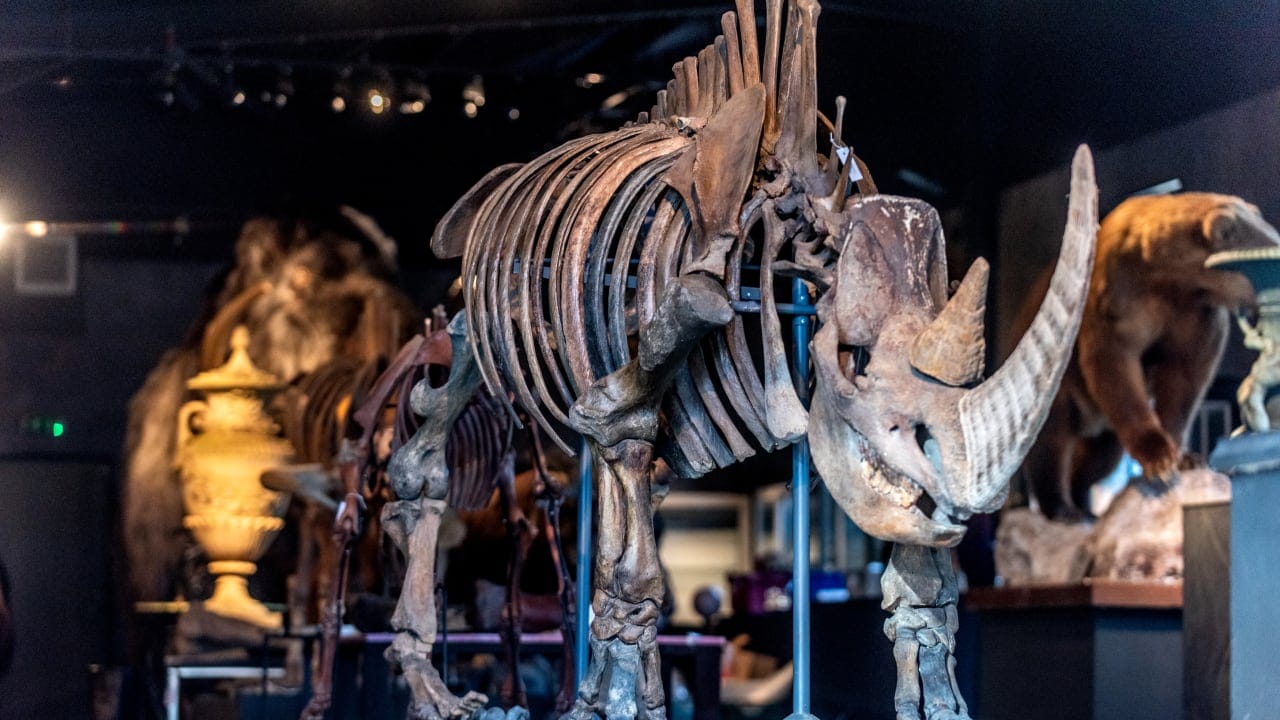
Markings found on fossilized woolly rhinoceros teeth in caves in Europe suggests that they may have been part of the Neanderthal toolkit, according to a study published in May in the Journal of Human Evolution.
The research, led by Alicia Sanz-Royo and colleagues from the Muséum National d'Histoire Naturelle in Paris, is the first to suggest that Neanderthals deliberately collected and used rhino teeth for tools during the Middle Paleolithic, around 300,000 to 40,000 years ago.
Researchers studied rhino teeth previously discovered in the El Castillo Cave in northern Spain and Pech-de-l'Azé II in southwestern France and noticed that many bore markings consistent with human activity.
Dental microwear analysis, which allows for the microscopic study of surface textures, confirmed that the marks were made after the animals' deaths, ruling out chewing or dietary wear as an explanation.
“I had never found teeth with these types of marks. At first, I was quite skeptical,” Sanz-Royo, of the University of Aberdeen in Scotland, told Science News. “This study is important because it opens the possibility that, in addition to bones and antlers, teeth, which are a superhard material, were also very useful.”

What appears to have allured Neanderthals into using rhino teeth despite their heavy unweildiness was the teeth’s hardness, according to the study, as the enamel coating of rhino teeth is made up of 97% hydroxyapatite, a mineral compound that gives it high resistance to fracture and impact.
Testing hypothesis using white rhino teeth
To test whether Neanderthals actually exploited this quality, the team obtained 18 freshly extracted teeth from white rhinoceroses sourced from three French zoos and hired a specialist knapper to turn them into recreations of tools used by Neanderthals.
Afterward, researchers used the tools as they would have been used by Neanderthals, such as retouching flint and quartz blades, knapping, and using the teeth as flat anvil surfaces to cut plant fibers and leather.
The entire process was filmed and supervised by taphonomists.
During the experiment, several distinct markings similar to those seen on the teeth discovered in France and Spain were created, including areas of overlapping enamel from repeated blows, shallow pitted areas on the inner layers of the teeth, percussion notches, and thin "sliding marks" left when a stone edge scraped across the surface during striking.
Findings indicate Neanderthals could think strategically
The study noted that findings carry broader implications for how we understand Neanderthal intelligence and adaptability, and suggest the possibility of strategic thinking.
Neanderthals’ deliberate choice to target older rhinos may have been “either because they were easier prey, because the advanced wear of their teeth made them more useful and comfortable tools, or both,” according to the study.
“This study shows that [Neandertals] not only ate the animals, but they utilized their remains for their technology,” archaeologist José Ramos-Muñoz of the University of Cadiz in Spain, who was not involved in the new study, told Science News. “It’s a trait of modernity.”