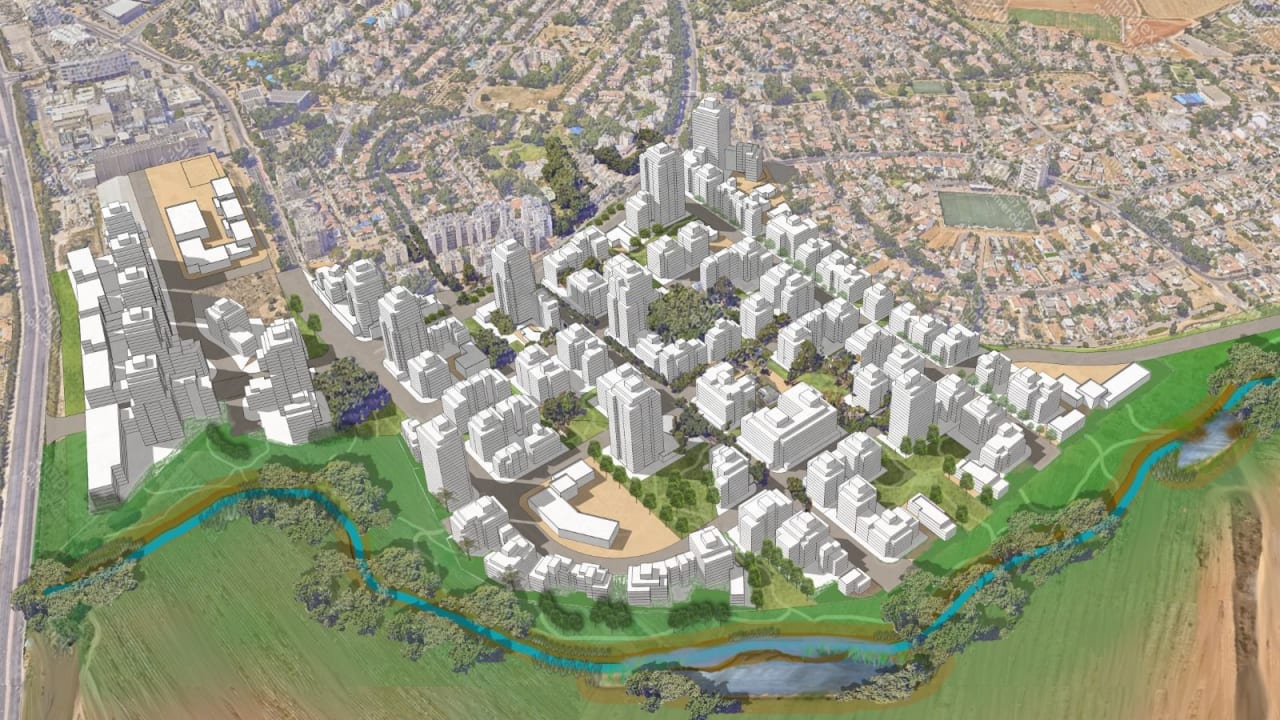
The urban renewal plan for the Yoseftal neighborhood will include the construction of 3,200 new housing units, totaling 4,140 units, as part of a combined process of eviction-reconstruction (Pinui-Binui) and expansion of the development area. The plan is expected to advance through the National Outline Plan (VATMAL) track. Kfar Saba Mayor Rafi Sa’ar stated: “We have reached agreements that will enable the real implementation of the renewal for the benefit of residents.”

The plan applies to a total area of approximately 424 dunams and includes the existing Yoseftal neighborhood, which has about 955 housing units in old train buildings on an area of approximately 160 dunams, as well as lands to the south and east of the neighborhood, owned by the state, covering about 264 dunams. In the urban renewal area (Pinui-Binui), 2,754 units are planned to be built, and in the expansion area, 1,386 units. These lands are intended to serve as a planning expansion to allow economic balance for the Pinui-Binui complexes.
The planning framework is based on dividing the neighborhood into 18 separate complexes, each of which can advance independently with developers. This model is intended to allow planning flexibility but also reflects the economic feasibility gaps between parts of the neighborhood. Industry sources note that without additional rights and housing units from state lands, some of the complexes would not pass the economic feasibility test.

Within this framework, the Mayor of Kfar Saba conducted negotiations in recent months with the Israel Land Authority (ILA), which concluded with an agreement to transfer housing units from state-owned lands to complexes with lower feasibility, in order to enable overall implementation of the plan and not just targeted advancement of stronger complexes.
According to Kfar Saba Mayor Rafi Sa’ar:
“The approval of the plan by the Committee’s plenary session is a significant step on the way to renewing the Yoseftal neighborhood. This is a complex process that required prolonged negotiations with the Israel Land Authority to ensure that the plan will be responsible, balanced, and, most importantly, feasible. We have reached agreements that will allow real implementation of the renewal for the benefit of residents, while maintaining the quality of life, infrastructure, and the community fabric of the neighborhood and the city as a whole.”

According to sources involved in the process, issues such as building height and density were central to the discussions, due to their direct impact on the economic feasibility of the projects. The feasibility of each complex will be examined in the next stages, with the advancement of detailed plans and the signing of agreements between developers and residents.
The plan’s approval constitutes a preliminary planning stage. Its further advancement is expected to proceed through the National Outline Plan (VATMAL) track, while its actual implementation is expected to take place gradually, according to planning readiness, residents’ agreements, and market conditions.