
Price (base/test vehicle): NIS 190,000 / 200,000
Competitors: Jaecoo 8, Chery Tiggo 9, Chery Tiggo 8, Mitsubishi Outlander, Skoda Kodiaq
We liked: Design, cabin, equipment, usability, and price
We didn’t like: Road handling, and there’s still room for improvement in ergonomics
Score: 8.5/10
One of the segments where the Chinese presence stands out is the 7-seat crossover category. Since the beginning of the year, about 600 Skoda Kodiaq units and around 1,250 Mitsubishi Outlanders have been delivered - models that for years dominated parking lots of large families and family trips. In contrast, during the same period, the Chery Tiggo 8 Pro delivered around 2,050 units since the start of 2026, almost all of them plug-in versions. The Jaecoo 8, offered only as a plug-in, delivered 2,330 units, despite being more expensive and despite having a twin model, the Chery Tiggo 9, which has been far less successful with around 200 deliveries.
The Tiggo 8 (from NIS 190,000 for the plug-in) has been the best-seller in the segment since its arrival three years ago, and now faces tough competition from the larger and more expensive Jaecoo 8 (from NIS 230,000) and the Tiggo 9 (from NIS 218,000). The Jaecoo is closer in size to the Kia Sorento and Hyundai Santa Fe, allowing it to offer a slightly roomier third row and cargo space. On the other hand, it still costs close to a quarter of a million shekels.
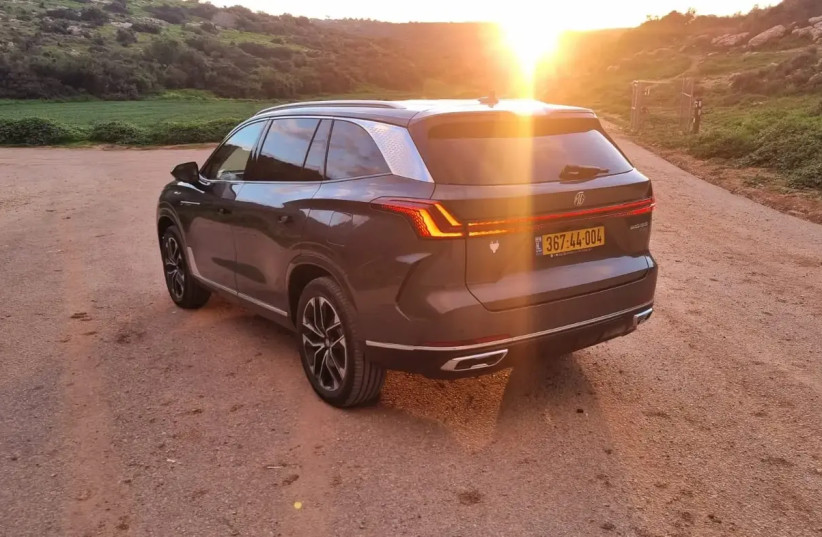
Now comes another Chinese 7-seater trying to offer the best of all worlds: The MG S9. It’s as large as the Jaecoo and even slightly bigger, yet priced like the Tiggo 8 at NIS 190,000. There’s a small catch we’ll get to later, but either way, it brings MG - the first Chinese brand to land here about 15 years ago - into a new and highly demanded category, and does so with a strong statement.

Design
The S9 doesn’t try to masquerade as an electric vehicle like some plug-in hybrids do, perhaps only slightly at the rear. With a classic front end and moderate chrome use, it mainly strives to look elegant and respectable, continuing the brand’s design language. This fits its size: 4.98 meters long, 1.97 meters wide, 1.79 meters tall, with a 2.92-meter wheelbase. The Tiggo 9 and Jaecoo 8 are shorter by 17 cm, narrower by 4 cm, lower by 5 cm, and have a 12 cm shorter wheelbase - but are therefore less bulky when parking. Try finding space for a five-meter vehicle in Tel Aviv - or practically anywhere else.
Interior
The driver’s environment is also respectable and pleasantly conservative: A pair of 12.3-inch screens, now almost standard in electrified vehicles - one for multimedia and controls, the other as a digital instrument cluster. And here’s a surprise: Physical buttons for climate control and the audio system. It’s a shame they aren’t easier-to-use rotary knobs, but it’s still a good start. It is less convenient that the central air vents can only be controlled via the screen, similar to Tesla. Material and build quality are decent.
The driver’s seat provides a high, commanding position and is electrically adjustable, as is the passenger seat. Rear seat space is excellent, with air vents, charging ports, and a flat floor. The second row slides to increase legroom for third-row passengers when needed. Folding the seats eases access to the third row, which, although low, offers sufficient legroom for an adult - no small feat in this category, especially at this price point. Passengers six and seven also get their own air vents and cup holders, though no Isofix anchors.
The trunk offers 332 liters - relatively large for the segment, yet still not truly sufficient for a family. One of the third-row seats can be folded to increase space at the cost of reducing seating to six. Alternatively, roof storage solutions can help. There’s no spare wheel, and no proper storage for the charging cable, which is left loose in the trunk.

Equipment
Two trim levels are available:
Comfort (from NIS 190,000) includes 20-inch wheels, dual 12.3-inch screens, Android Auto and Apple CarPlay, heated and electrically adjustable front seats, a powered tailgate, panoramic sunroof, roof rails, and 360-degree cameras.
Luxury (from NIS 200,000) adds a head-up display, LED headlights and fog lights, wireless phone charging, a 12-speaker BOSE sound system, gesture-controlled tailgate, 4-way lumbar adjustment, ventilated and massaging front seats, and leather upholstery in gray or beige.
Both versions cost an extra NIS 1,900 for metallic paint and NIS 1,555 for light upholstery. Returning MG customers receive a NIS 1,500 discount.

Safety
5 out of 5 stars in the European crash test (2025). Includes 7 airbags, autonomous emergency braking (forward and reverse), adaptive cruise control, blind-spot monitoring, lane keeping assist, and lane departure correction.
Electric
While its competitors offer a 34 kWh battery, MG settles for 24 kWh. This translates to a claimed electric range of 100 km versus 140 km in the Jaecoo and larger Chery models. In practice, we achieved about 75 km on a route combining some city driving and mostly moderate highway driving, compared to about 120 km in its rivals.
In hybrid mode with a charged battery, we achieved 25 km/l over 250 km. With a depleted battery, expect 14–15 km/l. It supports three-phase AC charging at 11 kW, but there’s no fast-charging option - which is not particularly necessary for plug-in hybrids given DC charging costs.

Engine and Performance
As expected, there’s a 1.5-liter turbocharged gasoline engine (143 hp) paired with an electric motor (231 hp), for a combined output of 272 hp sent to the front wheels. This is modest compared to the Jaecoo and Tiggo, which boast around 200 hp more and much stronger acceleration. The MG is more restrained, with an official 0–100 km/h time of 9.6 seconds - perfectly adequate for this type of vehicle. It’s quiet in electric mode and not much louder when the gasoline engine kicks in.
Comfort and Handling
Comfort is generally good, less so over urban bumps. The soft suspension tuning does not provide sporty handling, despite MG’s heritage. Steering could be more precise. Ride quality is quiet.

Bottom Line
The S9 isn’t perfect, but it’s a solid vehicle that offers excellent value for money. It’s less quick and has a shorter electric range than the Jaecoo and Tiggo, but remains efficient and sufficiently powerful. Given its price, the base version is more than adequate and well-equipped - it’s not a stripped-down fleet model. One thing is clear: The share of European and Korean crossovers in this segment is likely to shrink further.
MG S9: Technical Specifications
Engines: 1.5L turbo gasoline + electric motor, combined 272 hp
Transmission: Direct drive, front-wheel drive
Electric:
Battery capacity (kWh): 24.7
AC charging (kW): 11
DC fast charging: None
Performance (manufacturer):
0–100 km/h (sec): 9.6
Top speed (km/h): 180
Electric range (km, manufacturer): 100
Electric range (km, test): 75
Fuel consumption with charged battery (km/l, manufacturer): 43.5
Fuel consumption with charged battery (km/l, test): 25
Fuel consumption without charge (km/l, manufacturer): 15
Fuel consumption without charge (km/l, test): 14
Dimensions:
Length (m): 4.98
Width (m): 1.97
Height (m): 1.78
Wheelbase (m): 2.92
Curb weight (kg): 2,160
Trunk (liters): 332
Safety:
Euro NCAP rating: 5/5 stars
Active safety: Autonomous emergency braking (forward and reverse), adaptive cruise control, blind-spot monitoring, lane keeping assist
Warranty:
7 years or 150,000 km (vehicle), 8 years or 150,000 km (battery). Service interval: Once a year or every 15,000 km.