
Apple has done something in the laptop market it hasn't done in years: It made a market-disrupting move and "invaded" the budget laptop market, a segment it previously looked down upon, literally – both in terms of condescension and price. This move of creating a cheap but high-quality laptop with good value for money (starting at 600 dollars and even less in student deals, which translate to NIS 2,400), created so much noise in the sleepy laptop market that even the CEO of rival Asus offered praise.
However, the main claim raised against the Macbook Neo is the fact that it is a weak computer in terms of performance, and this claim has legs: The processor running at the heart of the laptop with the aluminum body is the A18 Pro – the same processor that runs the iPhone 16 Pro, and therefore some have dismissively dubbed it: "A computer with an iPhone processor."
True, when it comes to light applications, even an iPhone processor is strong enough: Browsing, word processing, a bit of work on spreadsheets – the A18 can carry that, and without effort. But what happens when you start loading it with heavier tasks like games, video editing, and so on? That is what we came to check.
I took a Macbook Neo provided to us for review courtesy of iStore, against an Asus laptop at a similar price level (provided to us courtesy of Asus Israel) and came to test their performance, head to head. For those expecting to find a full review here, comparing hardware, ports, screen quality, and so on – not this time. This time I tested one thing and one thing only: Performance.

How did we test?
Uniform performance tests and comparison between different platforms are, frankly, a massive headache for a technology journalist. Nevertheless, I used applications that measure performance in points and accurate numerical quantification that leaves no room for subjective interpretation or impressions (although I have a few and will share them later), also known as industry-standard benchmarks: Various tests by 3Dmark, currently owned by the German measurement and standards company UL, and Cinebench, another well-known and veteran performance test. Both computers were updated with all the latest updates of their respective operating systems (MacOS Tahoe vs. Windows 11), and were measured while in high-performance mode and connected to power.
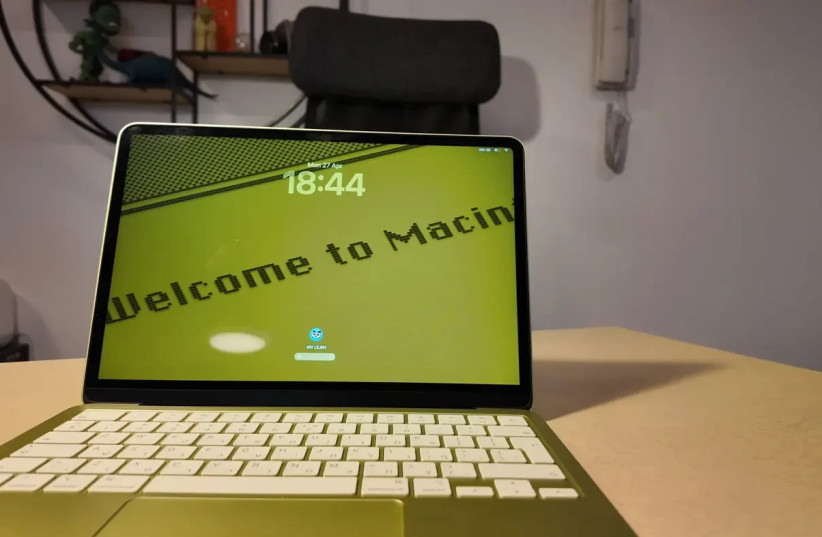
In the blue corner, in a lemon-colored chassis, a Macbook Neo weighing a light 1.23 kg, a 13-inch screen, with an A18 Pro processor, with six cores in an arrangement of two performance cores and four efficiency cores, and a five-core graphics processor with support for hardware ray tracing and eight gigabytes of memory.
In the red corner, in a platinum-colored chassis, an Asus VivoBook, weighing a light 1.49 kg, a 14-inch screen, with Qualcomm's Snapdragon X processor, with eight equal "Oryon" cores and eight threads, and an Adreno X1-45 graphics processor, with 45 cores and eight threads. The Asus computer has 16 gigabytes of memory, instead of eight.
It is important to note: In both cases, these are definitely not the strongest computers these two respected companies have to offer. The relevant field in which we came to compare them is the price – both revolve around NIS 2,500 today in the market, and these are cheap entry-level computers with a high value proposition.
In the case of the Snapdragon processor – this is the lower series of Snapdragon X processors and not the high-end X Elite series. And also with Apple, these are not the in-house M-series processors used by the Neo's older siblings. Both have modest processors.
Why not an Intel processor, you ask? Because I did not find systems with Intel processors of similar performance that were close in price. Intel, by the way, since we mentioned it, only recently announced a light and cheap platform called Wildcat, which will compete with the Macbook Neo, quite late... (the first computers based on it will hit the market only in the second half of the year). And another reason I chose Qualcomm's Snapdragon specifically – the cores of the competing processors ultimately come from the same house – both are designs by the British company ARM.
Results and performance
Before we get to the hard numbers, I must note that both computers behaved well and, subjectively, showed nice performance. For example, even when the "official" frame rate in the tests was low, the graphics still appeared fluid to the eye on both computers. But let's move to the numbers.
We'll start with a light test to warm up the barrel. Wild Life is 3Dmark's light performance test intended primarily for smartphones. Both computers passed this test with nice scores: The Macbook Neo produced 3771 points, with an average frame rate of 22.6 frames per second. The VivoBook did not lag far behind with 3266 points, and 19.56 frames per second on average. Not a big difference, but a small victory for the Mac.
The next test, Steel Nomad Light, is a test already developed for mid-range computers or powerful smartphones, and it is a more up-to-date graphical test. The Macbook Neo produced 1830 points and already started to pant a bit in the graphics department with only 13.5 frames per second. The Snapdragon, by contrast, was already short of breath: It produced only 1082 points. Another point for the Mac.
The third test they were put through is the Solar Bay test. This is one of my favorite tests to use for checking laptops, both because of its literally polished graphics (it is a scene of a futuristic solar panel factory in space, with many mirrored surfaces, which is demanding for graphics processors) and because it uses the ray tracing technique for light source mapping. Here, here the Macbook Neo perhaps enjoyed an advantage due to the hardware support for ray tracing. And indeed, the Macbook Neo produced a figure of 7438 points, with 28 frames per second on average, while the PC with the Snapdragon system produced 6055 points with an average frame rate of 23 frames per second. Here, too, a victory for the Mac, by a significant margin.
And we'll conclude with the Cinebench test, which is a test that primarily checks video performance and rendering of complex graphics. The uniqueness of Cinebench is that it is able to test, separately, both multi-core performance and single-core performance of the main processors.
The Macbook Neo, unsurprisingly, produced a score of 1501 points in multi-core, and a not-at-all-bad mid-range score (a good place in the middle, close to the M3 Ultra, Apple's main processor from 2024) of 541 points for a single core.
The Snapdragon from Qualcomm, equipped as remembered with eight cores, actually blasted through here with 1871 points for multi-core and bypassed the Macbook. However, in single-core performance, it came out very weak – only 234 points, weak even compared to equivalent systems in the same configuration.

The bottom line
The bottom line of this battle, which ended in a 3:1 victory in favor of the Macbook, pretty much shatters the "computer with an iPhone processor" claim as a taunt. It may be a computer with an iPhone processor, but its performance is certainly handsome and not weak at all, relative to the market segment in which it competes. This means that the Macbook Neo will stand with dignity even in light games and a bit more, in graphics work, and basic video editing. Is this a computer to edit 8K videos on or to process print posters for hanging on the Ayalon highway? Probably not. But even if you throw it a few curveballs, it will stand up to it with dignity.
And a word about the Asus – it, too, overall, displayed reasonable performance, and considering the fact that it is a 14-inch computer, with a variety of ports, and a respectable battery that lasts for long hours, the value for money even in the PC sector is good. The only place where it is felt that the Snapdragon platform does not quite deliver the goods is in the relatively weak graphics processor. Would we have received different results with Intel processors? It is possible. We will have to wait for the first swallows of the competing platform to repeat the battle.