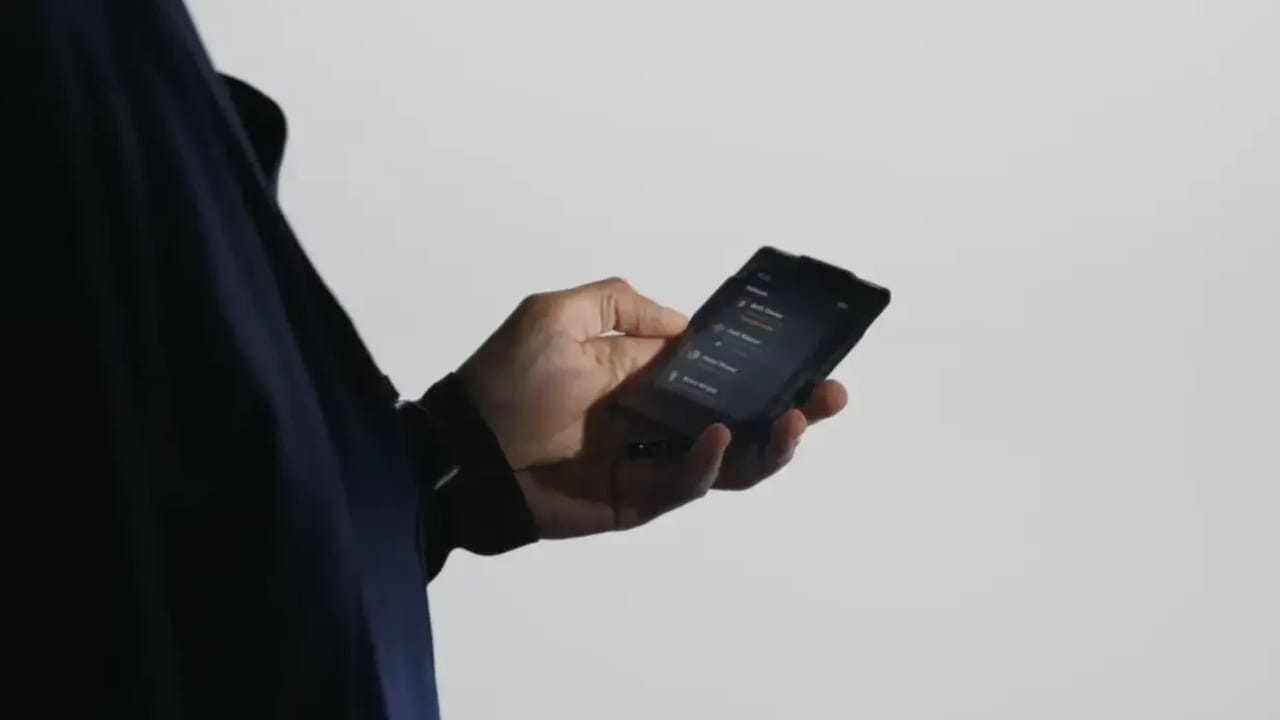
Microsoft announced this week at its Build 2026 conference Project Solara – a new operating system built from scratch for devices that run artificial intelligence agents. The platform is built on Android rather than Windows, and its purpose is to power AI agent-centric experiences on small and power-efficient devices. In other words – it allows you to get artificial intelligence agents directly from the cloud with wearable devices such as an employee badge. Everyone remembers Humane's failed attempt, but from what Microsoft presented at the developer conference – this looks like a completely different opera:
Microsoft demonstrated two prototypes: A desktop tablet and a smart employee badge. The desktop tablet resembles the Amazon Echo Show, featuring facial recognition unlock and access to AI agents. But the real star is the badge.
The badge is a wearable smart badge – just like an office building entry badge or an employee ID badge – but it is actually a tiny computer. Inside, it has a camera, a fingerprint scanner, a microphone, and a single button that activates an AI agent with a press. Microsoft demonstrated recording a conversation with instant transcription at a single press. The camera allows the agent to see exactly what the user sees, and to respond accordingly.
Microsoft does not plan to market the devices itself – they will serve as reference designs that other hardware manufacturers will implement. Retail giants like Target and Best Buy have already expressed interest in the smart employee badge.
The choice of Android is clear: These are devices with processing and battery limitations where Windows is simply not suitable, and they run on a weak Qualcomm processor that fits the thin and small form factor. Microsoft wrapped the platform in a management and security layer for enterprise deployment, and they immediately showcase advantages for industries such as medicine, construction, and more.
The work on Project Solara is still in an early stage. But the direction is clear: While Google and others are also working on wearable artificial intelligence, and Jony Ive is also developing a similar device for OpenAI, which has already become a competitor – Microsoft wants to be first in this space of intelligent wearable products, and it steps onto the field with major swings.