
“Please don’t sing this song to my children,” I once said to a friend who had come to visit us.
The song itself was perfectly harmless: “Two times two is four — everyone in the world knows that.”
And yet, behind it lies a deeper issue.
From the very beginning of our children’s lives, we often raise them according to a simple principle: to pass on our own experience and teach them how to live. From this come countless “unchangeable truths,” neatly packaged as cheerful rhymes, fairy tales, songs, and simple rules that children are expected to follow so that, one day, they can successfully fit into the social structure they are meant to become part of.
What we often overlook is that raising children within rigid axioms and rules may fail to teach them one of the most important skills in life: the ability to analyze and draw conclusions. Without this critical skill, each of us is destined to walk a well-worn path laid down by others, without ever asking where it ultimately leads.
So how do we develop a child’s ability to analyze and think critically?
The answer seems obvious: we stop offering children ready-made solutions.
But how can children learn these important skills?
By playing.
It is well known that children learn through play. By playing, a child learns how to interact with the world and with people around them. But play is more than that — it is a unique way to understand cause and effect.
If a child is building a tower from wooden blocks, let them build it the way they can.
How should the blocks be placed so the tower does not fall? Give the child space to try, to make mistakes and to pause if necessary. In doing so, the child learns something essential: how to return to a difficult task later with a new approach.
By allowing boredom.
Do you remember our childhood, when we had to entertain ourselves because our parents were often busy, and the only device at home was a television — sometimes just one for the whole family? We were bored — and that boredom became a powerful source of inspiration. We thought about life, invented games, sculpted, drew, wandered around the house, and created entire worlds in our imagination.
Modern children do not really know how to be bored. Their brains constantly demand faster and stronger doses of dopamine through various gadgets and online games. As a result, they have very little time to process and reflect on the world around them.
As parents, we can influence how our children grow. We can reduce — or even remove — constant screen time and allow our children to be bored. This “empty” time holds enormous potential. It teaches a child to build a relationship with the world through reflection and analysis. And yes, even watching a fly slowly crawl up the wall can sometimes be surprisingly useful.
By searching for answers.
Do you remember the song I mentioned at the beginning?
Instead of offering a child an axiom, place a small task in front of them. Let them arrive at the conclusion through experience — and through questions. Give them two blocks, then two more, and ask: how many do we have now? Suddenly, the words of the song gain form and meaning.
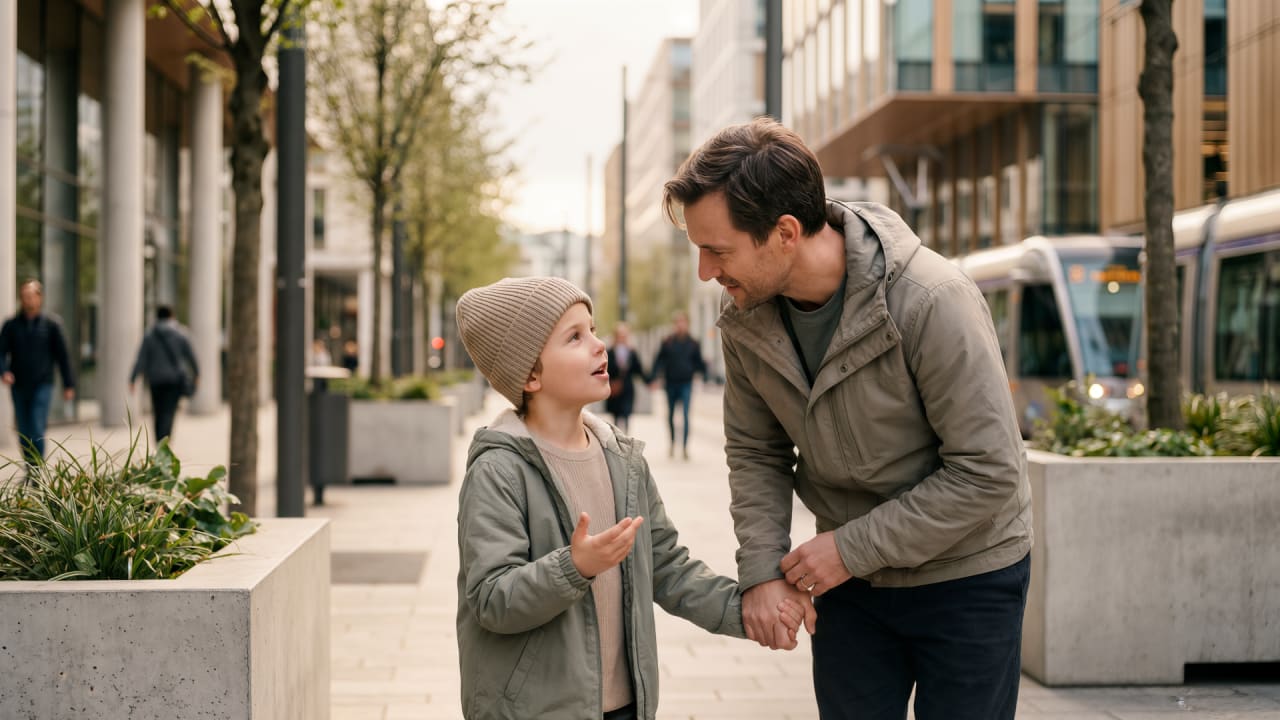
Of course, this is a very simple example. But the same principle applies to everything else. Turn your children into little explorers by constantly inviting them into dialogue. Ask: Why do you think this is so? What would you do in this situation? Is this good or bad, in your opinion?
This ongoing invitation to conversation helps a child develop a very important skill: an inner dialogue with themselves. Guided by their own moral compass, a child will one day be able to rely on themselves — rather than on others.
In the end, perhaps the most important gift we can offer a child is not certainty, but trust — trust in their ability to think, to question, and to find meaning on their own. Because life rarely gives us songs with only one correct verse. And those who learn to listen, reflect, and choose for themselves are the ones who can truly hear its music.
This article was written in cooperation with Lado Okhotnikov