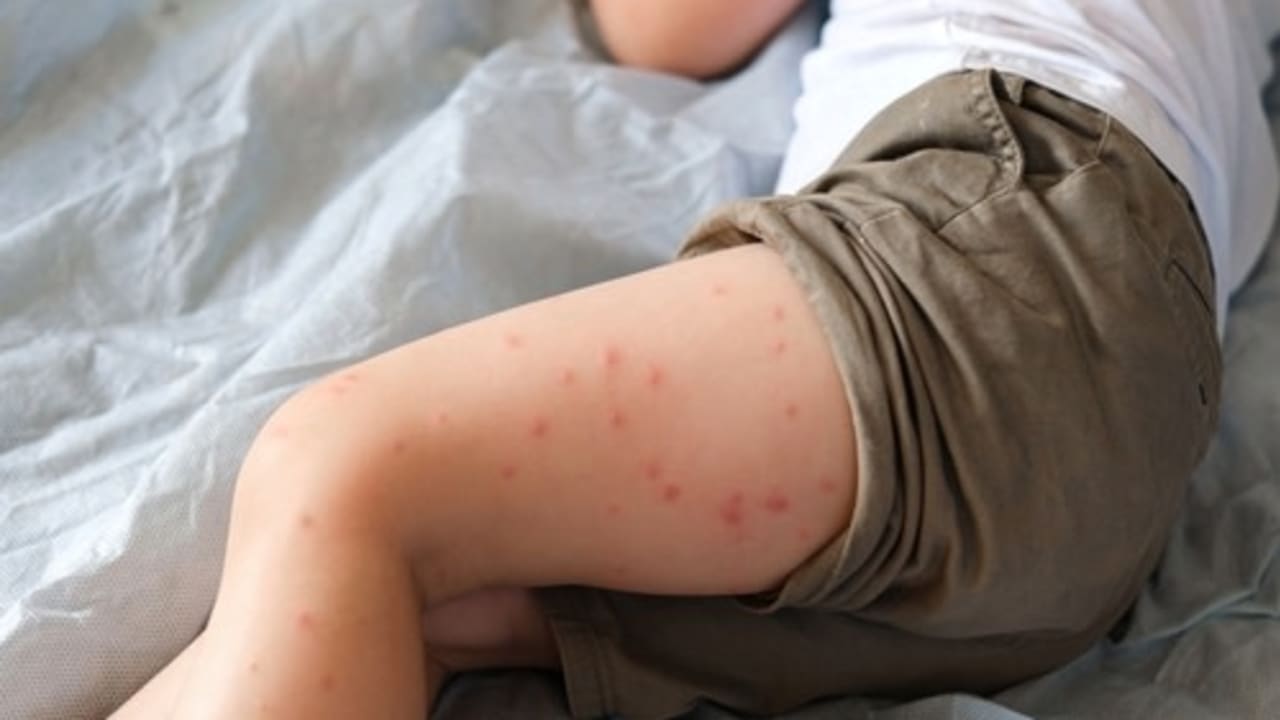
In days when many citizens in Israel are forced to go down again and again to shelters and reach protected spaces following the sirens, a health question also arises: Does staying in closed and crowded spaces increase infection with diseases, primarily measles?
According to Prof. Tamar Lachish, an infectious diseases specialist and a senior physician in Internal Medicine Department D at the Shaare Zedek Medical Center, there is indeed a possibility of infection, but in most cases the risk is low, especially when the population is vaccinated.
According to her, measles is considered one of the most contagious diseases. "The virus can remain in the air in a closed space for hours, and can also spread several meters from the patient", she explained. "Theoretically, a shelter is certainly a place where infection can occur".
However, she emphasizes that alongside the high risk of infection, this is also a disease that can be prevented relatively easily through vaccination. "The measles vaccine is an excellent vaccine given in two doses, with coverage of over 95% of the population. Even in rare cases where a vaccinated person becomes infected, the chance of severe illness is negligible".

The main concern: Areas with low vaccination rates
According to Prof. Lachish, the real risk of infection does not necessarily stem from the shelter itself, but from the composition of the population staying in it. "The concern is mainly in places where there are 'pockets' of an unvaccinated population, for example people who chose not to be vaccinated, people who did not complete the two vaccine doses, very young infants, or immunocompromised individuals".
She notes that in places where the vaccination rate is low, such as in certain parts of Jerusalem, Beit Shemesh, etc., there is greater sensitivity to outbreaks.
Is it advisable to wear masks?
"The only solution to prevent the spread of measles is to reach high vaccination coverage of about 95% of the population", she said. "When the vast majority is vaccinated, the disease has difficulty spreading even if isolated cases appear. When part of the public is not vaccinated, an outbreak occurs, after which many become infected or complete vaccinations, and again reach a high level of immunity – until new groups that were not vaccinated appear".
Regarding the question of whether it is advisable to use masks in shelters, Lachish notes that theoretically a mask can reduce infection, but not necessarily in a practical way in the case of measles.
"The mask that protects against measles is an N95 mask and not a regular surgical mask", she said. "This is a mask that not everyone has, and it is also less comfortable to use, especially in a stressful situation like going down to a shelter".
However, she emphasizes that people with a fever illness or respiratory symptoms should avoid being close to others as much as possible.
And what about other winter illnesses?
"They are mainly transmitted through droplet infection, meaning through large droplets that are expelled when a person coughs or speaks", she explained. "These droplets usually fall to the ground within a distance of up to one meter from the sick person. Therefore, even if a sick person is on the other side of the shelter, the risk of infection from them is relatively low. In such cases, a surgical mask can actually help reduce infection", she said.
Prof. Lachish's message: "The main recommendation of the Ministry of Health, even in complex days like now – is to get vaccinated against diseases that can be prevented through vaccination. We do not think that this is a significant concern for the general population", she said. "The best way to protect ourselves and the environment is simply to complete vaccinations".
According to the Ministry of Health, there are 24 hospitalized in hospitals with measles, 5 in intensive care. And 3,140 investigations that have been completed regarding the infection chain. At Hadassah Hospital there are 8 hospitalized, Sheba 3, Shaare Zedek 3, 2 at Ziv, 2 at Maayanei Hayeshua, 1 at Beilinson, 1 at Hillel Yaffe, 1 HaEmek, Laniado 1, Poria 1 and Rambam 1.