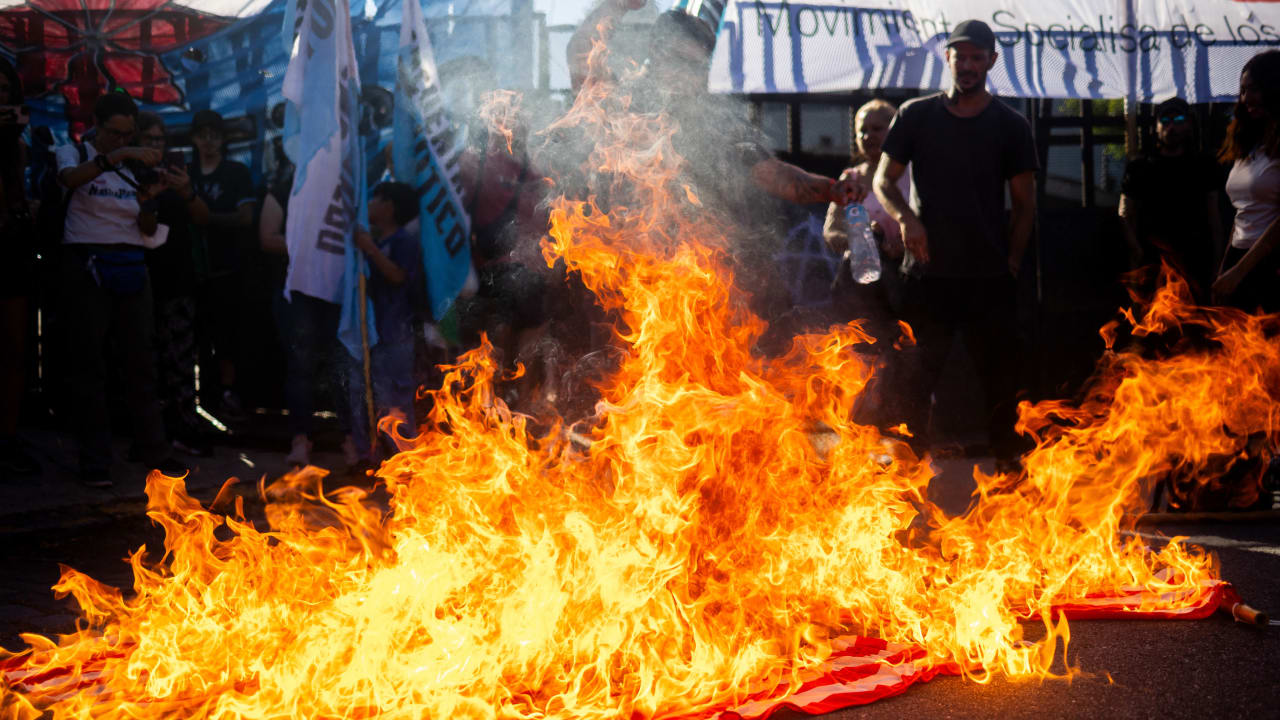
The US military strike in Venezuela was presented by Washington as a targeted operation, geographically contained within Latin America.
For more stories from The Media Line go to themedialine.org
Analysts, however, are increasingly interpreting the move as part of a broader strategic pattern, one that links energy markets, currency dominance, regional “backyards,” and the long-term contest between the United States and China.
What amplified the strike’s global resonance was not only where it occurred, but how it was executed. The operation was carried out without congressional authorization and with little public warning, surprising many observers with its speed and apparent success. At the same time, it did not signal the opening of a prolonged military campaign.
Many analysts stressed that the strike does not point toward a “boots on the ground” scenario, which would be politically costly and strategically difficult for Washington.
“I don’t think militarily there is a lot of support in Congress or within the US for boots on the ground. You’re talking about at the very least 20,000, 25,000, maybe 50,000 soldiers on the ground, which politically would be suicide for Trump. I don’t think he’s going to do that,” Rajat Ganguly, editor-in-chief of the Journal of Asian Security and International Affairs and a professor at Murdoch University in Australia, told The Media Line.

Ganguly said the strike in Venezuela cannot be understood in isolation.
“These events are probably interconnected,” he said. “America has been selling a lot of weapons to Taiwan recently, and China obviously was not very happy with that.”
He described developments in Latin America, East Asia, and the Middle East as part of a single geopolitical equation, in which pressure applied in one theater is intended to shape behavior in another. Rather than reacting to individual crises, he said, great powers are responding to each other’s cumulative moves across regions.
Venezuela, oil, currency dimension
At the heart of Ganguly’s analysis of Venezuela lies not only oil supply but also the currency in which that oil is traded. Venezuela, which holds one of the world’s largest proven oil reserves, has, in recent years, become China’s largest crude supplier.
“Over the past few years, China was the biggest buyer of Venezuelan oil,” he said. “And Venezuela is sitting on over 300 billion barrels of oil, which is larger than the deposit in Saudi Arabia.”
What elevated Venezuela from a regional issue to a global one, Ganguly said, was Caracas’s willingness to settle energy transactions outside the US dollar system.
“The most interesting thing is that this oil that Venezuela sold to China, they actually settled the payments in Chinese yuan,” he said. “This move by the US was not just to grab the oil and prevent China from taking this oil or buying this oil. This is also a move to prevent the de-dollarization of what is effectively the petrodollar.”
He framed the strike as a response to concerns about the gradual erosion of dollar dominance in global energy trade.
“If you suddenly move to an alternative currency, so in this case the Chinese yuan, or in the case of India and Russia the rupee-ruble agreement, and if in the future you get a BRICS currency, that would mean the collapse of the US dollar, which basically would mean the collapse of US power,” he said.
In that view, Venezuela is not only an oil producer, but a test case: can major energy suppliers aligned with US rivals bypass the dollar without consequences?
Energy pressure and China’s strategic exposure
Ganguly said Venezuela sits alongside Iran as one of the two most critical external pillars of China’s energy security.
“If you can prevent Venezuelan oil from going to China, or if you can prevent Iranian oil from going to China, Beijing probably would be under severe pressure,” he said.
The point, he said, is not necessarily escalation, but leverage.
“One way of international negotiation is to create pressure on the other side,” he said. “America could then drive a hard bargain and say, ‘Look, we’re going to give you the oil, but in return we want X, Y, Z.’”
He said the bargaining could take multiple forms.
“It could be a bargain in terms of rare earths. It could be a bargain in terms of silver or any other precious metal. It could be a bargain in terms of more favorable terms of trade,” he said.
That pressure would intensify dramatically, Ganguly said, if Iran’s current regime were to fall.
“If the Shiite clerical regime collapses in Iran and a pro-American regime comes to power, China is cut off completely,” he said. “They won’t negotiate with China. That creates even more pressure on Beijing.”
Such a scenario would represent a major strategic loss for both China and Russia, he said.
“This would be a much bigger loss to Russia and China than to the Arab countries in the Middle East,” he said.
Iran, regime change, Middle East balance
Ganguly described Iran as not merely an energy supplier, but an ideological and strategic hub whose alignment shapes the region.
“If this regime collapses, Hezbollah, Hamas, Islamic Jihad, the Houthis, these problems will quickly get settled,” he said.
He suggested that such a collapse would not occur organically, but would more likely result from external military action targeting the Islamic Republic founded by the late Iranian Supreme Leader Ayatollah Ruhollah Khomeini.
“If the regime established by Khomeini and his successors collapses in some way, whether by Israel, by the US, if this regime collapses and a new regime pro-West, pro-American, pro-Israel comes into power, the Sunni Arab world will actually support that,” he said.
In this scenario, an effort to end the Iranian regime would most likely be carried out by Israel, but with the green light and backing of the United States.
A pro-Western Iran would profoundly alter the Middle Eastern balance—cutting China off from a key energy supplier, weakening Russia’s regional depth, and consolidating US influence across Israel, the Gulf states, and beyond.
Taiwan enters the equation
While Venezuela and Iran revolve around oil and currency, Taiwan represents a different strategic asset: advanced semiconductor manufacturing. From Taipei, the Venezuela strike has been closely studied for what it reveals about US speed and decisiveness.
Kelvin Shen, a journalist at Taiwan News covering Taiwan’s military and foreign affairs, said the strike drew attention within Taiwan’s defense establishment.
“Taiwan is definitely looking at the strike itself as how the US was able to move so quickly,” Shen told The Media Line. “Hypothetically, Taiwan has definitely considered a Chinese decapitation strike on Taiwan.”
That concern is not theoretical, Shen said.
“The vice defense minister said that Taiwan has considered many hypothetical situations in terms of a Chinese attack and what could happen,” he said. “They’ve definitely made preparations, including how to protect important assets and also protect the president.”
Beijing’s interpretation: Opportunity, not deterrence
Shen stated that China interpreted the strike in Venezuela as an opportunity, not a warning.
“I don’t think China took offense to the strikes,” he said. “In fact, I think it sees this as an opportunity.”
Congressional authorization, he said, is central to how the strike reads in Beijing.
“The US never declared war on Venezuela and never sought congressional approval,” he said. “It gives China a certain type of justification and emboldens China to continue to act outside the law.”
He pointed to China’s recent posture around Taiwan and in the South China Sea as evidence of that dynamic.
“China has been conducting military exercises around Taiwan and military activities in the South China Sea,” he said. “Last week’s exercise actually simulated a blockade of Taiwan.”
China’s long game in Asia
Despite rising pressure, Shen said Beijing remains methodical.
“China is continuing with its original strategy toward Taiwan,” he said. “It’s taking its time, continuing with planning, testing new weapons and technology.”
Even as military readiness advances, he said, China continues to frame its objectives in non-kinetic terms.
“They haven’t given up on what they call peaceful unification,” Shen said. “But they’re very much ready for implementing a blockade, or worse comes to worst, an invasion.”
Ganguly described Taiwan as a red line for Beijing.
“As President Xi Jinping has said many times, Taiwan is a red line for China,” he said. “If there were any effort by the US, backed by Japan and others, to push Taiwan towards independence, that would trigger a full-scale war.”
Chips, escalation, strategic risk
Taiwan’s semiconductor industry adds a global dimension to any potential confrontation, Shen said.
“If China controlled Taiwan’s semiconductor industry, it would definitely be a threat to the global supply chain,” he said. “China would be able to control and decide who gets access to the chips.”
Ganguly cautioned against assumptions of a clean takeover.
“If the Chinese launch a massive military attack on Taiwan, this will probably destroy the Taiwanese chip-making infrastructure, significantly if not entirely,” he said.
Both experts converged on the unpredictability of escalation.
“Any war is risky,” Ganguly said. “Once a war starts, you never know how it escalates.”
Backyards, red lines, spheres of influence
Both interviews point to the same organizing principle: the re-emergence of spheres of influence as a driver of global politics.
“What America is signaling is very simple,” Ganguly said. “The Western Hemisphere is their backyard. You may not do things that they don’t like.”
He pointed to comments by Secretary of State Marco Rubio as an example of that framing.
“Marco Rubio basically said, ‘The Western Hemisphere is under our control.’ This is a new kind of Monroe Doctrine,” he said.
Ganguly drew a parallel to Russia’s position in Eastern Europe and Moscow’s longstanding opposition to NATO expansion.
“The Russians have been saying no since at least 2004. Russia seeks to make Ukraine a neutral buffer between Russia and Western Europe. No NATO weapons. No NATO soldiers. This is the red line,” he said.
He said China is pursuing a similar logic in Asia.
Beijing’s long-term objective is to govern Asia as the dominant power, a role it frames as historically natural. In this emerging order, Washington may tolerate Chinese primacy in Asia—provided China accepts US dominance over the Western Hemisphere, including Latin America, and alignment with Europe.
In the Middle East, however, competition remains active and extends into other arenas, including the Arctic.
Rather than blocking China entirely, Washington may allow Beijing to operate primarily as a commercial actor, purchasing oil and investing, so long as political and military dominance remain in US hands.
Ganguly framed the arrangement bluntly.
“The Chinese will be allowed as basically traders. They will buy from anybody. They will act as businessmen. So, if they try to extend their sphere of influence, there will be consequences,” he said.
He closed with a warning about the logic of power politics.
“In fact, if you poke a great power in the eye, it will strike back eventually. Otherwise, it’s not a great power,” he concluded.
From oil pricing and currency settlement to semiconductor supply chains, today’s flashpoints are linked by the material foundations of global power. The US strike in Venezuela, though geographically distant from East Asia, fits into a pattern in which moves in one theater are calibrated against reactions in another.
As the unipolar order recedes, strategic signaling is increasingly global in scope, raising the likelihood that actions intended as limited pressure points could produce cascading effects well beyond their original context.