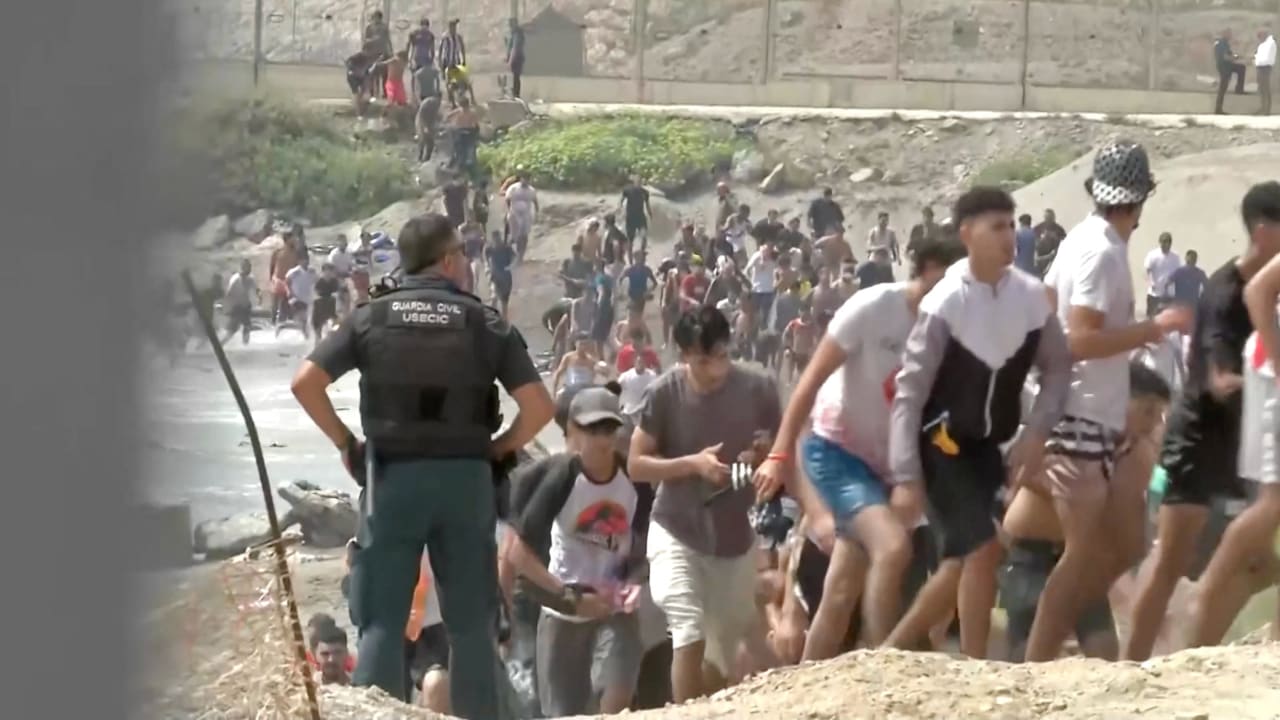
Migrants broke through the fences into Spain's North African enclave of Ceuta from Morocco on Thursday after overwhelming police at the city's breakwater, Spain's Guardia Civil said.
Video footage showed hundreds of migrants swimming over from the Moroccan side using inflatable inner tubes and other flotation devices, and others breaking through a gate in the fence and running into the city.
Nine corpses were found on Thursday, local authorities said, adding to a toll of 60 migrants who have died attempting to cross into Ceuta in recent months.
The scene was reminiscent of the crossing that occurred in May 2021, when some 10,000 people from Morocco and sub-Saharan Africa, many of them minors, entered the enclave of 85,000 people in days.
A Guardia Civil spokesperson said the migrants were "massively entering from the sea" through the Tarajal breakwater, but could not provide any estimates for the numbers.
State television TVE reported that 2,000 to 3,000 people had crossed. Reuters was not immediately able to confirm that report.

The White House on Thursday linked the migration crisis in Ceuta to policies pursued by the Spanish government, after thousands of people crossed irregularly from Morocco into Spanish territory through the border breakwater.
“President Trump has long warned Europe about the consequences of continuing to implement far-left globalist policies, such as enabling mass migration. Spain and other countries that have embraced this destructive philosophy should reverse course immediately or risk their own disappearance,” White House spokesperson Anna Kelly said in an email.
Many local shops were shuttered. Enrique Serrano, who runs a women's clothing store in central Ceuta, told Reuters business owners were organizing themselves to protect their property and families in case of possible disturbances as they believed police resources would be insufficient.
"I'm not opening this afternoon because the situation is extremely tense ... The first thing I have to do is protect my business and my family," he said, adding that when the fence was breached after midnight, hundreds of migrants rushed through in a matter of minutes.
Ceuta, together with Melilla, another Spanish autonomous city located in North Africa, represents the European Union's only land border with Africa. Both cities periodically experience surges in attempted crossings by migrants seeking to reach Europe.
Images showed some of the migrants shouting "Long live Spain" as they entered the territory.
Local government seeks state of emergency
Spain's Socialist government stands out in Europe for its pro-migrant stance, and has recently launched a program to provide legal status for some 500,000 undocumented migrants, creating an influx of applications double that number.
Right-wing parties criticized the drive, arguing it would attract more migrants to Spain, and were quick to blame Prime Minister Pedro Sanchez for allowing the situation in Ceuta to reach crisis proportions.
Conservative opposition People's Party leader Alberto Nuñez Feijoo said in a post on X: "The situation in Ceuta is desperate. The government cannot look the other way... because we are facing a national security crisis."
In a post on X, Sanchez said he had told the leader of Ceuta, Juan Jesus Vivas, that his government was "fully focused" on delivering an immediate response and preparing measures to restore normality as soon as possible, without providing further details.
Earlier on Thursday, Vivas had urged the national government to declare an emergency over the mass arrivals. The regional government wants Madrid to deploy the army to guarantee safety and close the border with Morocco.
Spain's Defense Ministry said there were no immediate plans to deploy the army.
Supreme Court ruling bars summary returns from Ceuta and Melilla
Earlier this month, Spain's Supreme Court ruled that migrants intercepted at sea while attempting to reach Ceuta or Melilla cannot be summarily returned under the enclaves' special border-rejection regime.
"It has been a slow trickle since the Supreme Court's ruling, but today has been an explosion," the Guardia Civil spokesperson told Reuters.
The Interior Ministry said it was working closely with Morocco to address the surge in irregular arrivals, having prevented thousands of migrants from illegally entering Ceuta in recent days.
It vowed to immediately deport those entering illegally, blaming people-smuggling networks for exploiting the Supreme Court's ruling to encourage undocumented migration.
Morocco's Interior Ministry did not immediately respond to a request for comment.
Migrant rights activist Zakaria Zarroqui said people were still flocking to the Moroccan city of Fnideq in an attempt to cross into Ceuta and the situation was still out of control.
Mauricio Valiente, director of the Spanish Commission for Refugees, which has lawyers working in Ceuta, said the migrants crossing into the enclave were of Moroccan and sub-Saharan origin, including families with people of different ages.
While acknowledging that the situation was chaotic, he said it "can be perfectly addressed by the Spanish state," which has sufficient capacity to receive those who may be seeking asylum.
Spain's Prime Minister Pedro Sanchez will travel to Ceuta on Friday with Interior Minister Fernando Grande-Marlaska for meetings with security forces and local authorities, his office said.