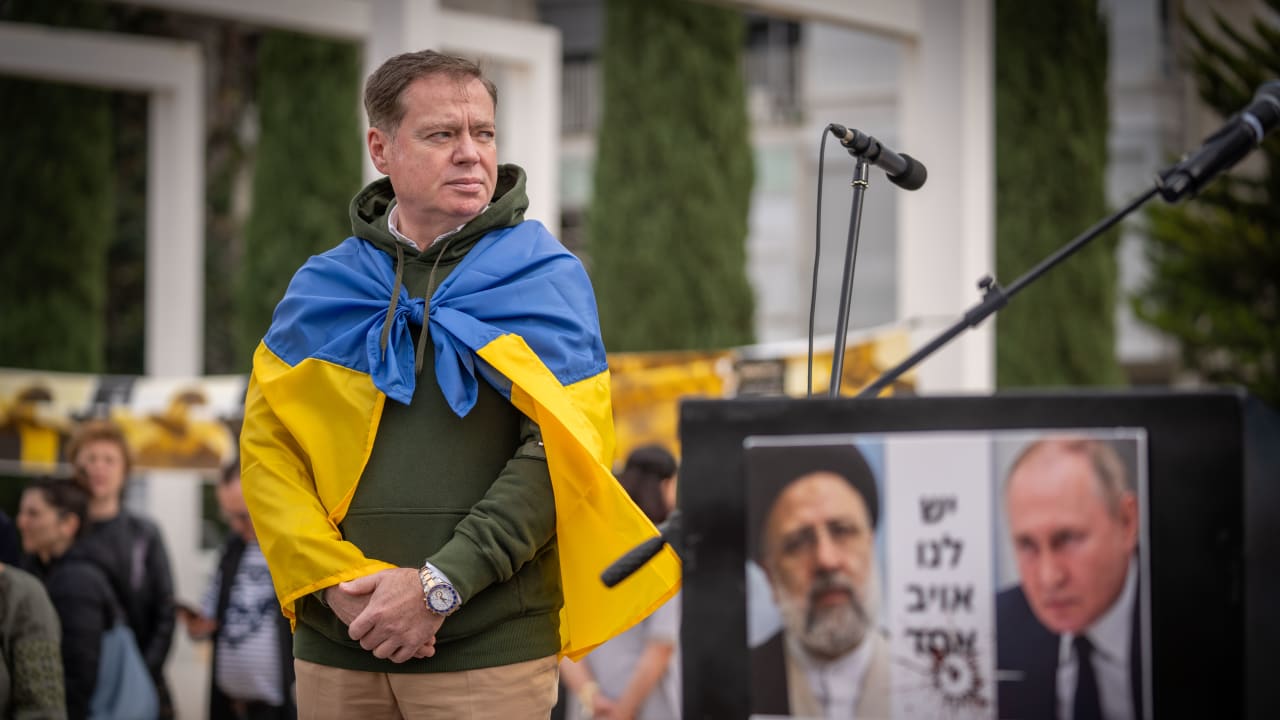
Israel must stand with Ukraine without hesitation as the two countries face similar, existential threats, Ukrainian Ambassador to Israel Yevhen Korniychuk said in an interview with Walla, marking the fourth anniversary of Russia's invasion of Ukraine.
“Russia is to Ukraine what Hamas is to Israel, an aggressive force seeking to undermine the very existence of a sovereign state, deliberately targeting civilians, and waging a limitless war against a free society,” Korniychuk said, noting that he saw a direct comparison between Russian aggression and Hamas, particularly after October 7.
He added that it is precisely because “Israel has experienced existential terror and threats to its right to exist, there is no country better positioned to understand the reality Ukraine faces,” which is why Israel “should stand without hesitation alongside Ukraine, on the right side of history.”
Regarding relations between the two countries, he said the ties are positive but incomplete and pointed to the growing engagement between them. He also highlighted the opening of Israel’s first Holodomor memorial in Jerusalem in 2025.

Peace can only be achieved int’l law
He also noted the strength and resilience of the Ukrainian people after four years of war, and expressed his gratitude to Ukraine’s allies.
“Ukraine in 2026 demonstrates a higher level of resilience and military strength, thanks to increased international support, the development of its independent defense industry, and the unique combat experience it has accumulated,” said Korniychuk.
He described the scale of Russia’s ongoing assault on civilian infrastructure using guided bombs, UAVs, and missiles, sharing that over the course of a single week in February, over 2,000 UAVs and guided bombs were launched at civilians.
Korniychuk added that Ukraine is optimistic about a peace agreement with Russia, but its desire for peace is difficult to truly believe when it continues to strike Ukraine while negotiations in Geneva are ongoing, making it "absolutely clear what Russia wants and what its true intentions are.”
In addition, he urged stronger economic sanctions against Russia and its allies, though he acknowledged that the matter depends on the "determination of the world."
According to Korniychuk, sustainable peace can only be achieved under international law, as set out in the Charter of the United Nations.
He explained that such an agreement must also include "full respect for Ukraine’s territorial integrity, sovereignty, and political independence, including Ukraine’s right to a future determined by itself," as well as security guarantees that will deter "the aggressor from future attacks.”
Regarding the United States, the ambassador rejected claims that the US position is overly favorable to Moscow, emphasizing bipartisan support for Ukraine in Congress. He further said that Ukrainian President Volodymyr Zelensky views relations with Washington as complex but strategically vital.
“American support is vital not only for Ukraine, but for European security as a whole," he said, stressing the importance of NATO and continued European involvement.
Iran’s regime change could majorly affect war
When asked about Iran, Korniychuk said that regime change could have major implications for the Ukraine-Russia War.
Korniychuk reaffirmed Ukraine’s support for the Iranian people and their protests against the regime, and condemned Russia and Iran’s cooperation, “particularly the supply of Shahed UAVs by the Iranian regime to Russia and the transfer of licenses for their production.”
“Such a partnership poses a real threat not only to Ukraine, but to the entire region,” he said, citing reports estimating Iran’s military exports to Russia at $3 billion.
He added that Ukraine has formally designated Iran’s Islamic Revolutionary Guard Corps (IRGC) as a terrorist organization, and that Kyiv and Jerusalem have begun a strategic dialogue on Iran, focusing on security cooperation.
“Ukrainians demonstrate optimism even in the most difficult times, expressed in their belief in a better future and in confidence in their children’s future,” Korniychuk concluded. “Despite danger and instability, most citizens feel that progress is taking place and believe in the possibility of a better, independent, and secure life in Ukraine.”
“And therefore we very much hope to meet you next year in Crimea, in Luhansk, and in Donetsk under the Ukrainian flag… Slava Ukraini!”