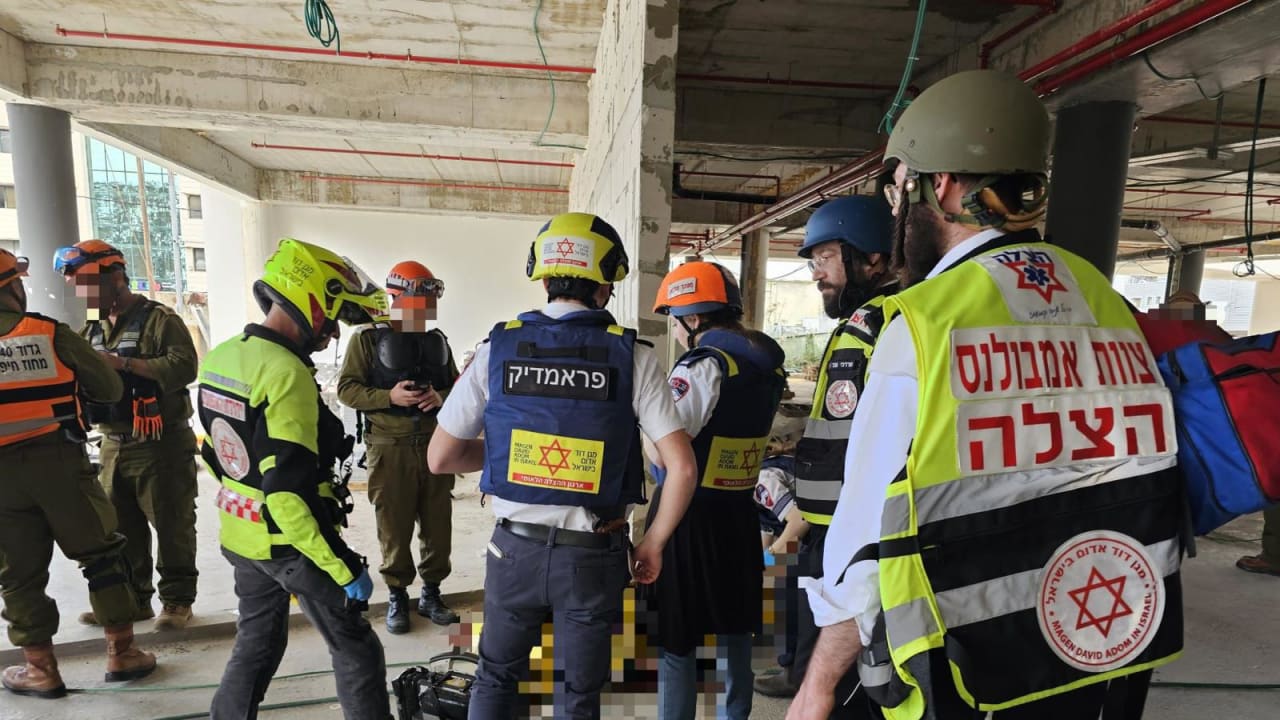
Two people were killed, and multiple others were seriously wounded during one of several Iranian ballistic missile barrages toward central Israel.
MDA had confirmed the death of the first victim on Monday afternoon, while the second, who was injured at the construction site, was later pronounced dead in the hospital, Israeli media reported on Tuesday.
The name of the first victim was Rustam Golomov, 62, a resident of Petah Tikva; the name of the second victim has yet to be released.
Cluster munitions were reportedly used by Iran, with around half a dozen sites hit.
In some of the locations that were hit, no early warnings or rocket sirens were sounded, and IDF Spokesperson Brig.-Gen. Effie Defrin said the military was reviewing what might have gone wrong.
In the past, cluster munitions or missiles that otherwise broke apart sometimes confused IDF warning systems looking for a full-sized missile.
The individual who was killed was found and declared dead at the scene after resuscitation efforts. He and one of the wounded are Chinese foreign workers, according to Israeli media outlet N12.

One of the wounded was evacuated from a construction site in serious and unstable condition to Sheba Medical Center in Tel Hashomer, MDA said.
“Immediately after the sirens, we received reports at MDA about several scenes in central Israel and were dispatched to search them all,” MDA paramedic Liz Goral said. “One of the scenes in central Israel was at a construction site. It was a difficult scene. The two casualties were lying unconscious and suffering from severe shrapnel injuries to their bodies.”
“After performing resuscitation efforts, we had to pronounce the death of a man, approximately 40-years-old, and we evacuated the second casualty in serious condition by Mobile Intensive Care Unit to the hospital.”
A second seriously wounded individual was also being evacuated with shrapnel wounds to Sheba Medical Center from a separate site in central Israel.
IEC says electricity infrastructure damaged by missile barrages, drones
The Israel Electric Corporation also noted that electricity infrastructure had been damaged at several locations across northern and central Israel after the recent missile barrages and drone intrusions. Power outages have been reported in multiple locales as a result.
Teams from the corporation are working to identify the damage and restore power.
All of Monday’s missile impacts occurred despite the IDF’s progress in reducing the volume of daily rocket fire from the earliest days of the war.
Defrin said on late Monday night that two civilians had been killed, but the IDF later said that was an error.
According to the military, the IDF has begun a new wave of strikes against the Iranian regime’s infrastructure across Tehran, Isfahan, and, strangely, in southern Iran, which has mostly been the US’s responsibility.
It was unclear if there were any broader strategic implications to Israel's attack in southern Iran in addition to US operations there.
At press time, some reports had said that the US has cut back on its airstrikes, while Israeli airstrikes have been cut back significantly from 1,000 bombs per day to likely between half and one-third that amount as the IDF readies itself for a potentially longer conflict.
US Central Command (CENTCOM) is expected to give a more comprehensive update later on Monday. No Israeli update was given.
Earlier on Monday, the IDF revealed it had struck several long-range ballistic missile launch sites and military infrastructure belonging to the Islamic Revolutionary Guard Corps (IRGC).
The regime’s Internal Security Force’s headquarters in Isfahan was struck, as well as the IRGC’s police force’s headquarters, a base belonging to the Basij militia, and a production facility for rocket engines, the military added.
The IDF later reported that the military had targeted an IRGC UAV headquarters, from which the Iranian regime had launched drones toward Israel and was storing more for future attacks.
“The combined effort to further degrade the regime’s firing capabilities and defense capabilities continues at this moment,” the military statement added, “alongside the continued expansion of strikes on the ballistic-missile production infrastructure throughout Iran.”
The IDF also gave details about additional attacks against 16 aircraft used by the IRGC to export terror throughout the region.
Also, the military has struck six different airports and runways in Iran.
Defrin said that, to date, around 1,900 regime fighters had been killed.
Earlier in the war, IDF sources had estimated the number at multiple thousands. It was unclear what caused the discrepancy.
Jerusalem Post Staff contributed to this story.