
Iran’s launch of a ballistic missile over a distance of around 4,000 km., shattering the 2,000 km. range that much of the world hoped it would stay under, likely involved a two-stage satellite-like launch process, former IDF air defense chief Brig.-Gen. Ran Kochav told The Jerusalem Post on Sunday.
Kochav said that the launch had “doubled the demonstrated capability overnight” of what Iran could do when it targeted the joint UK-US base at Diego Garcia in the Indian Ocean.
Echoing IDF Chief of Staff Lt.-Gen. Eyal Zamir’s statement on Saturday night that the additional distance probably stemmed from a launch vehicle that used multiple stages, Kochav noted that Iran has been working on such two-stage launch technologies for years to try to launch satellites into space.
Both Israel and the US have warned that Iranian satellite tests could turn out to have dual-use elements, leading to intercontinental ballistic missiles (ICBMs), both conventional and nuclear. While the Islamic Republic has long denied this possibility, Saturday’s launch has likely exposed a clandestine program it has operated for years for precisely such purposes.
Discussing different scenarios, Kochav, who was later also the IDF’s chief spokesman, said that it was possible that the kind of missile used might be a modified USSR-era R-27 ballistic missile. The R-27 was mainly fired by the USSR from submarines and potentially had nuclear capabilities, but Iran could have modified it to launch from a land-based platform.
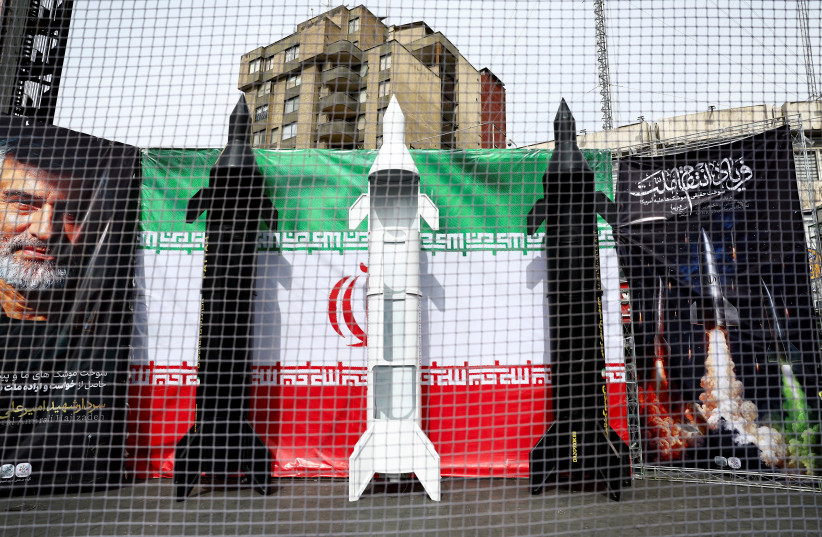
Kochav stated that North Korea has used a missile based on a similar technological background, which has proved capable of reaching around 3,000 km. If the missile came from the R-27 family, he said it would typically carry a warhead of 1.5-2 tons of explosives.
According to Kochav, one way the missile’s range could have been extended from 3,000 to 4,000 kilometers is if a clandestine program worked on launching the missile with a much lighter warhead. In other words, if the warhead is lighter, then the missile is lighter and could travel farther in a shorter time using the same amount of energy and a similar launch process.
Another possibility that has been discussed is a modified Khorramshahr-4 class.

Every European country now within Iran's reach
Tehran has long claimed a maximum range of approximately 2,000 km.
“From an engineering standpoint, ballistic missiles exit the atmosphere into exo-atmospheric flight before reentering,” Kochav explained further.
Moreover, he said that “trajectory physics means they [the missiles] can strike from any azimuth – north, east, west, or south – rendering directional origin irrelevant. Consequently, London, Paris, Berlin, and every other European capital now lie within credible Iranian reach.”
Significantly, Zamir had named Paris and Berlin, but Kochav added in London as also being in range.
“This escalation fundamentally alters the threat calculus: The Middle East is no longer a geographically contained theater. Europe must treat Iranian ballistic capability as a direct continental risk,” said Kochav.
Further, he said that regarding UK defenses, the country “possesses sophisticated naval assets able to deploy SM-3 interceptors and participates in NATO integrated air and missile defense.” However, he added that “it currently lacks a dedicated, ground-based exo-atmospheric layer comparable to Germany’s operational Arrow-3 batteries (first deployed late 2025, with major expansion under contract).”
Broader NATO and EU coverage remains uneven and insufficient against saturation or long-range strikes, warned Kochav, emphasizing that “the era of strategic complacency has ended.”
To reach the US, Iran would need to extend its missiles’ range to 10,000 km.
But if Iran has mastered a two-stage launch capability into space, it would not be difficult to extend the range of an ICBM once multistage technology has already been developed.
One unanswered question is how Israel missed this particularly threatening long-range missile for three weeks.
On March 16, in an extremely rare public statement, an IDF intelligence official from Unit 9900 said that Israel destroyed an Iranian base that was focused on building technologies to shoot down satellites belonging to Israel and other adversaries. According to the officer from the IDF’s clandestine satellite intelligence division, the goal of the attack was to maintain Israel’s supremacy in space, especially regarding satellite surveillance.
The site was used to develop Iran’s Chamran-1 (a low-earth-orbit technology demonstration satellite), built by the Iranian Defense Ministry’s electronics industries and launched into space with a rocket built by the Islamic Revolutionary Guard Corps in September 2024, Iran’s state-run media reported at the time.
The report described the event as the second comparable launch to place a satellite into orbit with the rocket.
At the time, Tehran identified the satellite-carrying rocket as the Qaem-100, which the IRGC used again in January for another successful launch.
The solid-fuel, three-stage rocket reportedly put the Chamran-1 satellite, weighing 60 kg. (132 pounds), into a 550-km. (340-mile) orbit.
The US intelligence community’s 2024 worldwide threat assessment warned that Iran’s development of satellite launch vehicles “would shorten the timeline” for it to develop an ICBM.
The IDF, on March 8, attacked the IRGC’s Aerospace Force Headquarters for launching satellites, technology with potential dual use for incorporation into future attempts to develop nuclear weapons, which could be fired long-range into space and hit the United States.
The headquarters had been used by the IRGC to promote its aerospace efforts, including the 2022 launch of the Khayyam satellite, successfully launched by Iran using a Russian Soyuz rocket from the Baikonur Cosmodrome in Kazakhstan.
Given all of the energy the IDF has invested in striking aerospace facilities, it is unclear why it missed this particular missile, other than the possibility that Iran succeeded in concealing the missile’s existence from Israel.