
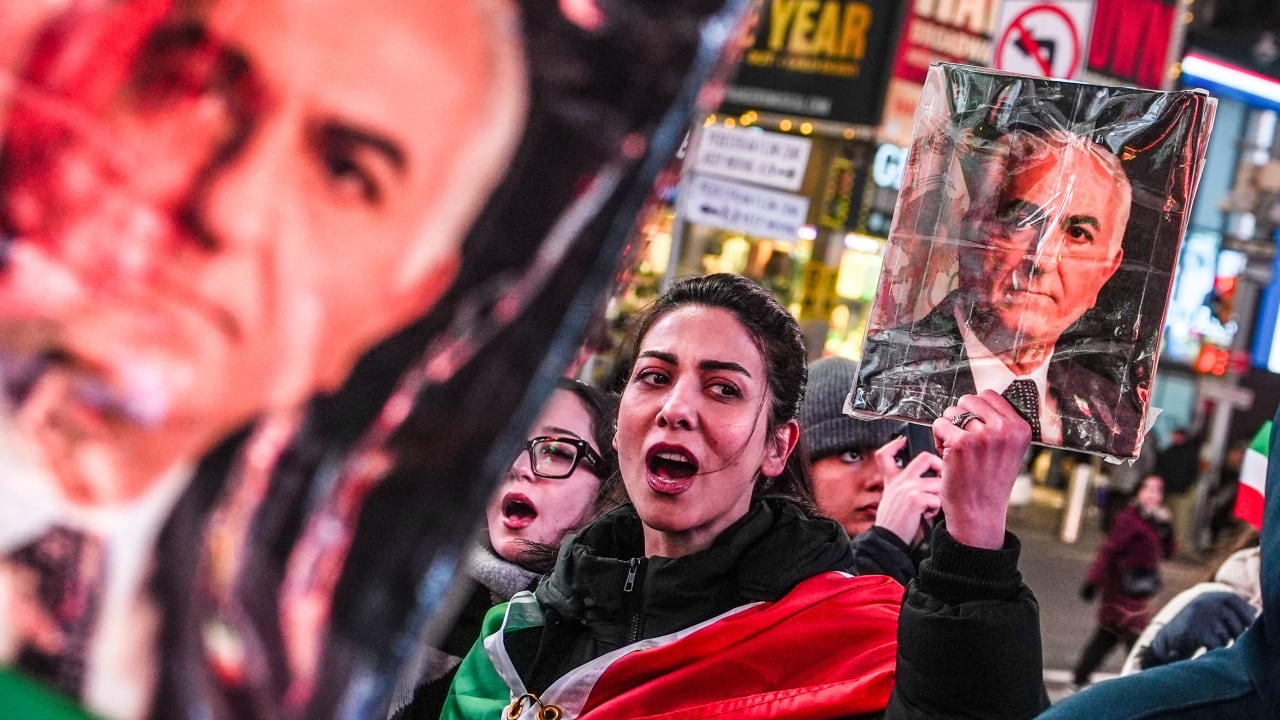

For weeks before the first strike, Iranians were glued to their screens with the focus of seasoned analysts. Social media, broadcast media in the diaspora, and living rooms across the country were buzzing with specifications of US aircraft carriers, the number of fighter jets deployed, the movements of American forces across the region, statements made by American and Israeli officials, and anticipation for the beginning of the attacks.
By the time the bombs fell, the attack was not a surprise. It was, for many, the moment they had been waiting for.
After initial denial, by Sunday morning, the government platforms confirmed that Iran’s former supreme leader, Ayatollah Ali Khamenei, and several members of his family were killed in an air strike.
Sources inside the capital report that Tehran, on the surface, looks almost ordinary. Shops are open. Streets are passable. But something has shifted in the air. The city is quiet, not with grief, but with a kind of electric, watchful anticipation. People are not out and about in large numbers, yet those who are carry what a source described as “a radiant look.”
“As if, for the first time in years, they are permitting themselves to hope,” the source added.
Hope for change
The hope for change was ignited the moment the war broke out, but the death of the supreme leader prompted a moment of celebration for many.
“The second we heard the news, people started whistling, clapping, and screaming with joy from their windows,” recounted several Tehran residents. “Neighbors were congratulating each other across the alley; some were chanting slogans, others were screaming with happiness.”
Despite wartime warnings and the roar of distant strikes, in some parts of the country, people went outside to celebrate. Phones lit up across the city with calls of congratulation.
A source residing in the suburbs on the outskirts of Tehran reported on Sunday morning: “I have not seen any sign of mourning in public. Our local mosque was holding a ceremony and the speakers were pouring sound into the street – but that was it.”
They shared screenshots of messages they had received from the government, inviting all citizens to go to their local mosques for “mourning for our martyred leader, and in defense of our beloved Iran,” using elevated nationalist language to provoke emotion and maximize attendance.
The overall public mood stands in sharp contrast to the official narrative the Islamic Republic is desperate to project. Regime supporters do exist, but the true scale of their numbers is difficult to gauge from inside or outside the country.
The regime seeks to flood social media with videos of mourners for Khamenei. If it feels sufficiently safe from airstrikes, the government will almost certainly attempt to stage large public gatherings across Iran – a carefully managed display of mass mourning for foreign audiences, designed to reinforce the image of Khamenei as a beloved and popular leader. It is a familiar playbook.
Whether the streets will cooperate is another matter entirely. The authorities have done this before. After previous uprisings in which protesters were killed, the state provided safe passage, transportation, and free food to mobilize pro-regime rallies, projecting an image of stability to Western media. They did the same after IRGC commander Qassem Soleimani’s death: a man loathed by millions inside Iran was portrayed as a “national hero” by much of the international media. This time, many believe, will be no different.
Lost legitimacy
For many Iranians, however, the regime lost its legitimacy years ago. Yet, the joy that the Islamic Republic may collapse is inseparable from years of accumulated pain. Families of those killed during the 2019 and 2022 protest crackdowns, or executed for political dissent in recent years, have been openly celebrating on social media, posting videos, sharing messages, and naming the victims alongside expressions of relief. For them, this is not merely a political moment. It is deeply and irreversibly personal.
The regime is clinging to its old repression strategies even as the war unfolds. One of the more darkly comic observations to emerge from inside Iran concerns the security response in the first days.
“They set up multiple checkpoints across the cities,” said several residents, barely concealing their amusement. “Which is truly ridiculous. While Israel and America are attacking from the air, these guys are on the ground searching cars. Nobody knows what they’re even looking for.”

It is the image of a system still reaching for the levers of control even as the architecture around it shakes – a display of the regime’s fear of its own people.
That architecture, built on 47 years of theocratic rule, fear, ideology, and oil wealth, is what many Iranians inside and outside the country now believe is finally cracking. People have such confidence in the precision of Israeli strikes that, even at the height of the attacks, some went up to their rooftops to watch which base or installation had been hit. They follow the news not with dread, but with the focus of people tracking a score.
“Everyone is just waiting to hear the news of each of these figures being taken out one by one,” said the Tehran source. “We know we are winning and soon we will celebrate our freedom.”
Whether that freedom materializes depends on questions being decided far from those rooftops. The constitutional process for replacing Khamenei – via an interim council – has been set in motion, even as much of the security apparatus’ chain of command has been dismantled.
Three futures now compete: a genuine collapse that opens space for transition; consolidation by the Revolutionary Guard into a harder authoritarianism; or a deal with Washington that preserves the coercive apparatus in exchange for cosmetic concessions – a scenario many fear as a slide into Venezuela-style stagnation.
Wave of hope
Inside Iran, none of these geopolitical calculations fully capture the texture of what is being lived. The wave of hope, as one source put it, has been reawakened.
After the horrific violence of recent protests, the country has taken on a feeling residents describe as something they had almost forgotten: the sensation of a future that might be different from the present. People are waiting, they say, for the moment, the signal, to pour into the streets and make it real.
The dominant chant among protesters inside Iran and in the diaspora has been unambiguous: “This is the last battle; Pahlavi will return.”
The slogan reflects one strand of a society that is, in truth, plural in its hopes. Some want the return of monarchy, not necessarily out of nostalgia for a dynasty, but for what it represents: an Iran once associated with culture and civilization rather than terrorism and isolation.
Others want a liberal democracy, fearing that any single figure or institution handed unchecked power risks becoming another form of authoritarianism.
Indeed, there are those who will continue to fight for the Islamic ideology that brought the country to this moment – a reminder that the path ahead will not be without contest.
What unites most Iranians, across these divides, is the belief that something irreversible has begun. After five decades, the question is no longer whether change will come, but what shape it will take – and how the people can have a say in it. ■
Sara Bazoobandi is a member of MENA2050 and a non-resident researcher at the Institute for Security Politics and Kiel University, Germany.