
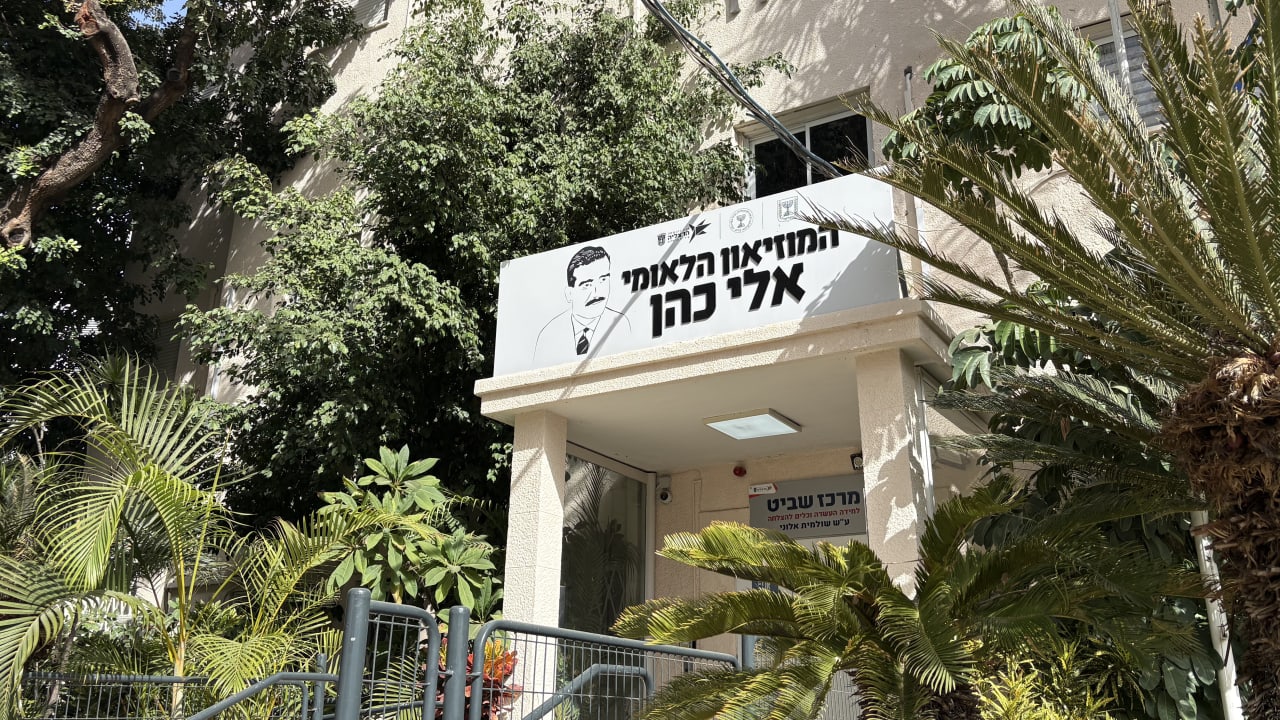

The ascent to the Eli Cohen Museum begins in a narrow building in Herzliya. Three staircases. Round and round, step after step, until the noise of the street falls away. At the top, a wood-paneled room wrapped in shelves. Papers and photographs line the walls. The space feels enclosed, deliberate – as if we are entering a secret place.
Secret, like the man at its center, whose life unfolded behind layers of concealment, the museum reveals itself slowly. Screens descend from above. The lights dim. An introductory video presents a national story first – strategy, borders, intelligence – before the personal one about the famous spy whose story continues to intrigue the nation, and beyond.
The Eli Cohen Museum opened on December 12, 2022. It now offers its first English-language tours devoted to the Israeli spy’s life, expanding access to the documents and artifacts behind one of Israel’s defining intelligence operations. For now, it is the only public space in Israel offering an English-language tour dedicated solely to his story.
This is where Eli Cohen’s life begins again – on paper, in photographs, in objects.
“It’s not just the case study of one person,” museum guide Lili Shasha told The Jerusalem Report on the magazine’s recent visit.
“Through his special story, you can tell a very big story,” she said.
Alexandria to Damascus
Eliyahu Ben-Shaul Cohen was born in Alexandria, Egypt, in 1924, to a devout Jewish family. His father had emigrated from Aleppo, and the household was steeped in Zionism and Syrian Jewish tradition.
When his family moved to Israel in 1949, Cohen remained in Egypt to complete his studies and assist in Zionist activity. He was arrested and interrogated by Egyptian authorities but was released due to lack of evidence. After the 1956 Suez War, he was expelled from Egypt and arrived in Israel in early 1957.
Artifacts in the museum’s second room trace that early life: the weathered suitcase from Alexandria, passport pages, immigration papers.
In 1959, he married Nadia Majald. Searching for direction in life, he applied to the Mossad but was initially rejected because of his prior arrest in Egypt.
As tensions between Israel and Syria escalated, the Mossad recruited him in 1960. He underwent six months of intensive training. Memorization skills and an ability to operate alone marked him as a strong candidate. Nathan Salomon, his instructor at the time, later said: “He proved himself in a remarkable way.”

Cohen was given a new identity: Kamal Amin Thabet, a Syrian-born businessman who had built a textile fortune in Argentina. He relocated to Buenos Aires in 1961 to establish his cover story, and then moved to Damascus in February 1962.
He did not rush. He listened. He hosted. He built relationships with senior officers and ministers.
The cost of secrecy
For years, Cohen’s family believed he was traveling abroad on business for the Defense Ministry. They didn’t know he was living deep undercover in Damascus.
Through his relationships with senior Syrian officers and ministers, Cohen gained access that few outsiders would have reached. During a visit to a fortified Syrian position in the Golan Heights, he offered a suggestion: plant trees to give soldiers shade. The cover, he said, would also signal to Israel that there was nothing in the area.
During the Six Day War in 1967, those trees served as markers for the Israeli Defense Forces.
Syrian intelligence began suspecting a leak after experiencing multiple strategic losses, such as the water diversion scheme, an Arab League-approved initiative led by Syria, to divert water away from Israel’s National Water Carrier.
In January 1965, Syrian counterintelligence, assisted by Soviet tracking equipment, traced unauthorized radio transmissions to Cohen’s apartment. He was arrested mid-broadcast, interrogated, tortured, and tried by a military tribunal.
According to a video played in the museum, when Cohen was asked during his trial whether he was a spy, he answered, “I am a messenger of my country, the State of Israel.”
On May 18, 1965, he was hanged in Marjeh Square in Damascus. The execution was broadcast on Syrian television. Syria refused repeated requests to return his body to Israel.
Reports last year claimed that Cohen’s remains could be returned amid ongoing talks between Damascus and Israel. This came due to the collapse of the long-ruling regime of Hafez al-Assad from 1970 until 2000, and then by his son, Bashar al-Assad, until December 8, 2024.
Syrian officials denied a pending handover, and the matter remains unresolved.

The archive returns
In May 2025, the Prime Minister’s Office announced that roughly 2,500 items from the Syrian intelligence archive on Eli Cohen had been brought to Israel in a covert Mossad operation. The materials – held in Syria since Cohen’s arrest in 1965 – include letters, photographs, forged passports, operational documents, and personal effects. Among them was his original will.
Some of the items were presented to Cohen’s family during a ceremony marking 60 years since his execution in Damascus. The full archive is now in Israel.
One artifact already on display predates that operation: Cohen’s wristwatch, retrieved from Syria in 2018. Then-Mossad director Yossi Cohen presented it to the family in a ceremony; details of how it was obtained were not disclosed.
The Mossad is still examining the newly recovered materials, and the museum is waiting to see what may be turned over to them.
“The returned artifacts are still being checked,” Shasha said. “We hope to get some – when and if.”
The English tour is still in its infancy. The decision to offer it, Shasha said, was made long ago, but translation, staffing, and budget delayed its launch.
“We’re hoping to have it in different languages – not just in English,” she said, adding that there are hopes to expand the museum’s physical space in the future.
“When you learn the story,” Shasha said, “you learn a little bit of the history of Israel.”
Back downstairs, the street noise resumes. Upstairs, the record remains – paper, photographs, objects – steady and unadorned. For now, this building is the only place in Israel where English-speaking visitors can encounter the documentary of a man who lived behind a constructed identity.■