
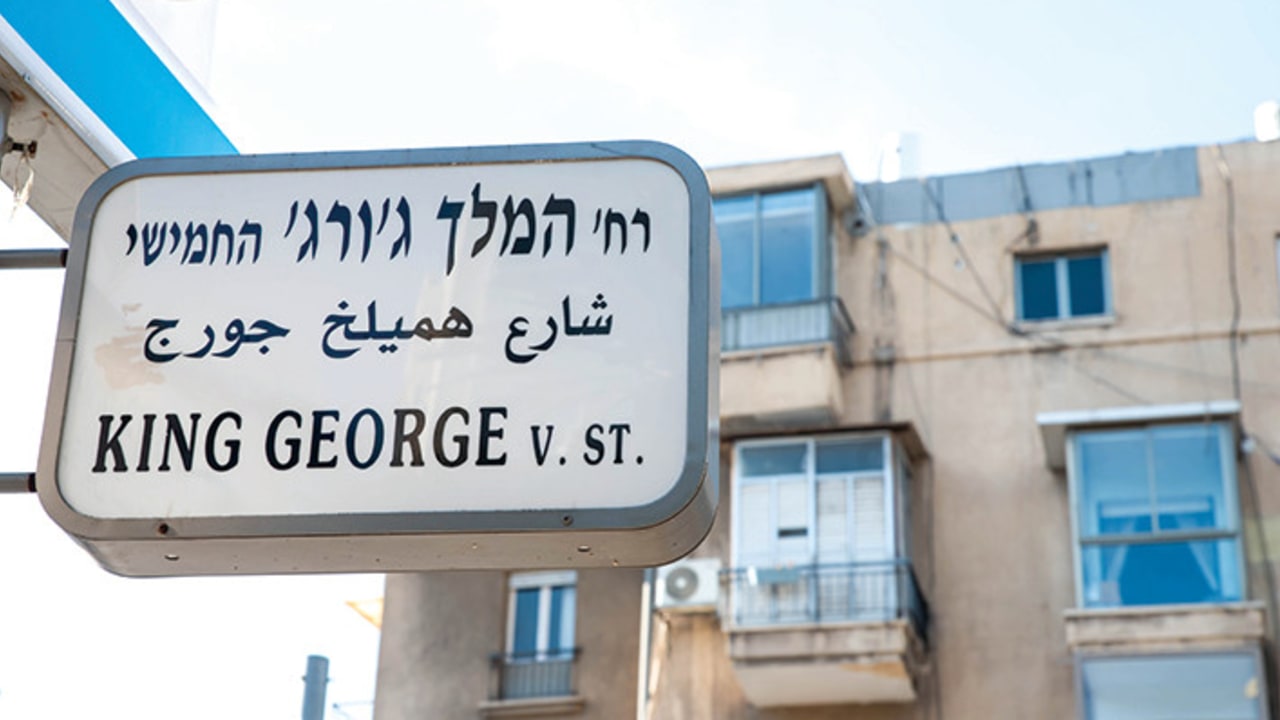

Visitors to Jerusalem walking down King George Street might well be struck by the incongruity of the situation. Why is one of the major thoroughfares in the eternal Jewish capital named after the long-dead monarch in the faraway nation of Great Britain?
A similar thought might occur when they visit Tel Aviv, where there is also a King George Street. And don’t both Tel Aviv and Haifa boast an Allenby Street?
What many visitors, both Israeli and not, might not know is that Allenby commemorates General Edmund Allenby, who, as commander of the British forces that captured Palestine in 1917, oversaw the initial military administration that gave practical effect to the Balfour Declaration.
Seesaw relations
But that provides the rationale behind those street names.
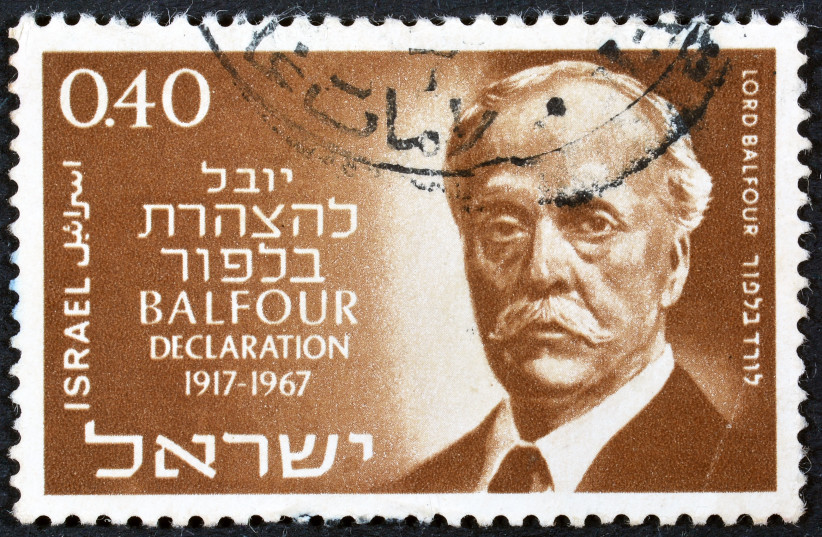
It was during the reign of King George V of Great Britain that the Balfour Declaration was issued – that seminal document in Israel’s story affirming that “His Majesty’s Government” (King George) supported the establishment of a national home for the Jewish people in what was then known as Palestine.
Accordingly, it is not surprising that there is also a Balfour Street in Jerusalem, Tel Aviv, Haifa, and in a dozen more towns, including Rishon LeZion and Petah Tikvah. In fact, the British connection runs so deep that Israel has preserved it in concrete.
No nation on earth has been more involved with the realization of the Zionist dream than Great Britain, even though that relationship has been like a seesaw – now up, now down; now sweet, now bitter.
The period during which Zionism as a political movement was born and developed happened to coincide with Britain’s heyday as a leading world power, and Britain was a major player in the events that brought Israel into existence.
Sour relations
The sweetest moment in that intimate relationship came on November 2, 1917, when the UK’s Foreign Secretary, Lord Balfour, wrote to one of the leading figures in Britain’s Jewish community, Lord Rothschild, asking him to “bring this declaration to the knowledge of the Zionist Federation.” (Interestingly, Rothschild also has a street, or rather a boulevard named after him in Tel Aviv.)
The document became known as the Balfour Declaration. Subsequent events may have taken the shine off this magical moment in British-Zionist relations, but nothing can diminish its significance in Israel’s history.
Despite distressing, hurtful, and even iniquitous actions by some British governments since the Declaration – and especially the anti-Israel stance of the UK over the Gaza conflict – there has been no attempt within Israel to expunge those British names from its cities and towns. The connection is simply too deep to be swept aside.
But the relationship has undoubtedly turned bitter.
Although the League of Nations mandated Great Britain to establish a national home for the Jewish people in the region then known as Palestine, Israel had to fight sustained Arab violence for much of the Mandate period, and finally, for its right to exist.
Resentment still runs deep at the UK’s 1939 decision, in response to Arab pressure, to close Palestine to most Jews fleeing Nazi Europe. Britain capped Jewish immigration at 75,000 over five years, and stipulated that any further immigration after 1944 would require Arab consent.
That framework remained in force throughout the Second World War. Even as the Holocaust unfolded, Britain maintained its strict limits on Jewish immigration.
The unkindest cut of all was administered by Britain’s Labour government after the end of the Second World War. Its Foreign Minister, Ernest Bevin, could find no compassion for the tens of thousands of Holocaust survivors left without family or possessions who yearned for a future in Palestine. He insisted on maintaining the restrictive immigration policy.
As a result, Britain intercepted some 40 “illegal” immigration ships, and interned more than 50,000 Jews – largely Holocaust survivors – in 12 detention camps in British-ruled Cyprus.
Especially remembered is the notorious incident of the “Exodus 1947,” later immortalized in Otto Preminger’s film Exodus.
Carrying around 4,515 Jewish refugees, “Exodus 1947” sailed from southern France in July 1947, bound for Palestine. Intercepted by Royal Navy destroyers, there was a violent struggle, and two passengers and a crew member were killed.
London decided to make an example. The refugees were transferred to three deportation ships, which returned to France. After the passengers refused to disembark, they went on to Hamburg in the British zone of Germany, where, in September 1947, the refugees were forcibly disembarked and sent to camps under German police guard. A bitter moment indeed.

Today, British-Israeli relations do not seem to be in good shape.
When details of Hamas’s attack on Israel on October 7 first emerged, Sir Keir Starmer, then leader of the Labour Party, stood shoulder-to-shoulder with then-UK prime minister Rishi Sunak, then-US president Joe Biden, and most Western political leaders, in proclaiming Israel’s right to defend itself.
Unfortunately for Starmer, his moral stance was not acceptable to two entities he faced on his own political terrain. One was the powerful hard-left element within his party; the other was the strong Muslim presence in some Labour-held constituencies.
When the International Criminal Court (ICC), alleging war crimes and crimes against humanity, issued arrest warrants for Prime Minister Benjamin Netanyahu and former cabinet minister Yoav Gallant in November 2024, Starmer declared that the UK “respects the independence of the ICC,” and indicated that Israel’s prime minister would face arrest if he entered the UK.
Further hardening of Labour government policy followed. In July 2025, Starmer announced that he intended to recognize the non-existent State of Palestine, and on September 21, he did so.
British-Israeli relations would appear to be at rock bottom. But things are not entirely as they seem. In fact, a close relationship has persisted throughout the Israel-Hamas War, cemented through integrated defense and intelligence collaboration, and backed by an expanding trade profile. Compared with the year to mid-2024, bilateral trade rose in 2025 by 3.4%.
Moreover, legal, institutional, and cultural affinities remain deep, and Israel is perceived in official UK policy as a “strategic partner” and “tier one” cyber ally.
In fact, the relationship remains as it ever was: bittersweet.■
The writer, a former senior civil servant, is the Middle East correspondent for Eurasia Review. Follow him at: www.a-mid-east-journal.blogspot.com