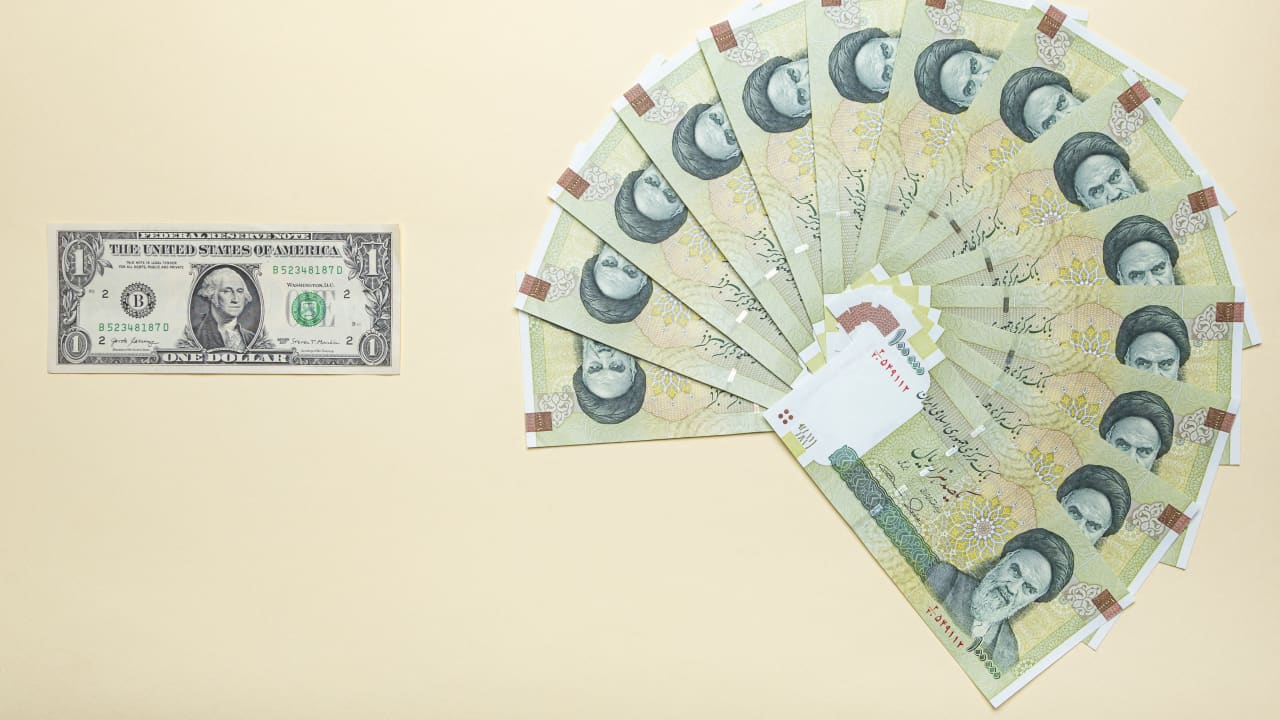
Iran’s economic crisis is not a new grievance. It is one of the reasons people have continued to return to the streets to express their unhappiness for years. What is changing is the pace of the breakdown and the state's response with emergency measures in response to how far the rial has fallen.
Iran’s central bank began distributing a 5,000,000-rial “Iran-cheque” on Sunday, describing it as a step to “facilitate the circulation of cash” and speed up everyday transactions. At an exchange rate of about 1.6 million rials per US dollar, the new 5 million rial note is worth roughly $3.10.
“The regime has failed the Iranian people on every aspect of their life, such as the economy, and the situation is very bad,” Saeed Ghasseminejad, an Iranian economist and senior financial economics adviser at the Foundation for Defense of Democracies (FDD) told The Jerusalem Post, explaining that the exchange rate has become a blunt indicator of institutional failure. “In 1979 [after the revolution], the dollar was 70 rial. Now it’s 1.6 million rial.”
On January 29, Iran International reported that bank branches were facing “growing shortages of cash,” citing Iranian media reports of informal daily withdrawal caps of 30 million to 50 million rials per customer (about $18–$30).
For Ghasseminejad, the country's finances are one of the core reasons for people’s dissatisfaction. That the state can still generate revenue, but the public sees little benefit. “Iran has been exporting billions of dollars over the past few years, but you don’t see it in people’s lives,” he said. “The money doesn’t go to the people. It goes to the regime’s insiders.”

He described a system shaped by incompetence, corruption, and priorities that divert resources away from ordinary households.
“A lot of this money is going to finance the regime’s proxies, the nuclear program, the ballistic missiles program, and finance the oppression machine,” he said. That point, he stressed, is long-standing. Years of funding armed groups such as Hezbollah in Lebanon and the Houthis in Yemen have been one element of a wider structure in which Iranians “get next to nothing” from national wealth, while security institutions and insiders are protected first.
Ghasseminejad argued that since 2017, protests triggered by specific shocks, such as fuel, wages, and price rises, have now turned into direct demands for regime change. “People have understood since 2017 that this regime must go,” he said.
One example is December’s fuel price hike. The regime implemented a long-planned fuel price increase, introducing a new three-tier pricing system after weeks of delay and years of political hesitation due to fear of public response.
The plan, first announced in November, raised prices for “high-volume consumers” while leaving most households’ subsidized quotas intact. Motorists who exceed 160 liters (about 42 gallons) of gasoline per month will now pay 50,000 rials per liter, up from 30,000. Eighty percent of households are expected to continue receiving subsidized fuel for most of their monthly needs.
Iranian public sees no path to recovery with kleptocratic government
Ghasseminejad explained that the Iranian public increasingly sees no normal recovery path while the Islamic Republic’s governing model remains intact. “The Iranian people know that as long as this regime exists, the economy is not going to get better,” he said, calling the system “extremely corrupt” and deeply incompetent.
The Islamic Republic regime is often described as a “kleptocracy,” due to the siphoning of funds to regime insiders and the monopolies they hold over trade. One of the biggest proofs of the regime’s corruption is the question of who controls the oil revenue
“In December, Iran exported 1.5 million barrels per day, and in January, that number is again 1.5,” Ghasseminejad told the Post. “They usually exported around 1.8-2 million barrels per day in the previous months. So it’s like a 20–25% decrease.” He added that if enforcement escalates against tankers due to sanctions, the volume could fall faster.
“If the United States decides to actually confiscate these tankers, that can quickly go down.”
That decline matters because in today’s Iran, oil revenue isn’t simply “state revenue” in the normal sense. Large portions of the oil economy are deeply entangled with the Islamic Revolutionary Guard Corps (IRGC) and its affiliated networks.
Over the past two decades, the Guards’ engineering and business arms have embedded themselves across the energy sector, winning major oil and petrochemical projects and building leverage over critical infrastructure. US Treasury reporting has said Iran’s Ministry of Petroleum awarded the IRGC-linked Khatam al-Anbiya Construction Headquarters multiple oil and petrochemical projects worth tens of billions of dollars.
There have also been numerous investigative reports that the IRGC is expanding operational control over exports, including sanctions-evasion logistics, shipping networks, and front companies, to keep crude flowing despite sanctions, particularly into China. In that model, exports are an engine of cash for security institutions, including the Guards’ external arm, Quds Force, and a mechanism for keeping regime insiders rich even as the broader economy deteriorates.
The economic crisis in Iran is also impacted by the state’s own tools of repression. Coercion is expensive. Ghasseminejad pointed to signs of strain inside the system itself, saying there were reports of “significant protest among the police forces about their salary,” and arguing that worsening economic conditions make it harder to keep the repression machine functioning smoothly.
“The regime is so greedy that I don't think they are going to take from their own pocket” to help the people, Ghasseminejad said.
Iran’s economic collapse is tightening the regime’s room for maneuver. It is expanding the pool of citizens who feel they have nothing to lose from standing against the regime that has led them to a dire financial situation. The state may attempt visible, short-term fixes to persuade the people, but day by day, as the rial’s value declines, the number of those who want to see the regime’s end grows.