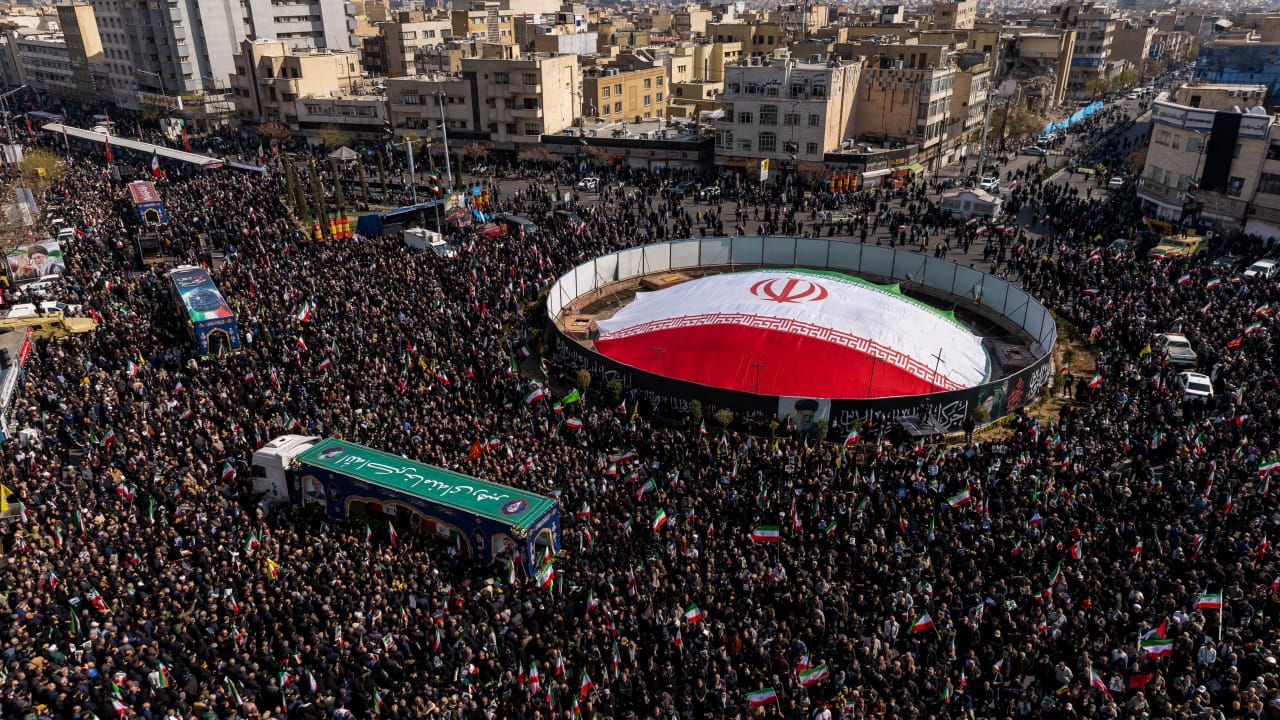
Crowds gathered to celebrate in Iran as the Islamic regime launched ballistic missiles toward Israel, destroying the period of relative calm since the pause in hostilities since April, according to footage released by the Islamic regime.
Celebrations were seemingly held in Tehran and Kermanshah, where crowds were recorded waving the regime’s flag alongside the flag of Hezbollah, a Lebanon-based arm of the IRGC.
The Islamic regime attacked Israel late on Sunday night and early on Monday morning, claiming the missile barrage was retaliation for Israeli strikes in Lebanon. Israel began targeting Hezbollah positions after the group violated an existing ceasefire by launching attacks in response to the killing of Ayatollah Ali Khamenei
The Iranian state-linked news site Tabnak shared videos of individuals driving through the streets, honking their horns in celebration and screaming “Allahu Akhbar” (God is most great).
In a video published by NBC News, one civilian claimed that the celebrations were to show a sense of “pride” that Iran’s missile capabilities “still exist” despite months of war with both Israel and Washington, and that “the ability to make decisions still resides within our officials.”
While the regime has painted a picture of support for the attacks on Israel, the war so far has devastated Iran’s already struggling economy and caused significant upheaval to civilian life.
A deadly intersection of soaring prices, protests, and inflation
Arman Khaleghi, head of Iran’s Chamber of Commerce, Industries and Mines, told Qatar’s Al Jazeera over the weekend that the US’s naval blockade of Tehran’s own blockade had been one of five factors that led to Iran’s inflation levels reaching the highest seen since the Second World War.
“We are facing a deadly intersection between the elimination of the preferential currency [the subsidised exchange rate for providing basic goods], which caused food prices to soar; the protests the country witnessed at the beginning of this year, which disrupted the market system and compromised the country’s security; followed by the [US-Israeli] ‘Ramadan War,’ which is not devoid of devastating inflationary effects,” Khaleghi said.
“These were followed by the annual increases in wages and energy prices at the beginning of the new Persian year, and finally the naval blockade that hindered import and export chains.”
The annual inflation made a historic jump to 77.2% from April 21 and May 20, with a monthly increase of 8.5$ and a point-to-point inflation of 113% for goods, according to a recent report by the Central Bank of Iran.
“With the outbreak of the war, people rushed to hoard basic goods, such as food and detergents. Demand jumped despite there being no real shortage in the markets, and this feverish rush alone is enough to drive up prices,” he claimed.
While Kaleghi has claimed there is “no real shortage” of goods, the central bank reported Iran’s merchandise imports fell by a sharp 32% during the fiscal year ending March 21 compared to the period prior. Numerous media sites have also reported on medication shortages and a severe cost-of-living crisis since the conflict broke out.