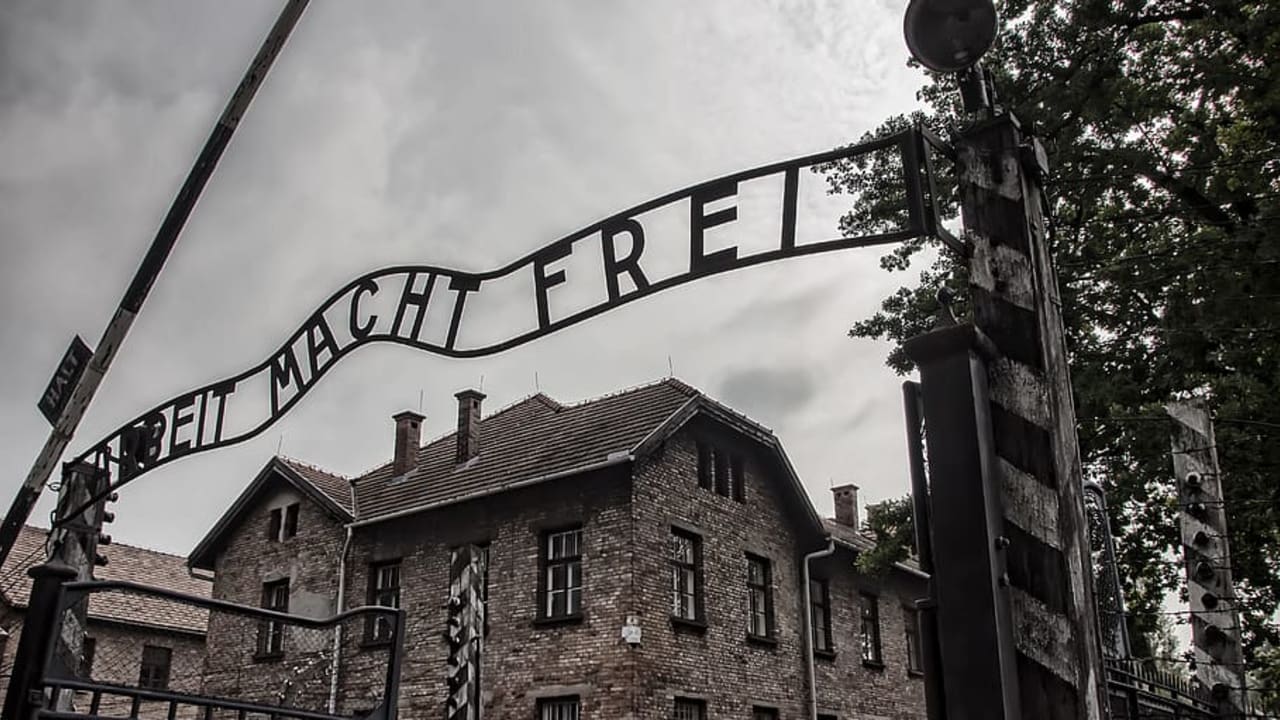
The massacre on Bondi Beach brought home to every Jew, everywhere, that no Jew is safe, anywhere.
As an American Jew, I watched the images of the antisemitic attack in Australia with horror – images that, like those of October 7 in Israel, brought back into our present-day lives the antisemitic violence of the past. Alongside this horror was a determination to fight back, using every means at our disposal to ensure that history is not forgotten.
As part of that fight, I have acquired an original architectural drawing – a “whiteprint” – of the very first design of the crematoria built in Birkenau as an expansion of Auschwitz.
The original plan was created in October 1941 by Walter Dejaco, the Austrian architect who designed the gas chambers and crematoria at Auschwitz. Only two copies of this original genocidal drawing exist: the one in my possession, which I will donate to a Holocaust museum, and another held in the State Military Archive in Moscow, beyond the reach of Western researchers.
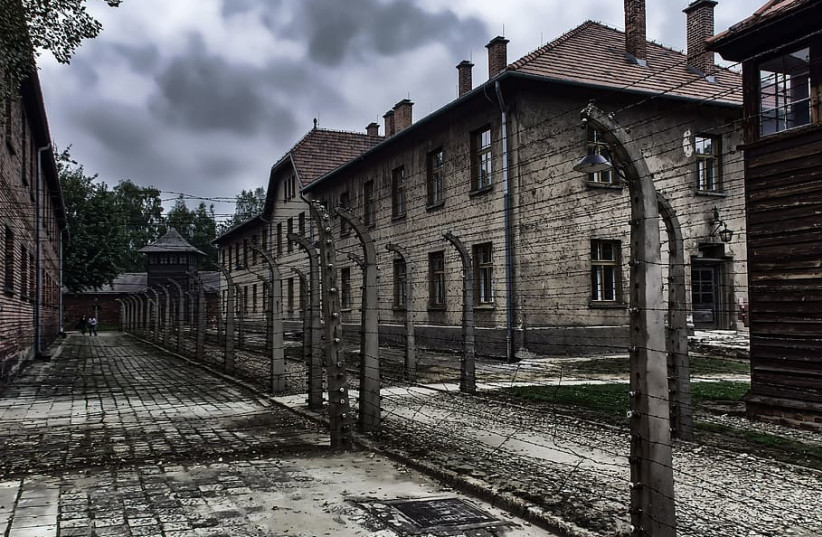
The term 'genocide'
The term “genocide” was first used in a legal context at the Nuremberg Trials, which began on November 20, 1945, almost exactly 80 years ago. It was intended to describe Nazi Germany’s systematic project to annihilate, with intent, an ethnic, racial, or religious group: the Jews.
Today, however, the concept of genocide has become debased and misused, most flagrantly in accusations leveled against Israel that it has committed genocide in Gaza. Holocaust deniers, of whom there are still too many for comfort, have been joined by a large and vocal crowd – including the United Nations and governments in Europe – who abuse the term genocide by applying it to Israel’s actions in Gaza.
Prior to acquiring the whiteprint, in 2024, I helped the Counter Extremism Project, a nonprofit organization, purchase a house next door to Auschwitz. Commandant Rudolf Hoss lived there from May 1940 to December 1943, and again in early 1944, with his wife and five children. His chillingly dispassionate approach to the horror he oversaw at Auschwitz was portrayed in the Academy Award-winning film The Zone of Interest.
I obtained the whiteprint from a rabbi in the Los Angeles area, who had been given the document a decade earlier by a collector of Nazi memorabilia known to one of his congregants. The donor had come across it at an auction in Germany without knowing its true historical value.
Whiteprint 'literally irreplaceable'
In exchange for the whiteprint, I committed to fund $1.5 million for an educational project that the rabbi is currently developing. It is an early-education curriculum on altruistic behavior – a “catch them while they are young” approach to safeguarding children from extremism. The sum is intended to honor the memory of the 1.5 million Jewish children murdered in the Holocaust.
The whiteprint is of immense historical significance. A member of my research team consulted Robert Jan van Pelt, a professor of architecture at the University of Waterloo in Canada and a leading authority on Nazi concentration camp architecture. He authenticated the whiteprint, describing it as “quite literally irreplaceable.”
Van Pelt explained that Dejaco created the design while visiting Auschwitz, where he would have been a guest of Hoss. The crematorium was initially planned to be located next to the Hoss family home, where he lived with his wife and young children. In 1942, the Nazis instead chose to build four crematoria in the nearby camp of Birkenau. These were later blown up by the Nazis as the Soviet Army advanced.
The four crematoria had an incineration capacity of nearly 4,400 corpses per day. Given their central role in the genocide of the Jews, van Pelt noted that Hoss “would have followed this project very intensely. It was a major capital outlay at a time of general rationing of resources like building materials and steel.”
Gassing and burning, starvation and disease
Although historians now estimate that approximately 1.1 million people were murdered at Auschwitz-Birkenau, roughly one million of them Jews, Hoss testified at Nuremberg that he believed the number was far higher. He stated that “at least 2,500,000 victims were executed and exterminated [at Auschwitz] by gassing and burning, and at least another half million succumbed to starvation and disease, making a total of about 3,000,000 dead.” This figure represents about 70% or 80% of all persons sent to Auschwitz as prisoners.”
Today, the two largest crematoria exist only in ruins.
Given the extraordinary rise in antisemitism across the globe and the threat it poses not only to Jews, but to Western civilization itself, we must make it impossible for anyone to deny that the Holocaust occurred. The whiteprint, in effect, makes denial untenable even for the most committed revisionists.
The writer is a philanthropist and chairman and CEO of Broidy Capital Holdings, LLC. He is co-chair of the Fund to End Antisemitism, Hate, and Extremism.