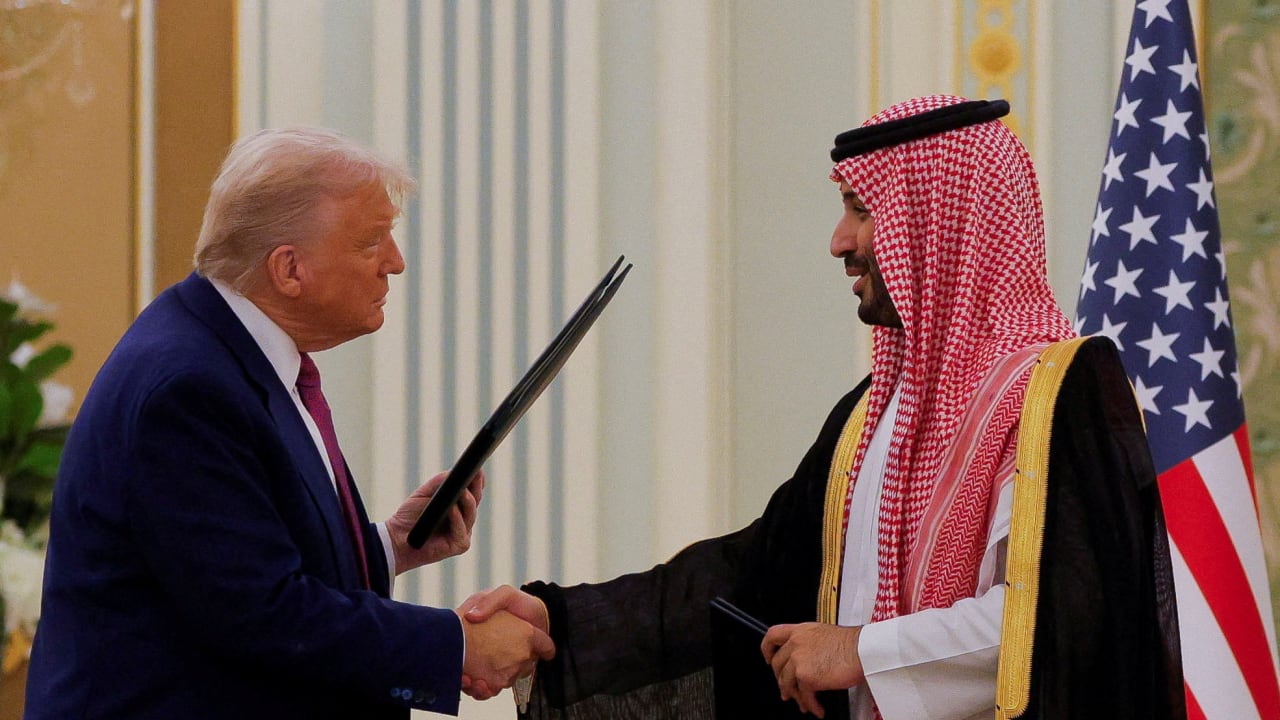
In September 2023, Israel and Saudi Arabia appeared poised to normalize relations, a strategic breakthrough that could have reshaped the Middle East.
Saudi officials were clear with me at the time: Riyadh would not merely follow the United Arab Emirates into the Abraham Accords. As the region’s most consequential Arab power, the Kingdom intended to chart its own course.
The strategic logic was compelling.
Normalization with Israel would accelerate Crown Prince Mohammed bin Salman’s Vision 2030 by pairing Saudi capital and ambition with Israeli innovation and security expertise, all underwritten by American strategic backing.
Mutual recognition promised increased influence and prosperity for both states while eclipsing their shared primary adversary, Iran, and advancing regional stability.
Iran and its jihadist proxies, Sunni and Shi’ite alike, understood exactly what was at stake. On October 7, Hamas seized control of history.

Its barbaric surprise attack devastated Israel, destabilized the region, and, at least for the foreseeable future, derailed Saudi-Israeli normalization.
Despite Israel’s subsequent battlefield successes in Gaza, Lebanon, and against Iran itself, October 7 remains a strategic victory for Hamas and Tehran: normalization was halted.
In the immediate aftermath, my previously open channels with Saudi officials grew noticeably colder.
One senior Saudi figure admitted privately that Riyadh had underestimated the depth of popular hostility, particularly among younger Saudis toward Israel. The answer was always visible: in textbooks, sermons, and media.
For years, Western observers projected a veneer of moderation onto a deeply conservative society. While some reforms are real, many Saudi imams still preach open hostility toward Jews.
Social media, amplified by Qatar’s Al Jazeera, has further radicalized Arab youth across the region, including within the Kingdom.
Public opinion and internal politics shape Saudi calculations
MBS has carefully read the political terrain. He is in no rush to formalize ties with Israel, especially as he has not yet ascended the throne. With King Salman still alive, though frail, the Crown Prince remains vulnerable.
The Saudi sense of strategic abandonment dates back to 2019, when Iran struck Saudi Aramco facilities, and the Trump administration chose not to respond militarily.
For Riyadh, this was a shock. Historically, such an attack would have triggered a US response to defend a critical ally and a vital energy supplier.
Searching for partners against an expansionist Iranian Shi’ite regime – one that despises Saudi Arabia and resents its custodianship of Mecca and Medina – the Saudis increasingly looked to Israel.
Quiet cooperation on intelligence, missile defense, cybersecurity, and innovation was already underway. Normalization would have elevated all of it. October 7 ended that first chapter.
Fast-forward to 2026, seven months after the 12-day war between Israel and Iran, conducted with American support. Iran today is wounded and strategically constrained. For Saudi Arabia and the Gulf states, the immediate Iranian threat has receded.
As a result, Riyadh calculates that public alignment with Israel, especially after years of inflammatory imagery from Gaza, is no longer urgent. Chapter two has begun, but the Crown Prince currently sees more risk than reward.
Those risks are internal. MBS has powerful enemies within the royal family who have not forgotten his consolidation of power, including the imprisonment of rival princes during the 2017 Ritz-Carlton purge.
When King Salman passes, knives, figurative and political, will come out.
MBS understands this dynamic and has made a calculated choice: to neutralize rivals by adopting a harder public line on Israel, embracing anti-Zionist sentiment among Saudi youth, and championing Palestinian statehood.
This denies his rivals political space. He has gone further by warming ties with Turkey, a Muslim Brotherhood-aligned state, and flirting with a security alignment involving Pakistan, partners that should concern Washington.
Against this backdrop, President Donald Trump should reconsider offering Saudi Arabia advanced F-35 fighters absent firm guarantees about succession and long-term strategic alignment.
Saudi Arabia remains governed by Wahhabi Islam, tempered since 9/11 but still dominant. The question must be asked plainly: should America provide its most advanced weaponry to a state where Islamist ideology still exerts deep influence?
Saudi-Israeli cooperation continues quietly on security and technology, but that is insufficient to advance US strategic interests.
Public normalization would force Saudi Arabia more firmly into the American orbit, blunt jihadist ideology, and consolidate a regional bloc capable of countering Iran and its proxies.
Trump wants Saudi Arabia in the Abraham Accords as part of his legacy. The path forward is leverage. Any sale of F-35s, a formal US defense treaty, or approval of a civilian nuclear program should be explicitly conditioned on normalization with Israel.
Strategic alignment should be earned, not assumed.
The writer is the director of MEPIN, the Middle East Political Information Network, and the senior security editor of The Jerusalem Report. He regularly briefs members of Congress, their foreign policy advisors, and the State Department.