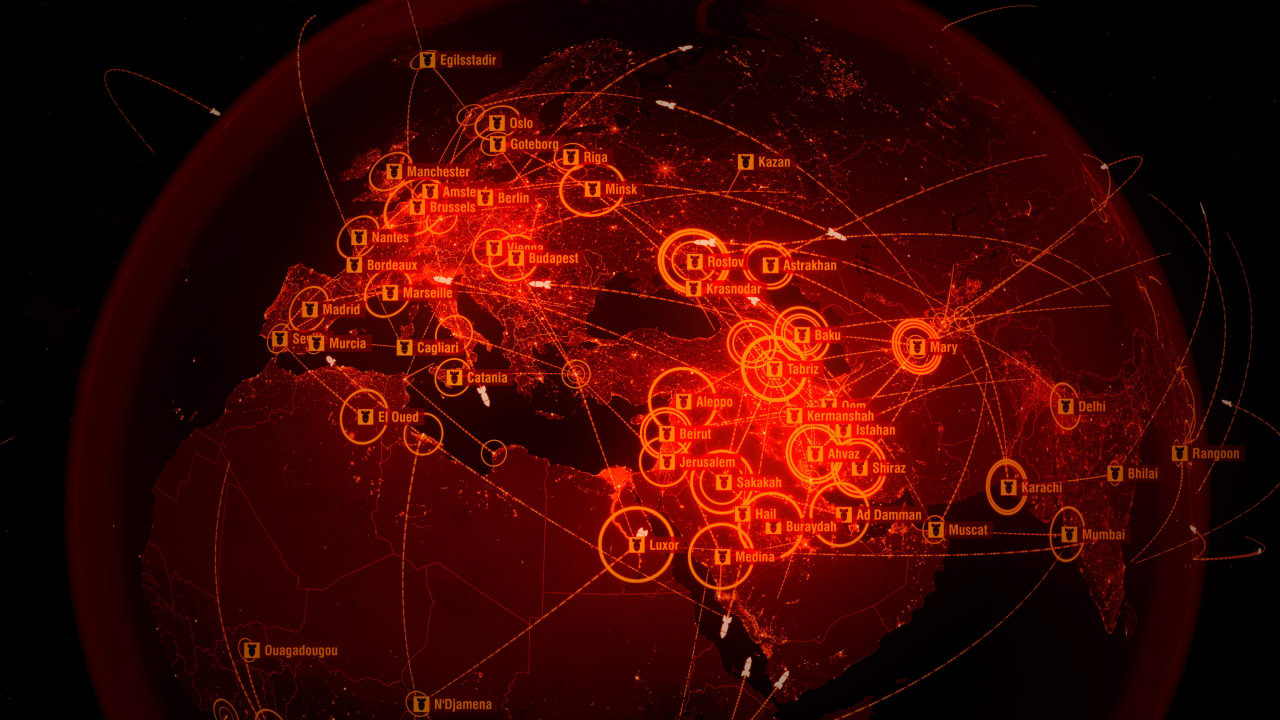
In the tense world of the early 21st century, it sometimes seems that humanity is walking directly towards another global conflict. Regional wars, tensions between superpowers, and the accelerating arms race create a constant sense of danger. But a more sober look at the global balance of power reveals a paradox: Precisely at a time when many countries possess significant nuclear arsenals, the chance of a full-scale world war is decreasing.
The main reason for this is the principle of nuclear deterrence. Since the end of World War II, when the United States used nuclear weapons against Japan, the powers have understood that this is a weapon not intended for normal battlefield use, but rather as an extreme deterrent. Its very existence creates a situation of "balance of terror" - a reality in which any use of such weapons would result in almost immediate mutual destruction.
As a result, nuclear weapons have become, for decades, a tool aimed at preventing war, not starting it. The United States, Russia, Britain, France, India, Pakistan, and even North Korea possess various nuclear capabilities, but for these countries, the weapons are seen primarily as a guarantee of national security and as a deterrent. Even when acute tensions arise, as we see between India and Pakistan or between Russia and the West, the mere knowledge of the possible destruction prevents the parties from escalating the conflict into an all-out war.
In this sense, the proliferation of nuclear states has, to a certain extent, created strategic stability. Every state knows that the use of such weapons will lead to a devastating response. Therefore, the cold logic of deterrence outweighs the temptation to use them.
Another factor that reduces the risk of a world war is the technological gap between the weapons systems of the various countries. In recent years, the superiority of American and Israeli weapons systems has been demonstrated time and again, from advanced interceptor systems to intelligence and precision combat capabilities. Missile defense systems, advanced aircraft, and cyber and intelligence capabilities create a layer of defense that was unimaginable a few decades ago.

The strategic significance of this superiority is profound. A nuclear confrontation between superpowers can occur only when both sides are convinced of military symmetry. When one side knows that its opponent has a clear technological and intelligence advantage, the chance of escalation decreases significantly. The recognition of American-Western military superiority, combined with advanced Israeli defense capabilities, sends a clear message to any country watching from the sidelines.
China and Russia also understand the implications of direct confrontation with the West. Although they invest enormous resources in developing weapons systems, they are aware that a full-scale conflict could bring unprecedented destruction to all sides. Therefore, even when international tensions rise, they usually remain at the diplomatic, economic, or regional level and do not escalate into a global war.
The main challenge: Iran and the Middle East
Within this picture, there is one dangerous exception: Iran. Unlike other countries, where nuclear weapons are seen as a means of deterrence only, the Iranian regime relies heavily on a religious ideology. This ideology, which combines a desire for regional hegemony with extremist rhetoric against its enemies, arouses deep concern in the international community.
Iran makes no secret of its desire to expand its influence in the Middle East, and one of its stated goals for years has been the destruction of the State of Israel. When a country with such a revolutionary ideology approaches nuclear capability, the threat becomes much more complex than that posed by other countries that possess nuclear arsenals.
According to various intelligence estimates, Iran has already managed to accumulate a significant amount of uranium enriched to a relatively high level. This is about 400 kilograms of uranium enriched to about 60% - an advanced technological stage on the way to completing military-grade fissile material. According to various publications, this material is scattered and hidden across several facilities, making it difficult to detect.
Therefore, one of the main goals of the international community is to locate those stockpiles and prevent further progress in the Iranian nuclear program. At the same time, it is also of great importance to damage Iran's missile program. According to various estimates, Iran still does not have a full operational system capable of launching a nuclear warhead over long distances. Stopping the development of this capability could be a decisive factor in preventing the nuclear threat from becoming a reality.
American policy in recent years, especially during periods when the hard line towards Iran was emphasized, is supposed to deal with precisely this threat. The economic pressure, intelligence activity, and international effort to expose Iran's nuclear facilities are designed to prevent a situation in which a country with an extremist ideology would possess the most dangerous weapon created by man.
However, as the danger inherent in the Iranian regime becomes clearer, it is becoming clearer that this is not just a regional problem in the Middle East, but a global threat. The regime in Tehran is not just an ordinary government with strategic ambitions; it is an ideological regime that combines religious fanaticism with a quest for regional dominance and systematic support for terrorist organizations. It finances, arms, and directs militias and organizations operating in many countries, and undermines international stability.
When such a regime approaches nuclear capability, the risk is not only to Israel or the countries of the region but to the entire world. Therefore, there is a growing understanding in the international community that curbing the Iranian nuclear project is not enough in itself. In the long run, profound change in Tehran and the replacement of the extremist regime with a more responsible government may be a necessary condition for global stability and the prevention of the greatest danger of all - the use of nuclear weapons by a leadership motivated by extremist ideology.
Ultimately, the current balance of power in the world may become a deterrent. When the superpowers are aware of the terrible cost of nuclear war, and when a clear technological advantage prevents the illusion of an easy victory, the chance of global conflict decreases. The central challenge of the international community is no longer preventing war between the superpowers, but rather containing attempts by radical regimes to breach the limits of deterrence.
The world may not be safer, but it is more sober. This soberness - based on strength, deterrence, and an understanding of the true cost of nuclear war - is why, even now, despite all the tensions, the risk of all-out world war is less than we think.
The writer is the CEO of 100FM Radio, Honorary Consul and Deputy Dean of the Consular Staff, President of the Israeli Radio Media Association, and a former IDF Radio anchor and correspondent for the NBC television network.