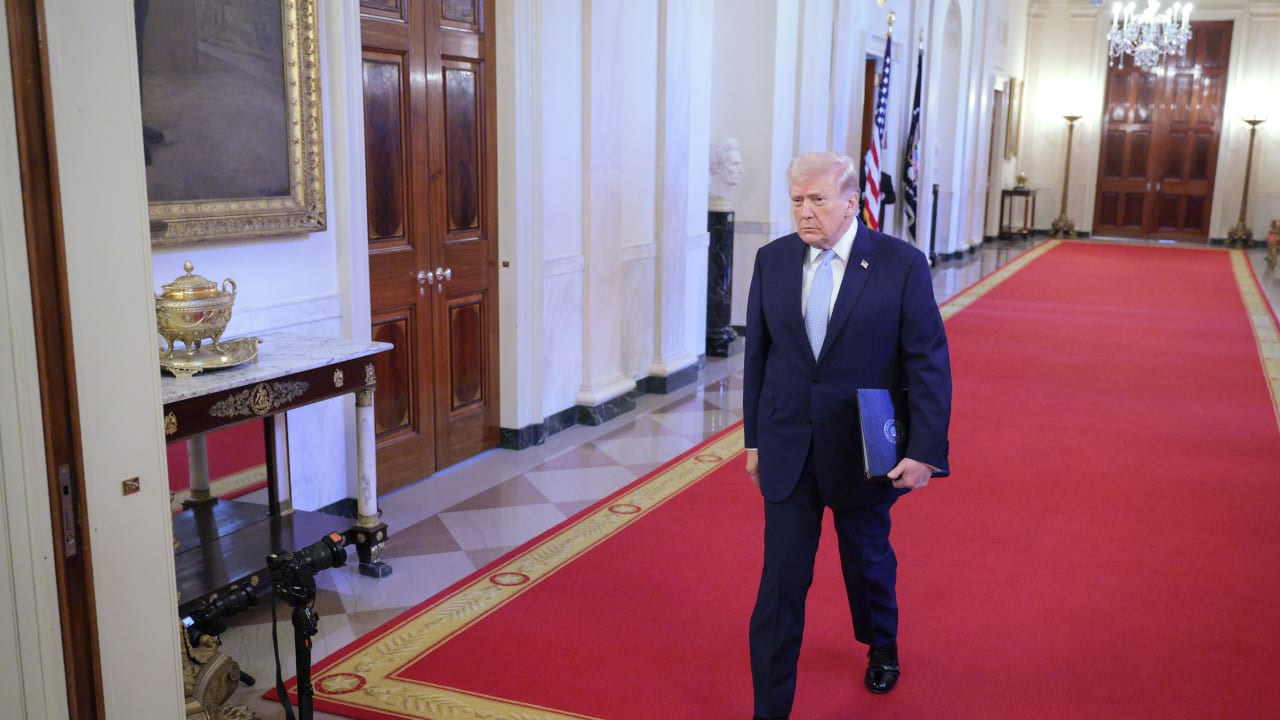
If you listen to mainstream media and prominent American commentators such as Tucker Carlson, Megyn Kelly, Candace Owens, Steve Bannon, Marjorie Taylor Greene, Joe Kent, and others, you might come away convinced that someone persuaded US President Donald Trump to go to war against Iran.
In a sense, that conclusion is correct: someone did convince the president.
The decision behind the war
I spoke with two individuals who were present at the meeting where the final decision was made. Both were emphatic about who ultimately convinced Trump.
To understand the context, it is important to go back several months.
In September 2026, Prime Minister Benjamin Netanyahu presented his deep concerns about Iran. Then, in December, I hosted a meeting at Mar-a-Lago with Evangelical leaders and the prime minister. That same evening, Netanyahu met privately with the US president.

During that meeting, Trump remarked, “Now I hear that Iran is trying to build up again. If they are, we’re going to have to knock them down. We’ll knock them down. We’ll knock the hell out of them, but hopefully that’s not happening.”
Diplomatic efforts continued into the new year. On February 6, 17, and 26, negotiations took place in Geneva, Switzerland, involving Jared Kushner and the US Special Envoy to the Middle East, Steve Witkoff.
Despite these efforts, many voices in media and politics have suggested that Netanyahu was the driving force behind any eventual military action. According to those I spoke with, that claim is not true.As one individual in the room told me, “Everyone in the room knows who convinced the president.”
So who was it?
The answer is simple: Donald Trump convinced himself.
One source stated plainly, “The president made the decision, [and] the president alone made [the decision] to use military force.”
Another individual present explained that Israel presented four different options. One of them involved Israel acting independently, without US involvement, to strike Iran.
According to this source, “The discussion focused on various approaches to Iran’s nuclear program, ranging from independent action to different levels of collaboration.”
One of those in the meeting added further context: “Trump understood the threat. Once that threat became imminent and he was confident we would win, he made the decision.”
Ultimately, after an extended period of attempting negotiations with Iran and consulting with his cabinet and military advisors, President Trump made the decision on his own.
Why the blame falls elsewhere
So why are figures like Carlson and others blaming Netanyahu for the war with Iran?
Because the human mind often struggles with complexity. It looks for simple explanations and clear targets of blame. Throughout history, that tendency has, at times, led to assigning responsibility along ethnic or religious lines rather than engaging with the full reality of events.
That tendency to simplify complex events and assign blame reflects a broader ideological movement that is gaining momentum today.
The ideology of Hitler’s seed
A movement is taking place in America among the extreme Right, predominantly on podcasts, which mirrors a movement that took place in the 1930s under Adolf Hitler.
That movement was obsessed with nationalism and rooting out its perceived enemies. At that time, the Jews were designated as the enemy, and today it’s the Zionists.
The current movement’s objective is to dismantle America’s biblical base, and nothing must stand in their way, not Donald Trump nor the Republican Party.
Hitler felt the same about Germany, and he created a plan not only to neutralize the Evangelical church in his country, birthed by the Great Reformation, but also to rebrand it and fashion it in his image. To do this, he needed an enemy, and he found one: the Jews, even though they represented less than 1% of the population of Germany.
Hitler did not discourage people from attending church. Though he was a baptized Catholic, he had long since abandoned his faith.
He claimed he would not interfere with the specific doctrines of the church, so long as those teachings aligned with what he defined as the good of the German people. He referred to this approach as “Positive Christianity.”
In reality, his plan was to marginalize the church and ensure that no genuine Christian influence would shape government policy.
Under his regime, traditional Christian holidays were reshaped: Christmas was rebranded as Yuletide, and Easter was reframed as a celebration of spring. He even distributed an image of himself emerging from a church to suggest sympathy with Christianity.
Hitler often stated that the best way to conquer enemies was to divide them. In line with this thinking, he encouraged alternative religious movements, including the God Believers, further fragmenting religious unity in Germany.
Parallels between then and now
Major Republican podcasters are deploying Nazi imagery and rhetoric and espousing ideas associated with the Nazi Party during its rise to power in the early 1930s.
The church in Germany was not only neutralized by Hitler’s ideology. It was largely activated to support it. Many joined the Nazi Party. They had swastikas on their altars. They praised Hitler, saying God sent the chancellor and that the trains ran on time.
Instead of pictures of Jesus, they had pictures of Hitler in their churches, and they supported his campaign to target the enemy of Germany: the Jews.
Nick Fuentes operates in this world. His entire theological framework, “Christ is King” invocations, and Apostles’ Creed imagery are similar to Carlson’s.
Hitler would have been proud of them, these people accusing Israel of genocide and racism while claiming to be the authentic voice of the spiritual Israel – the church. They are targeting the next generation, setting them up to become the equivalent of Hitler Youth.
Only 32% of Christians aged 18 to 34 now sympathize with Israel over the Palestinians, more than 30 points lower than the older generation. In the same age range, overall support for Israel is only 24%.
A warning about the future
Hitler blamed the Jews of Germany for World War I. These disciples of darkness are blaming the Jews for the Israel-Hamas War and the war with Iran.
In Carlson’s mind, Christian Zionists are worse than Islamic terrorists, and Hitler would have felt the same. They are selling the big lie that Jewish lobbyists, the “Jeffrey Epsteins,” have taken over the White House and that d Trump is doing Netanyahu’s bidding.
The churchgoers in Germany embraced replacement theology, believing that they were, in fact, the spiritual Israel.
This was the foundation that fueled and fed their antisemitism, and it is precisely what is happening to young Evangelical people in America, whom these disciples of darkness are targeting. They are pounding away at these young people, mocking God’s promises to the Jews.
The goal is to undermine the belief that the Bible is the word of God. Carlson has become the most powerful anti-Evangelical voice in America, all the while claiming to be an Evangelical follower of Jesus.
Carlson claims that a demon visited him one night and left claw marks on his ribs. I believe him. I believe that demons are in him and need to be cast out.
The Bible says that Satan comes to kill, steal, and destroy. That’s precisely what these apostles of darkness are doing to America.
The writer has written 120 books and is a #1 New York Times bestselling author. He is the founder of the Friends of Zion Museum in Jerusalem, the Corrie ten Boom Museum in Holland, and Churches United with Israel, the largest Christian Zionist network in America, with more than thirty million followers.