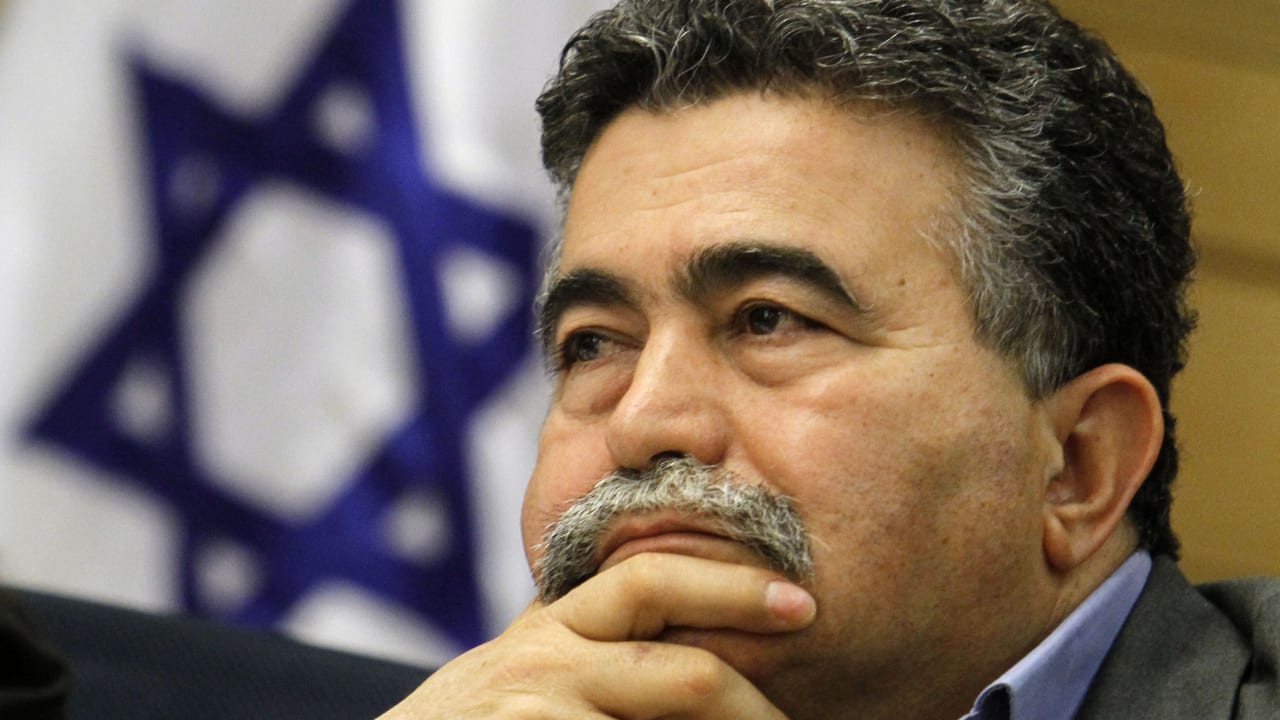
Whenever I walk back up the 52 steps from our building’s shelter to our apartment in Jerusalem, after hearing the booms in the skies, I thank heaven and I whisper a thank you to Amir Peretz.
Young readers, you may not know who that is. After all, he was defense minister for just one year.
Amir Peretz, who turned 74 on March 9, served as defense minister of the State of Israel from 2006 to 2007. In that short span of time, he fought skeptics and approved the development of the Iron Dome. This altered Israel’s military objectives and our future,
Amir Peretz, then called Armond, was born in the central Moroccan town of Boujad, also spelled Bejaad, known for its vibrant red Berber rugs. The town was unusual in that the Jewish community wasn’t segregated into a Jewish section, like the mellah in most Moroccan cities. The Jews of Boujad lived among non-Jews, which might have something to do with Peretz’s future liberal political identification. His father was the head of the Jewish community.
When Armond was four, the family made aliyah, settling in the rough-and-ready town of Sderot, two years after it received permanent housing, and residents moved from tin huts and tents. Now calling himself Amir, he was already a teen activist and would eventually win the mayor’s office running for the Labor Party.
Peretz dismissed as inexperienced, bad fit
When he became defense minister, he was scorned as an inexperienced bad fit.

Although six Israeli defense ministers were former chiefs of staff, and eight served as prime minister, among them were other significant defense ministers who weren’t battlefield heroes but geniuses in strategy and procurement of arms. In the IDF, Amir Peretz wasn’t a pilot or general. He served in the less glamorous Ordnance Corps, where he rose to become a captain. He was run over while serving in the Mitla Pass and spent a year recovering in a hospital.
Peretz served as defense minister during the controversial Second Lebanon War and was publicly disparaged for lack of military expertise. Nonetheless, the Winograd Commission, which investigated the war’s successes and failures, found that responsibility for the war’s losses was shared also by then-chief of staff Dan Halutz and prime minister Ehud Olmert.
A snapshot taken by photographer Effi Sharir caused the seemingly irreparable damage to his image. Decades before we used the term “going viral,” in the photo of defense minister Peretz inspecting troops in the Golan Heights, nodding agreement as IDF chief of staff Gabi Ashkenazi explained what was happening in the terrain, the protective caps were still on the binoculars.
The supposedly humorous imagine confirmed everyone’s prejudices. Reportedly, the cap was on only for a short time and quickly corrected, but the picture of the mustached social organizer without glorified military experience as the antithesis of the heroic Ashkenazi generals stuck. Ironically, chief of staff Ashkenazi wasn’t Ashkenazi, either.
For six years, that picture worth a thousand words made Peretz a laughingstock. Then, as journalist Shmuel Rosner wrote eloquently in The New York Times in 2012, “Peretz may be the one laughing now, as Israelis laud him for seeing what experienced generals didn’t see with their open binoculars.”
Because Peretz was an outsider, he could think outside the box. It brings to mind the Hans Christian Andersen fairy tale of “The Emperor’s New Clothes.” Con men convince the king they can weave him elegant invisible clothing. Everyone parrots the praise of the new garments until a little boy in the crowd shouts that the emperor is actually naked.
The Israeli strategy had, in fact, focused on offense and ignored defense, leaving us as exposed as the emperor. It took a defense minister who grew up in beleaguered Sderot to make defense a priority.
In 1983, American president Ronald Reagan planned the grand-scale Strategic Defense Initiative, popularly called Star Wars. Reagan wanted to protect the US from long-range intercontinental nuclear-armed missiles. The program was canceled before it could be realized.
Not that the doubters were idiots. There was adequate reason for skepticism. The idea that a missile could hit another missile with exactitude sounds fantastical. Even after the Iron Dome was showing its worth, you can look back in military history to find claims by so-called experts magnifying its imperfections.
Once Israeli ingenuity was applied to defensive systems, an Amir Peretz priority, additional systems were developed with the confident financial support and technical collaboration of the United States. David’s Sling and Iron Dome are complementary layers of Israel’s multi-tier missile defense. Iron Dome works for four to 70 kilometers, intercepting short-range rockets and mortars, while David’s Sling intercepts up to 300 kilometers and defends against medium- to long-range missiles, cruise missiles, and drones. David’s Sling was jointly developed by Israel’s government-owned Rafael Advanced Defense Systems and US contractor Raytheon. The next level is protected by Arrow 3, jointly developed by the Israel Missile Defense Organization and the US Missile Defense Agency. The primary contractor is Israel Aerospace Industries.
The same Amir Peretz concluded his three-year tenure as chairman of Israel Aerospace Industries in November 2024. He successfully boosted international partnerships and company revenue.
The newest Israeli defense system, Iron Beam, depends on the development of powerful fiber lasers and is designed to destroy drones, rockets, and mortars at the speed of light, at a negligible cost per interception. None of these amazing tools is complete or airtight. The defensive systems are not “hermetic,” as the IDF spokesperson reminds us daily. Even with 90% accuracy, we have experienced enough misses to understand what horror we would face without our made-in-Israel protection. Bigger and richer countries than Israel do not have the defense systems we have.
So thank you, Mr. Peretz, for your foresight and persistence. President Donald Trump wants to name an American defensive system Golden Dome. He just might be calling you.
The writer is the Israel director of public relations at Hadassah, the Women’s Zionist Organization of America. Her latest book is A Daughter of Many Mothers, written with Holocaust survivor and premier English-language witness Rena Quint.