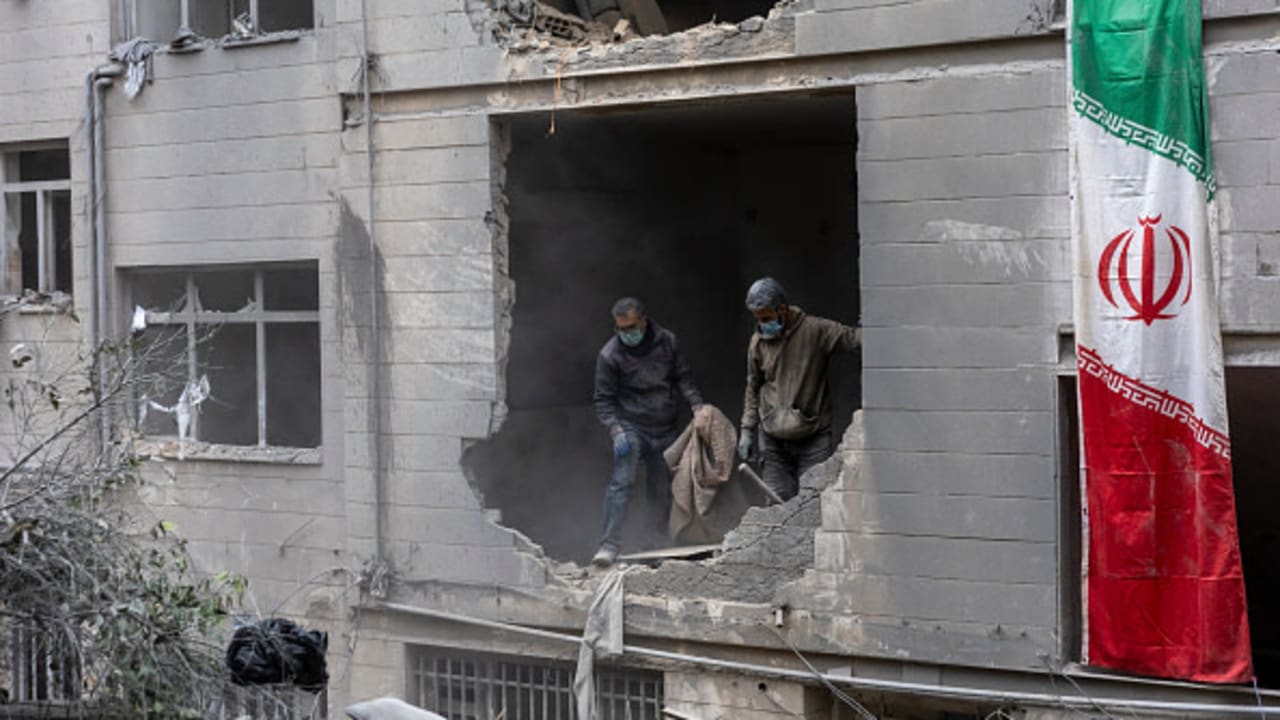
To understand why the Islamic Republic is resisting mediation efforts to end the war, and why its missiles are now flying toward Israel and the heart of the Gulf, it is not enough to look only at maps, missile ranges, or military balances. Sometimes the deeper explanation lies elsewhere: in the religious and symbolic language through which injury is understood and response is shaped.
That is where an ancient Shi'ite text may help illuminate the present moment.
More than deterrence
The Islamic Republic’s missiles are not only a military response. They may also be understood as an attempt to erase humiliation. In other words, if the “house” in Tehran has been struck, then other “houses” in the region cannot remain untouched. This is why the idea of a balance of humiliation may help explain something that conventional Western notions of deterrence do not fully capture.
What troubles the Islamic Republic is not only threat, but humiliation. Not only damage, but disgrace.
To explore that logic, it is worth turning to one of the most influential texts in the Shi'ite tradition.

The text behind the logic
Nahj al-Balagha (“The Peak of Eloquence”) is one of the central works of Shi'ite thought: a collection of sermons, letters, and sayings attributed to Imam Ali. For many Shi'ites, it is not merely a literary or historical text, but a source of profound moral, religious, and psychological significance.
That is what makes it important here. It offers a window into the language through which injury, honor, and response may be interpreted.
In one of the sermons, delivered in the context of the confrontation with Mu’awiya ibn Abi Sufyan, the ruler of Syria, Imam Ali says:
“Attack them before they attack you. By Allah, no people have ever been attacked in the heart of their own home without being humiliated.”
This is more than a call to battle. It reflects a particular way of understanding injury: the question is not only whether a people were struck, but where they were struck. Not only how much damage was done, but whether the enemy penetrated the heart of the home.
The meaning of the “home”
The key phrase in the Arabic is ‘aqr darihim — “the heart of their home.” It points not only to territory, but to the innermost protected space, the place that is supposed to remain secure, stable, and untouched. Once the enemy reaches that space, the blow is no longer merely operational. It becomes humiliation.
That is why the word dhull is so important. It does not simply mean weakness. It carries the sense of disgrace, wounded honor, and the loss of standing in one’s own eyes and in the eyes of others.
This is where the ancient text meets the present.
A lens on the current moment
From this perspective, the Islamic Republic may be trying to alter not only a balance of deterrence, but a balance of humiliation. After the blows it has sustained, it may also be seeking to reverse the symbolic meaning of vulnerability.
Seen through this lens, resistance to mediation becomes easier to understand. As long as the “house” in Tehran is perceived as breached, a ceasefire may be experienced not as prudence, but as dhull — as submission to humiliation.
From such a viewpoint, the missiles are not merely weapons. They also serve a symbolic and psychological function: to erase disgrace, restore honor, and transfer the experience of intrusion to the other side.
This is not only about retaliation. It is also about image, dignity, and the question of who is left carrying the shame of a violated home.
Not theology alone — but theology still matters
Of course, an ancient religious text does not explain every move the Islamic Republic makes. Iran does not act on theology alone. Power, regime survival, and political interests all matter. But texts such as Nahj al-Balagha reveal something essential about the language through which injury acquires meaning in practice.
They show how a breach can be understood not only as a security threat, but as a humiliation that must be erased.
At times, that desire to erase humiliation may weigh as heavily as material considerations — especially when it is reinforced by religious memory, symbolic language, and ideological conviction.
To understand Iran in March 2026, a Shi'ite text may at times illuminate the present more clearly than a headline. Not because it predicts events, but because it reveals the interpretive code through which events are given meaning — and, at times, acted upon.
The writer is a specialist in negotiation and interpersonal dynamics in Arab-Islamic culture and a consultant on cross-cultural communication. He is a senior research fellow at Reichman University’s Sheleg Chair for Crisis Research and lectures on Arabic language, culture, and Islam.