![American Jews [Illustrative]](https://images.jpost.com/image/upload/f_auto,fl_lossy/q_auto/c_fill,g_faces:center,h_720,w_1280/433149 "American Jews [Illustrative]")
In some sectors of American Jewry, there is frustration with Israeli journalists’ critical reporting and opinion pieces that are picked up by hostile voices in the United States. These pieces are, at times, repurposed in ways that can fuel antisemitism, thus creating, in the eyes of some American Jews, a direct and tangible threat.
I understand and feel their concern. The rise in antisemitic rhetoric and incidents is real, troubling, and demands serious attention. Yet focusing blame on Israeli media risks misdiagnosing the problem. It directs attention to symptoms rather than to the underlying structural features of the challenge.
At its core, the issue reflects a long-standing tension between Israel and Diaspora Jewish communities, despite a deep and genuine sense of shared peoplehood. On the one hand, there has been mutual support and strengthening. Israel has historically acted on behalf of Diaspora Jews, from the struggle for Soviet Jewry to contemporary efforts to counter antisemitism. At the same time, Diaspora communities have provided Israel with political, economic, and moral support.
On the other hand, Israel’s actions have caused indirect harm to the Diaspora. Israel, like all sovereign states, acts in self-defense. The exercise of that force has generated, in some cases, backlash against Jewish communities far beyond Israel’s borders.
History offers some reminders. Egyptian Jews were effectively expelled in the wake of Israeli-Egyptian wars in the mid-20th century. In 1994, 85 people, most of them Argentinian Jews, were killed in the bombing of the AMIA Jewish community center in Buenos Aires, an attack widely understood as a Hezbollah retaliation linked to Israeli actions in Lebanon. These examples do not challenge Israel’s right to defend itself. Rather, they highlight a difficult reality: Israel’s actions, even when justified from a security perspective, can have consequences for Jews elsewhere.
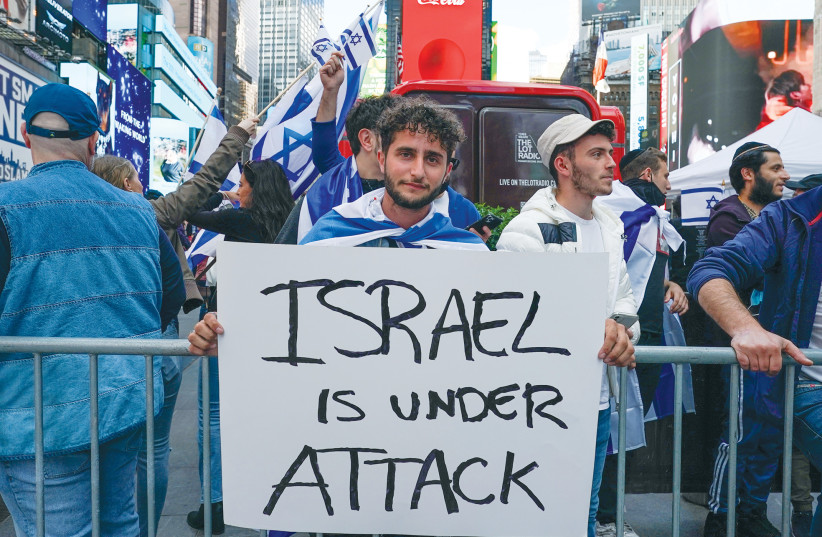
Israeli actions reverberate abroad
This dynamic intersects with another enduring force: antisemitism. Deeply rooted in European history, antisemitism has repeatedly intensified under specific political and economic conditions. Nineteenth-century Germany saw periods of Jewish integration and relative acceptance.
Yet following defeat in World War I and the turmoil of economic crisis, this shifted catastrophically, culminating in unprecedented antisemitic violence. While today’s context is obviously different, the broader lesson remains: antisemitism is not static. It can intensify rapidly when broader conditions enable it.
Israel does not control all of these conditions. However, unlike non-sovereign Jewish communities of the past, its actions do affect some of them. Prolonged conflict, particularly when it involves significant civilian harm and strains relations with key allies, contributes to a more permissive environment for anti-Israel sentiment to spill over into antisemitism. This is not the sole cause, but it is part of the broader context.
Israelis and Diaspora Jews further operate in different environments. As a sovereign state, much of Israel’s focus is on its government’s policy, military necessity, and leadership decisions. Since the war began, for example, Israelis have been debating fiercely Prime Minister Benjamin Netanyahu’s policies, such as his approach towards Hamas before the war, his handling of intelligence warnings, or the strategic logic behind expanding the conflict to other arenas. These are not abstract discussions; they are questions of national survival and democratic accountability.
For Diaspora communities, however, the environment is different. The consequences are experienced through shifts in social and political climates, on campuses, in public discourse, and in everyday life, evident in the surge of antisemitic attacks, including deadly ones, since October 7, 2023. It is therefore understandable that internal Israeli debates, when amplified abroad, can feel like an added vulnerability.
But suppressing those debates is neither feasible nor desirable. Open criticism and investigative journalism are essential components of a democratic society. In a global world, it is impossible to contain an internal debate within the territorial confines of the state.
As such, the core issue is not how Israeli policies and debates are reported, but the policies themselves.
This does not mean that Diaspora concerns should be dismissed, far from it. Jewish communities abroad have an important role to play in communicating to Israeli leadership the costs they are bearing. But addressing those costs requires engaging with the deeper structural tensions at the heart of the Israel-Diaspora relationship, rather than focusing solely on the tone of individual journalists.
The writer is the chair of the Department of International Relations at the University of Haifa.