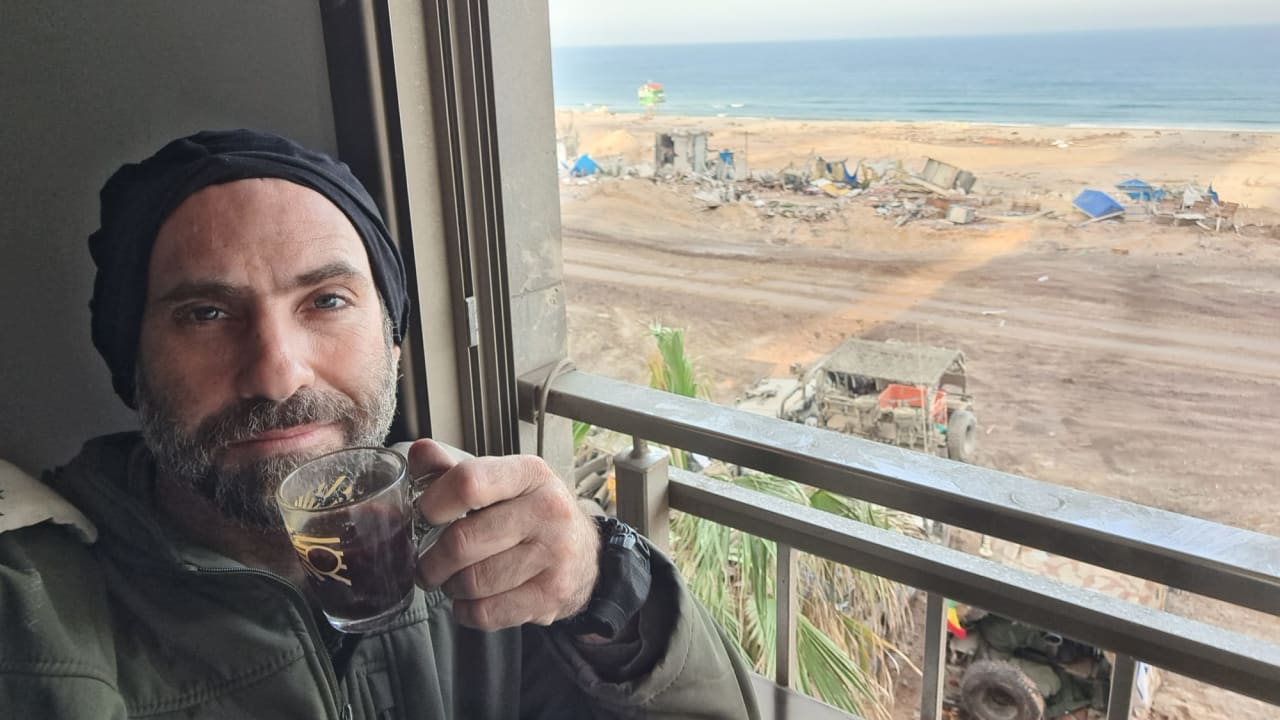
There is a kind of injury that does not bleed, does not bruise, and does not announce itself when a soldier walks into a room. It sits quietly beneath the surface, hidden behind straight posture and steady eyes. It is the kind of injury that demands not only resilience from the one who carries it, but awareness from the society that surrounds him.
I think about this often when I think about Nitzan Yuval.
If you met him in the pine scented valleys of Emek Ha’ela, you would see a man deeply connected to the land. A forest ranger, a father of five, a man who understands growth, patience, and renewal. His work is to heal what has been burned, to plant what will outlive him. There is something almost symbolic in that role, especially now.
Because since October 7, Nitzan has been living a different reality. One that cannot be measured in hectares restored or trees planted, but in endurance, in silence, and in the weight a human being can carry without breaking.
Like so many others, he did not wait to be called. He simply showed up.

As part of the Engineering Corps heavy equipment unit, he operated the D9 bulldozer, the massive armored machine that clears the path before anyone else can move forward. In places like Shejaiya, this is not just engineering. It is survival. Every meter cleared is the difference between life and death for the soldiers behind him.
Inside that metal cabin, under constant threat, there is no room for hesitation. Only movement. Only responsibility.
And then, in the middle of it all, something gave way.
Not from enemy fire, but from within.
A severe injury to his cervical spine. The kind of injury that radiates pain through every movement, every vibration, every breath. The kind of injury that most doctors would immediately remove from the battlefield.
But Nitzan stayed.
Not because he did not understand the consequences, but because he did. Because he knew what it meant if he left. Because he understood that sometimes duty is not about what is reasonable, but about what is necessary.
A different kind of battle
We are often comfortable with visible sacrifice. A cast, a scar, a photograph we can point to. But what do we do with the soldier who looks whole
When Nitzan returned home and doctors recommended surgery, he faced a different kind of battlefield. One that did not involve armored vehicles or enemy fire, but long term decisions about identity, service, and belonging. Surgery might have healed the body but it would have ended his ability to return.
And so he chose another path. A harder one. A quieter one.
He began living what he describes as two parallel lives. In one, he is strong, capable, functioning. In the other, he is in constant pain, managing an injury that affects not just the body, but the nervous system, the mind, the way one experiences the world.
This is the invisible scar.
It is easy to overlook. Easy to dismiss. Easy to misunderstand.
But it is no less real.
In the work we do through the Special in Uniform program, I have seen something powerful emerge from these invisible places. Special in Uniform, a joint initiative with JNF USA, integrates young people with special needs into meaningful IDF service while creating powerful human connections that extend far beyond the military framework. Within this space, Nitzan was paired with Yitzhak, a young man with special needs serving as a soldier in the program. On paper, they are very different. In reality, they meet in a space where labels disappear.
Because trauma and vulnerability have a way of leveling us.
In their time together, through therapeutic riding and shared experience, something shifts. Nitzan gives strength, structure, and confidence. Yitzhak offers something just as critical, presence, honesty, and a kind of silence that allows healing to begin.
This is not charity. This is not one side helping the other.
This is mutual restoration.
It is a reminder that healing does not always come from above. Sometimes it comes from standing shoulder to shoulder, without hierarchy, without definitions.
And then there is the front that receives the least attention, the one at home.
We speak about combat zones, about borders, about strategy. But we speak far less about the moment a soldier steps back through his front door and is expected to switch roles instantly. From warrior to father. From survival mode to tenderness.
Nitzan describes this transition as almost impossible.
One moment he is operating heavy machinery under threat near the Lebanese border. The next, he is bathing his children, helping with homework, trying to be fully present. There is no decompression chamber between those worlds. No pause.
Just expectation.
And in one quiet moment, when his young daughter called him, unable to sleep without him home, the reality broke through. Not in anger. Not in frustration. But in tears.
That is the cost we rarely calculate.
Not in budgets. Not in headlines.
But in hearts.
So when Nitzan asks for one thing, a good eye, an ayin tova, it is not a philosophical request. It is a practical one.
He is asking us to see.
To recognize that not all wounds are visible. That strength does not always look like invincibility. That behind many of the men and women we call fine are layers of pain, responsibility, and quiet endurance.
He is also asking us to see the families. The spouses who carry the weight at home. The children who learn, far too early, what absence feels like. The invisible network that allows resilience to exist at all.
We are a society that knows how to honor sacrifice. But we must learn how to recognize it in its more subtle forms.
Because the future of our resilience depends not only on those who stand at the front, but on our ability to stand behind them, with awareness, with sensitivity, and with that same good eye.
Nitzan continues to serve. He continues to heal the land. He continues to carry both his visible and invisible burdens with a kind of quiet dignity that does not ask for applause.
Only understanding.
And perhaps that is the real test before us.
Not whether we can see the scar, but whether we are willing to look for it.
The writer is the director of Special in Uniform.