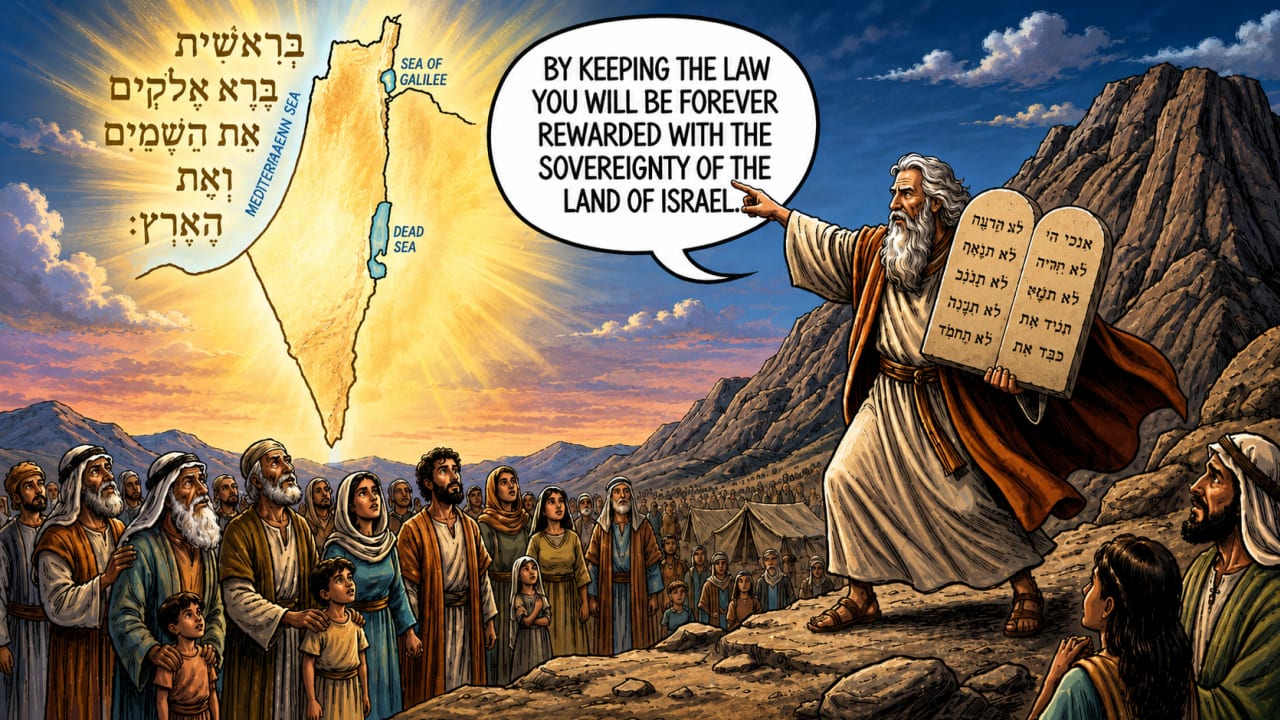
As Israel approaches the holiday of Shavuot amid war, political division, and renewed international attacks on its legitimacy, it is worth revisiting one of the most unusual ideas in human civilization: The Jewish people became a nation before they possessed the land promised to them and enshrined in the law they received on Mount Sinai.
Most nations in history emerged in the opposite direction. First came geography. Settlements became villages. Villages became cities. Armies defended borders. Eventually, systems of governance and laws emerged to regulate life within those borders.
More than 900 years ago, Rashi asked why the Bible begins with Creation rather than with the first Jewish commandment. His answer was strikingly political and timelessly relevant: because the Torah sought to establish the legitimacy of the Jewish people’s relationship to the Land of Israel.
If the nations accused Israel of theft, Rashi explained, the Jewish response would be that the Creator of the world determines the course of nations and sovereignty. Remarkably, one of Judaism’s foundational commentators anticipated that the legitimacy of Jewish presence in the land would one day become a central international dispute.
The Jewish story unfolded uniquely from its very start. The modern revisionist history deployed by the Palestinians and their supporters supplants a different narrative. How interesting that 900 years before these questions of Israel’s legitimacy there was a Jewish scholar who foresaw the future.

At Mount Sinai, the Israelites possessed no capital city, no sovereign territory, no army, and no kingdom. They stood in a desert between slavery and statehood. Yet before entering the Land of Israel, they received something else first: a covenant, a system of law, and a shared moral framework. Before there was sovereignty, there was responsibility.
This distinction matters far beyond theology. It may explain not only the survival of the Jewish people for thousands of years but also much of the modern struggle surrounding Israel today.
The Torah presents the Land of Israel as promised to Abraham and his descendants. Yet the promise was never presented as simple ownership detached from conduct. The biblical narrative repeatedly links permanence in the land to moral behavior, justice, and national responsibility. Sovereignty was not merely a right; it was also a test, or more importantly an individual and national commitment.
This was revolutionary in the ancient world. Most empires conquered first and moralized later. Assyria, Babylon, Persia, Greece, and Rome expanded through force, power, and territorial control. Their legitimacy rested largely on military success and political dominance.
The Jewish model introduced something different: the idea that a nation’s survival depended not only on military strength or territorial possession but on whether it remained worthy of the covenant that bound it together.
IN THIS sense, Jewish civilization was built not merely around land but around law.
A foundation of law at the core of Jewish identity
Perhaps that is why Jewish identity survived what would have destroyed most ancient peoples. Rome destroyed Judea and dispersed the Jewish population, but it could not erase Jewish civilization itself. For nearly 2,000 years, Jews maintained a national identity without territorial continuity. Empires rose and disappeared, yet the Jewish people carried their legal, ethical, and spiritual framework across continents and generations.
The nation survived exile because its foundation was never solely geographic.
This reality makes many modern attempts to erase Jewish ties to the Land of Israel particularly striking. Increasingly, public discourse in parts of the West presents Jews as foreign colonizers disconnected from the very land where Jewish civilization originated. Demonstrators protest outside synagogues in America accusing Jews of “selling stolen land.” Some deny the existence of the Jewish temples in Jerusalem altogether. Others describe Israel as though Jewish history in the land began only in the modern era.
Such claims require a remarkable level of historical amnesia.
Jewish ties to Jerusalem and the Land of Israel are acknowledged not only in Jewish sources but throughout Christian, Roman, Byzantine, Islamic, and Ottoman history. Christianity itself emerged from Jewish civilization rooted in Jerusalem and Judea. The Hebrew Bible, which shaped much of Western civilization, is inseparable from the geography of the Land of Israel.
Even the name “Palestine” itself emerged after the Romans renamed Judea as “Syria Palaestina” following the Bar Kochba revolt, partly as an attempt to sever Jewish identification with the land after fierce Jewish resistance to Roman rule. The renaming was not an indigenous national movement; it was an imperial act of political and psychological warfare.
None of this denies that other populations lived in the land over centuries, or that Arabs who claim to be from the nation of Palestine possess their own history, identity, and human aspirations. Ironically, Arabs and Jews living in the area during the British Mandate were called Palestinians. Even this newspaper, which predated the foundation of the modern state of Israel, was originally called The Palestine Post.
But there is a difference between acknowledging Palestinian identity and erasing Jewish indigeneity altogether. Parts of the international discourse attempt not merely to criticize Israeli policy but to delegitimize the very notion of Jewish historical belonging.
That distinction matters enormously.
A COUNTRY can survive criticism. Democracies are built to withstand disagreement, protests, and political battles. But when a nation’s right to exist is denied altogether, the conflict moves beyond borders into something much deeper: legitimacy itself.
This issue has become even more urgent after October 7.
For decades, many strategic discussions surrounding Israel focused primarily on territory and borders. How much strategic depth was necessary? Would additional buffer zones provide greater security? Could territorial concessions reduce hostility?
Yet modern warfare increasingly exposes the limitations of geography alone.
Missiles ignore borders. Drones bypass terrain. Cyberwarfare penetrates from thousands of miles away. Iran projects influence through proxies across the region without sharing borders directly with Israel. The massacre of October 7 shattered assumptions that barriers alone could guarantee security.
At some point, nations are forced to confront an uncomfortable reality: If large segments of surrounding societies fundamentally reject your right to exist, no border is wide enough. This does not mean borders are irrelevant. Security zones, military positioning, and strategic depth still matter enormously. But military realities alone cannot resolve civilizational conflicts rooted in legitimacy, identity, and historical narrative.
In many ways, the current struggle surrounding Israel is not only about land. It is about whether the Jewish people are viewed as an authentic indigenous civilization returning home or as temporary intruders whose sovereignty is inherently illegitimate.
That battle is now being fought not only on military fronts but across universities, media platforms, international institutions, and social networks.
At the same time, Israel faces internal divisions that are impossible to ignore. Political polarization, protests, judicial battles, tensions between secular and religious communities, and growing distrust across sectors of society all raise difficult questions about national cohesion.
And perhaps this is where Shavuot becomes especially relevant.
The giving of the Torah at Sinai represented more than a religious moment. It represented the formation of shared responsibility before sovereignty. The Jewish people did not become a nation merely because they inherited territory. They became a nation because they accepted obligations toward one another and toward a larger moral framework.
That lesson feels profoundly relevant today.
Israel’s long-term survival will certainly depend on military strength, technological superiority, and strategic alliances. But survival may also depend on whether Israeli society can preserve a shared sense of purpose strong enough to withstand both external attacks and internal fragmentation.
The Jewish people were not sustained for thousands of years merely by borders. They were sustained by memory, covenant, law, and shared identity.
On Shavuot, Jews remember that before there was Jerusalem, before there was a kingdom, before there was even a state, there was an idea: that freedom without moral responsibility eventually collapses, and that sovereignty without purpose cannot endure.
Perhaps that is the deeper lesson of this moment.
The future of Israel will not be determined only by where its borders are drawn but by whether the nation remembers what made it a nation in the first place. This lesson that sovereignty requires moral responsibility needs to be loudly repeated to the Palestinian leadership and their supporters.
The author is an experienced global strategist and a strategic adviser at the Jerusalem Center for Security and Foreign Affairs (JCFA). He can be reached at globalstrategist2020@gmail.com.