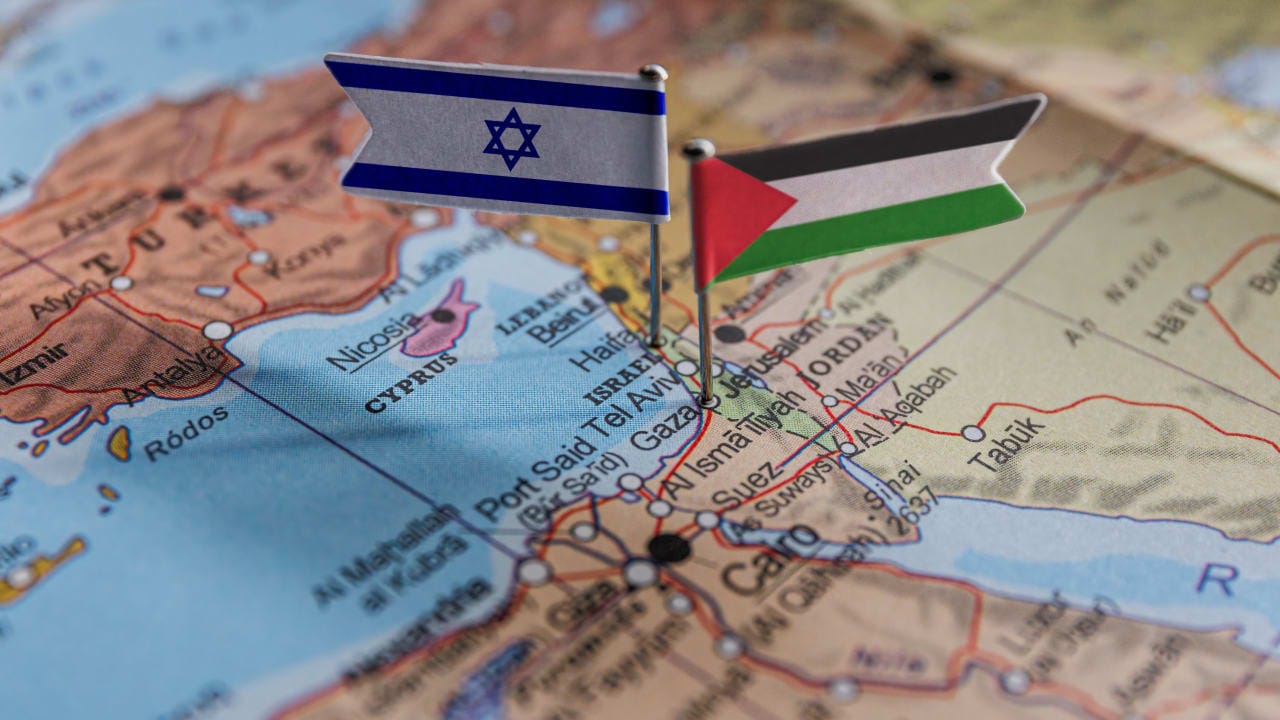
Modern diplomacy consistently fails in the Middle East because it treats the Israeli-Palestinian conflict as a zero-sum collision of physical facts, mechanical borders, divisions, and raw power politics. It is based on an obsolete paradigm.
This reductionist dogma, which views the world strictly through a materialist lens, transforms human beings into uniform combatants and freezes conflicts into permanent deadlocks. If we wish to break this cycle, we must embrace a fundamental philosophical shift: The world is a totality of values, not merely a totality of physical facts.
To achieve a civilizing breakthrough, we must reject the traditional, failing approach of physically carving up the narrow geography of the West Bank. Dividing this contested land guarantees continuous friction, perpetual radicalization, and strategic insecurity.
Instead, an evolutionary approach to international relations demands a structural grand geopolitical exchange – one that satisfies the deepest historical needs of both peoples without degrading the dignity of either.
A blueprint for peace
The blueprint for this value-based solution requires two complementary pillars.
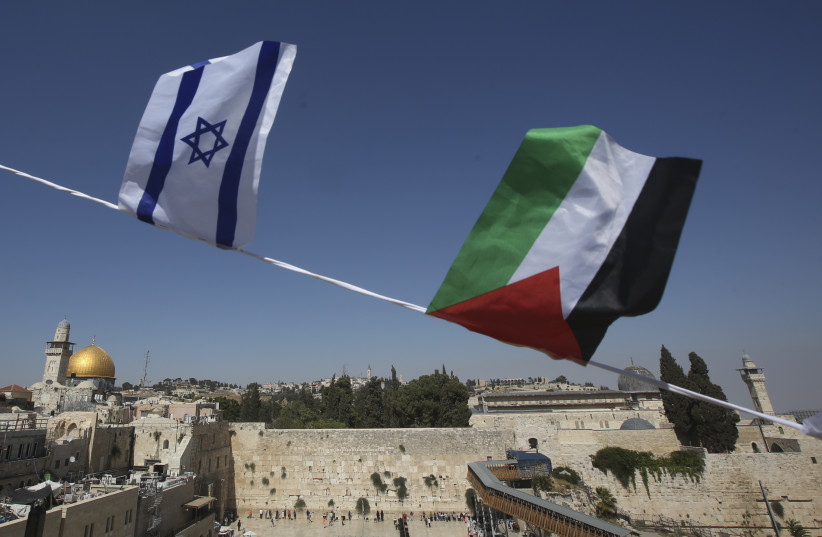
First, the entire West Bank and the Golan Heights must be integrated into sovereign Israeli territory. This step provides Israel with continuous, defensible, and permanent borders, resolving its existential security dilemmas.
Crucially, this territorial integration must not result in displacement. Palestinians choosing to remain in the West Bank must be offered the voluntary option to acquire full Israeli citizenship with equal civil rights.
Simultaneously, Jerusalem must be elevated above provincial politics. It should not be treated as a political prize, but recognized as the Spiritual Capital of the World. In this framework, Israel acts as the guardian of the sacred, maintaining Jerusalem as an ecumenical center where Judaism, Christianity, and Islam meet to foster global spiritual unity.
Second, we must establish “The New Palestine” – a fully sovereign, hyper-developed state encompassing the Gaza Strip, linked to an expanded territory in the Sinai Peninsula, ideally one-and-a-half times the size of the West Bank. This territory, currently an underutilized desert, can be transformed into a global economic powerhouse.
By utilizing a Dubai-style development model, the international community will entirely fund the construction of world-class trade, transit, and commercial infrastructure, alongside state-of-the-art schools, universities, and residential centers.
For Egypt, ceding this portion of land will be balanced by a synchronized international multibillion-dollar financial package designed to catalyze its own national economic renewal.
To satisfy Israel’s legitimate defense requirements, the New Palestine will be fully demilitarized. Its security, borders, and airspace will be monitored by an advanced, neutral, and international AI-driven satellite network managed jointly by the United Nations and the League of Arab States. This algorithmic security framework replaces occupying armies with objective technology.
Investing in peace
Skeptics will immediately point to the immense financial cost of building a new state from scratch.
Yet this objection falls apart under economic scrutiny. The capital required to build The New Palestine is a fraction of the trillions of dollars currently bled from the global economy due to ongoing Middle Eastern instability, volatile energy markets, shipping disruptions, and endless foreign military interventions.
Investing in construction is infinitely more rational than financing continuous destruction.
Humanity currently faces a profound crisis of the spirit, where reductionist political models combined with modern technology threaten global stability. The Middle East conflict acts as the primary catalyst for this global destabilization.
True peace is not a static political treaty; it is a dynamic, evolutionary process that creates the conditions for human flourishing, reflection, and moral perfection.
Every historic paradigm shift requires the alignment of a clear framework and the right timing. We have arrived at a critical historical juncture – a Kairos, as formulated in thesis 7.9 of my Tractatus Politico-Philosophicus: “For each change, we need the right person and the right time.”
The old diplomatic models are exhausted. The time for a value-based, evolutionary blueprint for the Holy Land is now.
The writer is one of Poland’s most renowned philosophers and political theorists. He has received his doctorate in philosophy from the University of Oxford and has taught at many universities. In 2021-2022, he was a Lady Davis Visiting Professor at the Hebrew University of Jerusalem. He published several books, including Political Realism: An Evolutionary Theory of International Relations (Routledge, 2026).