
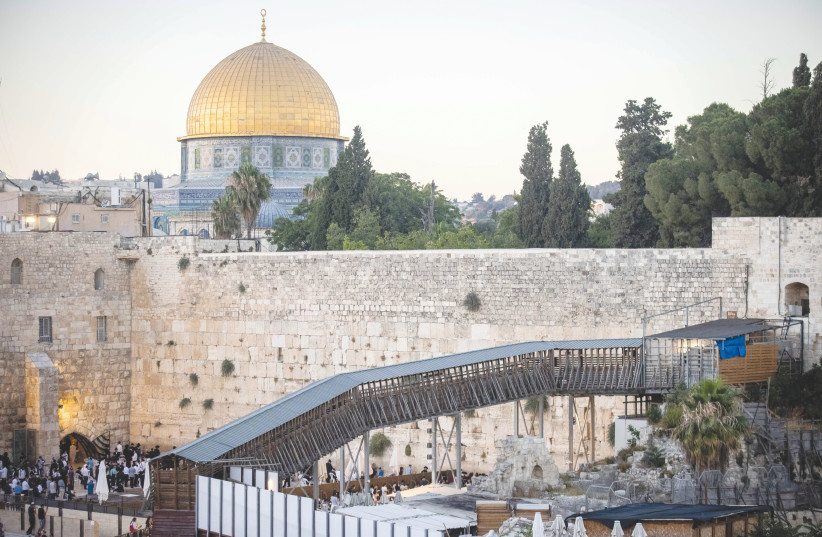
Two visits with one of my children to the Temple Mount, separated by 16 and a half years, help illustrate the Israeli government’s slow weaning from its toxic appeasement of Arab terror and intolerance. The process must be completed.
In December 2009, the day before my oldest daughter got married, we went up to the Temple Mount. The next time she joined me was this past Shavuot eve. I have been going up the Temple Mount at various times of the year and on special occasions since the Israeli government reopened the holiest place in Judaism to Jews in 2004, albeit in very small numbers, and, until recently, with all forms of prayer by any non-Muslim strictly prohibited.
Simply closing one’s eyes in introspection, or plaintively looking up to the heavens, were grounds for removal and questioning at the police station. That is where my daughter and I found ourselves the day before her wedding in 2009.
During separate questioning, I was asked, “Was your daughter swaying?” Incredulous, I asked the officer to repeat the question, thinking perhaps I hadn’t heard right. “You know,” and he nodded his head back and forth, explaining, in a hostile manner, how that was quite obviously a provocative action and, therefore, an unlawful and improper movement for a Jew to make on the Temple Mount.
Before we were released, we were required to hear a lecture from the officer in charge of Jerusalem’s holy places, admonishing us in absolute seriousness that body motions, gestures, and facial expressions by Jews on the Temple Mount, even without an audible prayer, could trigger a religious war by surrounding Muslim countries and populations.
It was extremely distressing to note the extent to which the Israeli government and police had abjectly surrendered to threats of Muslim violence. I asked the police officers what they would do if a Jewish group threatened violence unless Muslims were banned from praying at the al-Aqsa Mosque on the Temple Mount.
Would they forbid Muslim prayer, or would they arrest the Jews for incitement? I urged them to stop being so afraid and to take seriously their mandate to enforce public order, rather than forbidding the most fundamental of civil rights in order to make their jobs easier.
They didn’t appreciate the comments, and angrily threatened that if I kept it up, they would ensure that my daughter and I would spend the whole day in detention, maybe even miss the wedding. I yielded to the abuse of power and went along with the rest of the proceedings.
My daughter was, understandably, upset, spending part of the day before her wedding detained and questioned in a police station. I told her that by the time her children got married, Jews would be praying on the Temple Mount in the kind of numbers they do today at the Western Wall. Then, she would tell them the hard-to-believe story of how their mother was arrested the day before her wedding because her silent prayer on the Temple Mount was considered a danger to public safety.
There were times in the years that followed when I wondered whether my optimism was realistic. Not only did the situation not improve, but there were also times the appeasement and kowtowing resulted in even further restrictions, such as limiting the number of Jews on the Temple Mount to a maximum of five people at a time. But over the past five and a half years, there has been an evolution.
While Muslims have uninterrupted and unlimited access to the Temple Mount through nine gates, Jewish entry is still restricted to a few hours each day, Sunday through Thursday. Jewish prayer is still, officially, not allowed. But, by the end of 2020, silent prayers by Jews were no longer a cause for arrest.
Restrictions ease for Jews on the Temple Mount
In 2024, Jews started praying together out loud. Jews are still prohibited from bringing into the Temple Mount any religious item, but the police allow, as of January of this year, the distribution of a pamphlet with the text of the two-thousand-year-old Amida prayer, recited by Jews three times a day, including a prayer for the building of Jerusalem.
On the Shavuot eve visit with my daughter, we joined a prayer group of about 30 people for Mincha, the afternoon service, using the authorized prayer pamphlets. And my daughter didn’t have to worry about swaying. Numerous Biblical statements, including by the Prophet Isaiah, speak of a time when the Jewish People will go up to Jerusalem and prostrate before God on the Temple Mount.
In August 2024, I was on the Temple Mount on the first Tisha B’Av after October 7, 2023. Jews bowed down in prayer, head to the rock, a gesture only allowed by Jewish law on the Temple Mount. They were not removed and arrested by the police.
This fundamental right of worship, central to the religious experience of Jews on the Temple Mount, has not been interfered with since. And so it was that on my daughter’s first return visit to the Temple Mount, 16 and a half years after her silent prayerful swaying landed us in police detention, we joined tens of other Jews in a prostration before God on the Temple Mount.
The lunacy of decades of appeasement of Muslim extremism, and the flagrant injustice resulting from it, is highlighted by contrasting the restrictions on Jewish worship on the Temple Mount with the freedom of religious worship afforded every day of the year to thousands of Muslims on the Temple Mount, asserted by Islam to be its third holiest spot.
On the recent Muslim holiday of Eid al-Adha, the Feast of the Sacrifice, an estimated 140,000 Muslims worshipped and prostrated on the Temple Mount.
It is worthy of note that Muslim worshippers actually turn their backs on the al-Aqsa Mosque and prostrate in the direction of the Kaaba, their holiest site, 1600 km. away in Mecca. Yet it is news, a matter of great consternation, fear and concern to many, that Jews are being given some level of exercise of religion on the holiest spot in Judaism.
The extent of the flagrant injustice in the current arrangement on the Temple Mount can perhaps be better appreciated if we were to consider a comparable demand made by Jews of the Saudi government to forbid Muslim prayer at the Kaaba in Mecca (no non-Muslim is even allowed entry to Islam’s two holiest cities – Mecca and Medina), or a demand by Jews or Muslims of the Vatican to prohibit Christian prayers at St. Peter’s Basilica. Both would be viewed as preposterous and, of course, are inconceivable.
Only in the case of the Temple Mount do we countenance such extreme religious imperialism. And only with Islam do we indulge and accommodate the ludicrous historic revisionism that attempts to obliterate the historic Jewish connection and claim to Jerusalem, the Cave of the Patriarchs in Hebron, Rachel’s Tomb in Bethlehem and Joseph’s Tomb in Nablus, and even denies the very existence of the First and Second Temples.
Surrender to Muslim religious intolerance and imperialism has not only resulted in terrible injustice and inequity. It has also made Israel, and now the US and Europe, far more vulnerable to acts of violence and terror. It is long past the time for the deadly appeasement and discriminatory practices to fully end.
The writer is an attorney in Israel and New York.