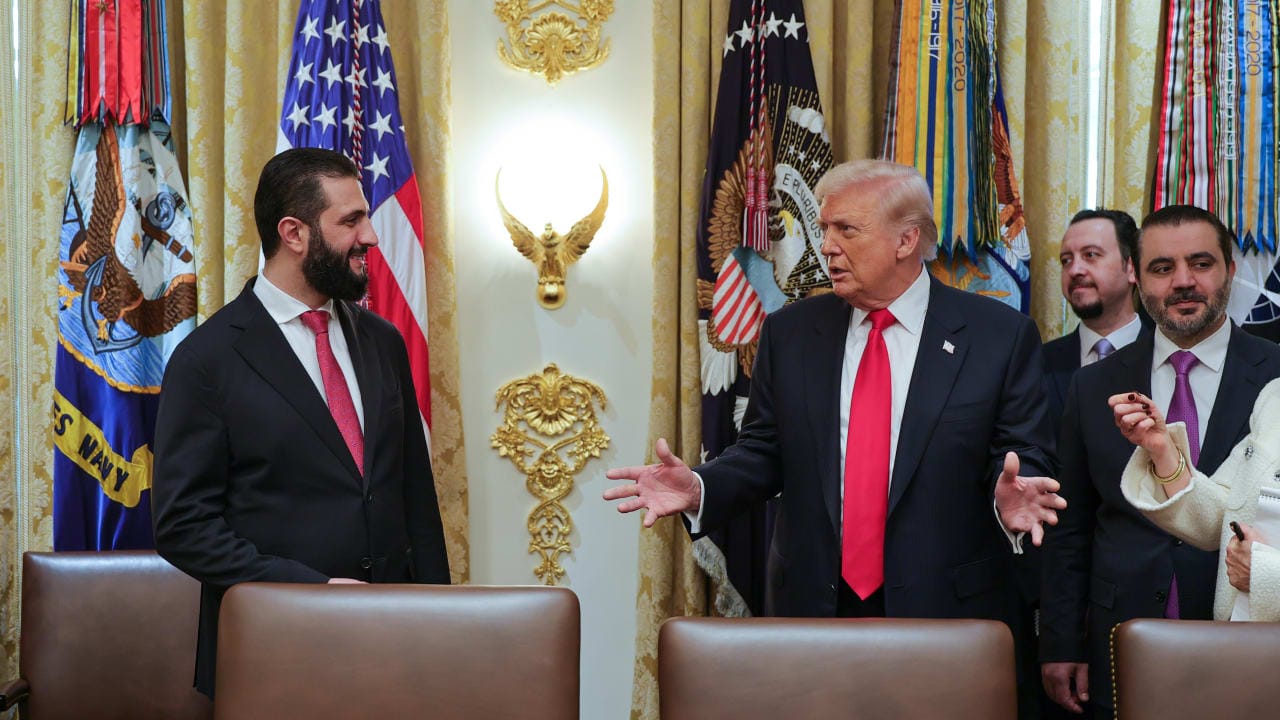
In recent weeks, reports have emerged that US President Donald Trump floated the idea that Syria’s new government, led by Ahmed al-Sharaa, also known as Abu Mohammed al-Julani, could play a role in dismantling Hezbollah in Lebanon.
If this is indeed a policy direction being seriously considered, it raises troubling questions about the understanding of Middle Eastern realities and the lessons of the past.
Sharaa is no ordinary figure in the regional arena. For years, he was associated with jihadist organizations, including al-Qaeda’s affiliate in Syria.
Although he has sought in recent years to rebrand himself as a more pragmatic leader intent on building a stable government, his past cannot simply be erased. The question is whether this change in image truly reflects a deeper transformation in ideology and interests.
The notion that someone who was once part of an extremist organization could become the force responsible for dismantling Hezbollah, one of the most powerful military organizations in the Middle East, strikes many as a paradox.

Hezbollah is not merely a militia. It is a military, political and economic organization with tens of thousands of fighters, a vast missile arsenal and deep influence over Lebanon’s state institutions. It cannot be dismantled through declarations or by an external actor with no meaningful power base inside Lebanon.
Moreover, any such move must be examined in the context of the regional alliance system. According to numerous reports, the new government in Damascus enjoys substantial support from Turkey.
Ankara has invested military, economic and diplomatic resources in northern Syria for years, and its influence over developments there is clear. Strengthening Syria’s new leadership could therefore also expand Turkey’s regional influence.
From Israel’s perspective, this is an issue of strategic significance. Relations between Jerusalem and Ankara have experienced both highs and lows, but in recent years Turkish President Recep Tayyip Erdogan’s rhetoric toward Israel has become increasingly hostile.
His sharp statements and openly expressed regional ambitions have raised concerns in Israel over the expansion of Turkish influence across the Middle East.
Turkish sphere of influence in the Middle East
In such a reality, Israel must assess not only the direct threat posed by Hezbollah, but also the future balance of power. Replacing an Iranian sphere of influence with a Turkish one would not necessarily improve Israel’s strategic position. One threat could simply be replaced by another, no less complex challenge.
Washington, too, must proceed with caution. US policy in the Middle East has often relied on the assumption that regional realities can be reshaped through local partners. The experiences of Iraq, Afghanistan and other arenas show that the region is far more complex, and that short-term alliances can produce unforeseen consequences.
Another issue deserving scrutiny is the continuation of security cooperation between the United States and Turkey.
Turkey is a NATO member with an advanced defense industry, yet in recent years significant disputes have emerged between Ankara and Washington over Turkey’s purchase of Russian weapons systems, its regional policies and its relations with other countries.
Any US decision to approve the sale of advanced components, including engines or equipment for the military aviation industry, must take into account the long-term strategic implications.
From an Israeli perspective, the concern is that advanced technologies transferred to Turkey could strengthen its military capabilities at a time when political relations between the two countries remain far from stable. Advocates of a more cautious approach argue that the United States must consider not only NATO’s requirements, but also the effect of a stronger Turkey on America’s regional allies.
Ultimately, Hezbollah’s future cannot be resolved through simplistic ideas or magical solutions. Lebanon is suffering from a profound political, economic and security crisis, and any change in its balance of power will require a complex process grounded first and foremost in the country’s state institutions, as well as in regional and international agreements.
History has repeatedly shown that in the Middle East, the enemy of one’s enemy is not necessarily a friend. Strengthening one actor in order to weaken another can create a new threat in the future, sometimes an even more serious one. For that reason, every diplomatic initiative must be examined carefully and with a broad view of its long-term consequences.
The United States and Israel share deep security interests, but genuine friendship does not require automatic agreement on every policy. On the contrary, it also requires honest and critical dialogue when strategic disagreements arise.
If the possibility is indeed being considered of entrusting a person once identified with a jihadist organization with a central role in shaping Lebanon’s future, that decision should be accompanied by a sober assessment of the risks, not merely the hopes.
In the Middle East, decisions driven by optimism that is not grounded in a realistic assessment can ultimately prove to be especially dangerous mistakes.
The author is CEO of Radios 100FM, an honorary consul and deputy dean of the Consular Diplomatic Corps, president of the Israel Communications Association, and a former Israel Defense Forces Radio monitor and NBC television correspondent.