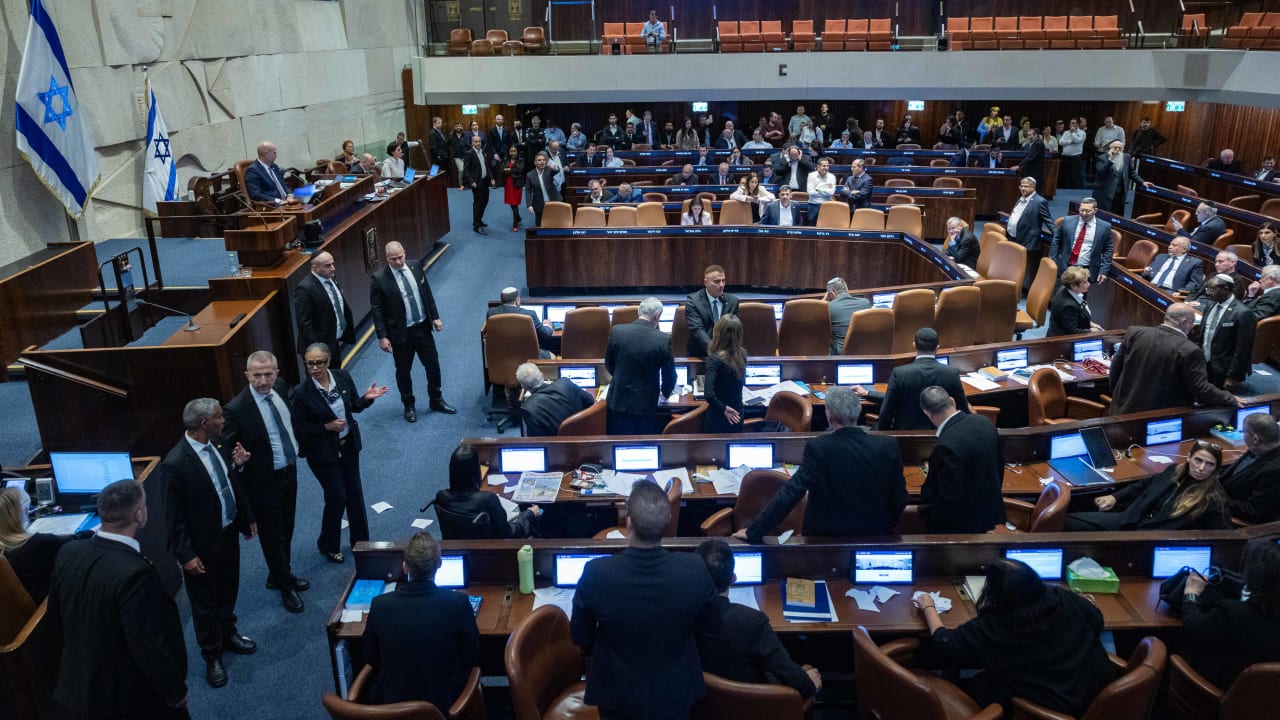
Israelis are set to elect a new Knesset on October 27. This time, however, far more is at stake than the replacement of one governing coalition with another.
Israel stands at a historic crossroads. The election will determine the country’s strategic direction, the character of its domestic order and its ability to provide lasting security. The chairman of the Democrats, Yair Golan, views this election as Israel’s “second War of Independence.” Indeed, this war is being fought over the future character and capacity of the state itself.
Israel can no longer rely on the old doctrine of short, decisive wars. It now faces a protracted, multi-front conflict extending from Gaza and Lebanon to Yemen, Iraq, Syria and Iran. The next government must therefore do more than find a way out of an endless cycle of military operations. It must also begin repairing the deep divisions within Israeli society. Years of polarization have badly damaged public trust in state institutions and weakened national cohesion.
Israel’s fundamental problem, however, is the strategic vacuum at the heart of its policy. The IDF has undoubtedly achieved major tactical successes. But military force is not an end in itself. It must create the conditions for sustainable diplomatic and political arrangements and for a clearly defined strategic end state.
That political and diplomatic compass is precisely what has been missing. The present leadership has repeatedly failed to convert military achievements into durable agreements. Without an exit strategy, every withdrawal creates another vacuum, leaving Israel trapped in a reactive posture. The result is the continued expenditure of military, economic and human resources without the promise of lasting security.

Nowhere is this lack of strategic thinking more apparent than in Israel’s approach to Iran. The decades-long shadow war between Jerusalem and Tehran has given way to open military confrontation.
For years, Iran constructed a ring of fire around Israel by supporting allies and proxies in Gaza, Lebanon, Yemen, Iraq and Syria. Iran’s direct missile and drone attack in April 2024 crossed a historic threshold and sharply increased the danger of regional escalation.
At the same time, Iran has continued to advance its nuclear program while sharply restricting international oversight. Following military strikes on Iranian nuclear facilities and Tehran’s reduction of cooperation with the International Atomic Energy Agency, there is no longer a reliable overall picture of the condition of the sites or the whereabouts of enriched nuclear material. That uncertainty itself magnifies the strategic threat.
Israel cannot manage the Iranian threat indefinitely on its own. The most effective response would be a regional security architecture led by Israel and the US together with pragmatic Arab states, first and foremost Saudi Arabia. Such an alliance would be more than a military framework. It could reshape the regional order and contain Iranian influence politically, economically and strategically.
But this opportunity carries a political price that Israel’s government has so far refused to pay. Riyadh has made normalization conditional on credible and irreversible progress toward a political resolution of the Israeli-Palestinian conflict.
That demand exposes the failure of Israel’s old paradigms. Neither “conflict management” nor “economic peace” resolved the conflict, prevented its escalation or offered Israel a viable diplomatic horizon.
If the next government wants to improve Israel’s international standing, restore its legitimacy and advance regional integration, it must tell the public an uncomfortable truth: preserving the status quo in Judea and Samaria is steadily driving Israel toward a one-state reality between the Mediterranean Sea and the Jordan River.
Even those who regard a near-term peace agreement as unrealistic must act to preserve the possibility of future separation from the Palestinians. Separation is also the strongest political answer to Finance Minister Bezalel Smotrich’s so-called Decisive Plan, which seeks permanent Israeli control over the entire territory and the prevention of Palestinian statehood.
The alternative is a single state for two peoples. If Israel grants equal political rights to everyone under its rule, it risks losing its Jewish character. If it denies those rights to the Palestinians, it risks becoming an apartheid state. Under either scenario, Israel could no longer remain both Jewish and democratic.
The consequences of having no political alternative are already evident on today’s battlefronts. In Gaza, the IDF has severely damaged Hamas’s military infrastructure. Yet because the government rejects the establishment of a moderate Palestinian civilian administration, preferably backed by Arab partners, Israel risks assuming indefinite responsibility for civilian life in a territory left without a viable political or institutional order.
Lebanon also illustrates the limits of military action. Strikes against Hezbollah may be operationally necessary to enable residents of northern Israel to return home safely. Lasting security, however, requires a robust, internationally supervised arrangement. Without such a political framework, every ceasefire will remain little more than an interval before the next round of escalation.
The absence of a diplomatic horizon is also exacting a growing international price. Israel is losing support among important Western partners and faces the mounting risk of political isolation, restrictive measures by allied governments and increasing legal pressure in international courts.
Precision matters here. The International Court of Justice addresses the responsibility of states, while the International Criminal Court considers the possible criminal responsibility of individuals. Both are part of a legal and political reality that Israel cannot afford to ignore.
At home, the foundations of national resilience are eroding. The burden of war continues to fall on a limited part of society. The continuing broad exemption of haredi (ultra-Orthodox) men from military service is damaging the social contract.
Israel's economic struggles
At the same time, the hi-tech sector is suffering from capital flight and political uncertainty. A strong and independent judiciary is not merely a pillar of democracy. Its ability to investigate alleged violations credibly and independently is also essential to Israel’s standing before international legal institutions.
The October election is therefore a referendum on Israel’s future. More of the same will deepen economic weakness, social fragmentation and international isolation.
Israel needs a government capable of combining military power with diplomatic judgment, building regional alliances, distributing national burdens more fairly and finally abandoning the illusion that the conflict can simply be managed.
Israel has no choice but to find its way toward better days. To do so, it must break with a reality in which chaos has become the policy of the Netanyahu government, a government that has lost not only its political compass, but also its social, economic and military direction.
This second War of Independence will not be decided on the battlefield alone. It will be won by restoring Israel’s strategic agency, internal cohesion and political reason. Only then can Israel safeguard its future as a Jewish, democratic and secure state. A lack of vision, too, has a price.
The writer is a retired Israeli diplomat who served as ambassador to Hungary and Croatia, following a distinguished career in senior diplomatic and strategic roles.