The wordplay and mind games going on in Israeli politics are fascinating.
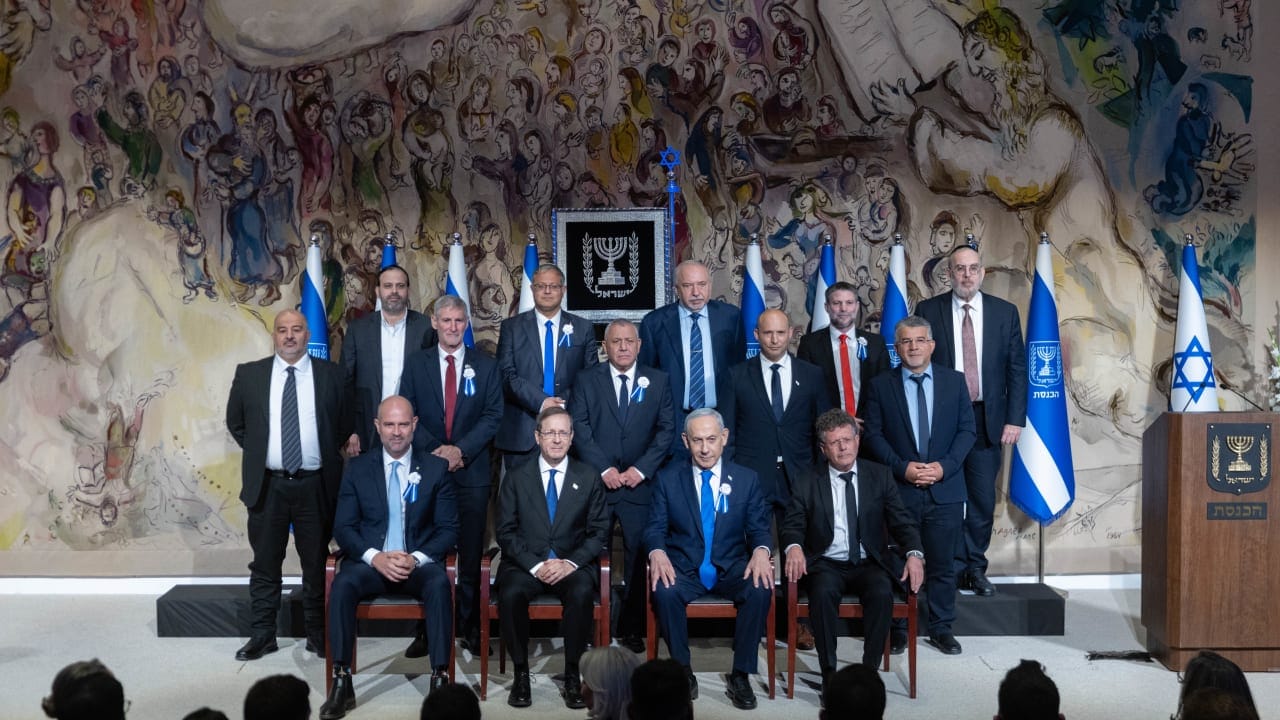
New levels of rhetoric and creative rhetorical devices have been reached after last month’s general elections and President Isaac Herzog’s decision to task Yashar leader Gadi Eisenkot with trying to form a government.
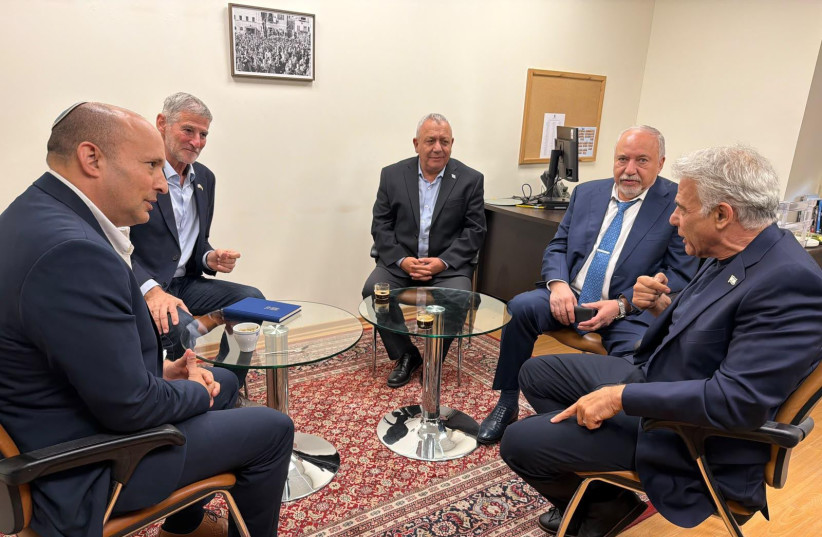
Eisenkot and the so-called change bloc – Yisrael Beytenu led by Avigdor Liberman, B’Yachad led by Naftali Bennett with Yair Lapid, and the Democrats party headed by Yair Golan – have no way of reaching the 61 out of 120 mandates to form a majority coalition in the Knesset without relying either on the haredim (ultra-Orthodox), who have 13 seats in two parties, or the two Arab parties, who collectively hold 19 seats.
Hence the need for creative rewording not only of campaign promises but of the political lexicon itself.
Eisenkot, Liberman, Bennett, and Lapid all pledged not to sit in a government with the haredim or rely on the Arab parties.
Golan doesn’t have a problem with the Arab parties: the Joint List, comprising three separate secular, pro-Palestinian parties, and Islamist Ra’am. However, he sees the ultra-Orthodox as unacceptable partners.
Incidentally, although the Joint List and Ra’am are political rivals, they both support creating a Palestinian state with Jerusalem as its capital and the “right of return for Palestinian refugees.”
The issue about including them in the coalition is not that they are Arab but that they promote a Palestinian nationalist agenda and have repeatedly refused to condemn Hamas as a terrorist organization.
Ra’am leader Mansour Abbas told the Arabic-language Radio Nas on Tuesday that “a minority government without the ultra-Orthodox is a very dangerous scenario. There is no chance that such a government would survive.”
Rather awkwardly for the change bloc leaders, neither the haredi parties nor the Arab parties favor military service, although an essential part of the bloc’s campaigns included “sharing the burden.”
This refers to the massive number of days of reserve duty in the wake of the October 7, 2023 Hamas invasion mega-atrocity and subsequent war.
Thus, what used to be known as the “Conscription Bill,” an effort to enforce mandatory service of the majority of haredi yeshiva students, turned into the “Draft-dodgers’ Bill.” That is, until two weeks ago.
As Liberman led the shift to trying to find a way to bring the haredi parties into a governing coalition, the former, less judgmental, phrasing returned, with one pundit quipping that they should just change the word “mishtamtim” (draft-dodgers) into “me’utim” (minorities) and solve the problem.
It is typical of Israeli politics that even though there is common agreement on the need to tackle the problem of the draft, the need for judicial reform, and to ensure Iran does not achieve its aim of nuclear weapons, there is a reluctance to accept any steps by the other side to do so.
Once the election was over, there was a need to change both tune and words, but it still boils down to “Only Bibi” or “Anyone but Bibi.”
'A kind word immediately makes me feel better'
The mainstream media readily adopted the move to drop the derogatory “draft-dodgers” terminology it had previously favored.
It is becoming increasingly hard to distinguish news from opinion across the media, including public broadcasting.
When reporters use the words “judicial overhaul” for the reform and “draft-dodging bill” for the proposed conscription law, they are taking a side as much as a stand, dropping all pretense of neutrality.
The change bloc has constantly accused Prime Minister Benjamin Netanyahu’s government of trying to destroy media freedom, although Golan sees no contradiction in declaring he will close the right-leaning Channel 14 in the name of democracy.
This week, prominent journalist Ayala Hasson announced she was leaving KAN, the public broadcast company, posting on X/Twitter: “I will not be part of a system that seeks to silence significant and substantial voices within Israel to appease a specific camp.”
Hasson’s decision to leave the broadcaster followed an incident when she had made generalizations about the Bedouin community in an interview on the independent Galei Israel radio station.
Referring to the possibility of the change bloc establishing a coalition relying on the Arab parties’ support, she asked: “With whom is the ‘change’? With the Bedouin women in the Negev, with veils, whose husbands have several other wives like them, and most of whom are battered women?”
She issued an apology on social media to anyone she had offended but refused to read on her own program a text that had been dictated word-for-word by her boss.
The incident was no surprise to those who follow Hasson’s work, a rare voice on the public broadcaster willing to speak out on what she perceives as injustices and irregularities across the political spectrum.
The timing, however, was more surprising. Or shocking. Before a new “change” government had been sworn in, one of the most prominent voices that had questioned it had been forced to resign.
Hasson’s case came the same week as another “scandal.”
Popular singer-songwriter Yehudit Ravitz managed to raise the ire of the “Anyone but Bibi” crowd – not for something she said, but for merely “liking” Instagram posts that leaned to the Right and, horror of horrors, even following the page of Netanyahu himself.
Bar Shem-Ur, a journalist on Guy Lerer’s The Pipeline program, broke the story, noting that Ravitz’s official Instagram page included reposts of reels against relying on the Arab parties.
Some of the media were so astonished that the cultural icon could express an opinion – or at least give a thumbs-up emoji – that differed from theirs that, at first, they refused to believe it.
Shem-Ur contacted Ravitz for a response, saying his team had initially assumed that maybe a student handled the singer’s Instagram account for her.
Ravitz, who turns 70 next month, assured him that she was responsible for likes and shares on her own page and declared: “I’m in reality; I’m not on the political map.”
Having sung “Hatikvah” at a Kaplan protest against judicial reform in 2023, Ravitz was mourned as betraying a side. There were discussions on social media about whether to support her music and any future appearances.
Imagine what would have happened had she actually written and performed a song with a political message instead of just hitting “like” on a keyboard.
Many Israeli performers have literally voiced their political convictions in protest songs, but Ravitz, openly secular and lesbian, broke a stereotype – in the wrong direction.
Haaretz had a particularly hard time with Ravitz’s Instagram choices. Itay Ziv wrote an opinion piece titled: “It always hurts when a person supports evildoers. In Yehudit Ravitz’s case, it is crushing.”
The Haaretz advertising slogan is: “The newspaper for thinking people.” It’s obviously hard to accept that some thinking people think differently. Or that thinking people can change their opinions, especially after the trauma of October 7.
Who will speak out if they fear the backlash can cost them their jobs or income? That’s possibly how the Likud party, defying most pre-election polls, ended up with 27 mandates – six more than Yashar.
Some supporters were quiet, or silenced, expressing their voice only in the privacy of the ballot box.
Ironically, at a time when both sides are ostensibly calling for “unity,” defining what that means has become yet another divisive issue. But I’d like to give Ravitz the last word – the lyrics of her song “Mila Tova” (“A Kind Word”):
“Sometimes, it’s hard/But usually, a kind word/Immediately makes me feel better/Just a kind word/or two, nothing more than that.”
Who can argue with that?