Israel responded positively Saturday, and the Palestinians negatively, to a
formula for restarting negotiations issued by the Quartet that would place a
December 2012 deadline on reaching an agreement.
“We are studying the
statement, and view favorably the call for a return to direct talks,” a senior
Israeli official said.
RELATED:
Abbas: Decision on UN bid will take weeks, not months
PA unhappy with 'incomplete' Quartet peace initiative
Steinitz touts 'sanctions' if PA state bid goes to UN voteHe added that the government would not respond to
the proposal, which made no mention of the pre-1967 lines or Palestinian
recognition of Israel as a Jewish state, until Prime Minister Binyamin Netanyahu
discussed the matter with senior cabinet ministers after returning to Israel on
Monday.
The Middle East Quartet – the US, EU, Russia and the UN – has
been trying for months to come up with a formula that would enable direct talks.
Its formula was released on Friday afternoon, after Palestinian Authority
President Mahmoud Abbas formally submitted a letter to UN Secretary-General Ban
Ki-moon seeking full UN membership.
The Quartet statement urged the
parties “to overcome the current obstacles and resume direct bilateral
Israeli-Palestinian negotiations without delay or
preconditions.”
Acknowledging that talks by themselves will not
reestablish trust, the Quartet proposed the following: a “preparatory meeting”
between the parties within a month to agree to an agenda and a “method of
proceeding in the negotiation.” The two sides will commit that the objective is
to “reach an agreement within a time frame agreed to by the parties but not
longer than the end of 2012.”
The statement said the expectation is that
the parties will come up with comprehensive proposal on territory and security
with three months, and will have made “substantial progress” within six
months. To facilitate this, an international conference will be held in
Moscow “at the appropriate time.”
The statement also called for another
donors conference to help the PA state-building efforts. In addition, “the
members of the Quartet will consult to identify additional steps they can
actively support towards Palestinian statehood individually and together, to
secure in accordance with existing procedures significantly greater independence
and sovereignty for the Palestinian Authority over its affairs.”
In what
could be interpreted as a veiled reference to settlement construction, the statement continued: “The Quartet calls upon the
parties to refrain from provocative actions if negotiations are to be
effective. The Quartet reiterated the obligations of both parties under
the road map.”
In an interview on Friday with CNN’s Wolf Blitzer,
Netanyahu – after being asked a number of times if he would consider another
settlement freeze – said that he tried that once, and it went nowhere, but
added, “I am willing to talk about it.”
Even before the Quartet issued
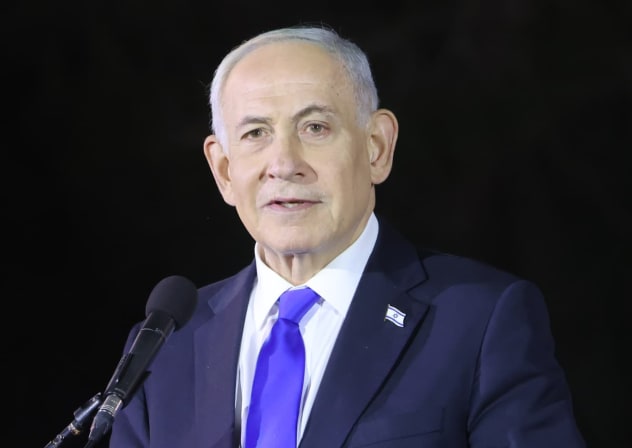
its statement, the prime minister – during his speech to the UN – called on
Abbas to restart peace talks in New York.
“Let’s talk
doogri
[straightforward],” Netanyahu said in his speech.
“There’s an old Arab
saying that you cannot applaud with one hand. Well, the same is true of peace. I
cannot make peace alone. I cannot make peace without you. President Abbas, I
extend my hand – the hand of Israel – in peace. I hope that you will grasp that
hand,” he said.
“If you wish, I’ll come to Ramallah. Actually, I have a
better suggestion. We’ve both just flown thousands of miles to New York. Now
we’re in the same city. We’re in the same building. So let’s meet here
today in the United Nations.
“What is there to stop us? If we genuinely
want peace, what is there to stop us from meeting today and beginning peace
negotiations? I’ll tell you my needs and concerns. You’ll tell me yours. And
with God’s help, we’ll find the common ground of peace,” Netanyahu
said.
The PA was quick to reject the Quartet’s proposal.
Its
Foreign Minister Riad Malki said on Saturday that the Quartet’s initiative is
“incomplete.” He pointed out that it does not call for a cessation of settlement
construction or a pullout to the pre- 1967 lines.
“The only new thing
that the Quartet carries is a time line for discussing the issues of security
and borders,” Malki said, referring to the Quartet’s statement calling for an
agreement by December 2012.
Chief PLO negotiator Saeb Erekat said that
the PA leadership would discuss the Quartet initiative in the coming
days.
A number of Palestinian factions, including Hamas and the Popular
Front for the Liberation of Palestine also rejected the Quartet plan, saying it
was designed to “foil” Palestinian aspirations for independence.
UN chief
Ban said, “I sincerely hope that the parties will respond constructively to our
statement.”
The European Union’s foreign policy chief Catherine Ashton
told reporters that there had been intense diplomatic activity in recent months
to get the parties back to the negotiating table. “This has been my primary
objective in the belief that through negotiations we would end the conflict,”
she said.
The Palestinians, meanwhile, have their eyes set toward Monday,
when the Security Council is scheduled to discuss Abbas’s application for full
UN membership of a Palestinian state. It could take weeks, even months, before
the matter is brought to a vote, however. While the US has pledged to veto the
resolution if necessary, efforts are being made to deny the Palestinians the
nine positive votes they need in the Security Council for it to be accepted and
passed on to the General Assembly for a vote, so that the US won’t have to use
its veto and be isolated on this issue.
Malki expressed hope that the
Security Council would vote in favor of the request. He added that the PA was
continuing its efforts to persuade additional countries to back the
request.
Following his speech to the UN, Netanyahu gave nine interviews
on Friday, three to Israeli television networks, and six to foreign networks,
including ABC, BBC, Fox News and CNN. He is scheduled to give an interview to a
pan-Arabic network on Sunday.