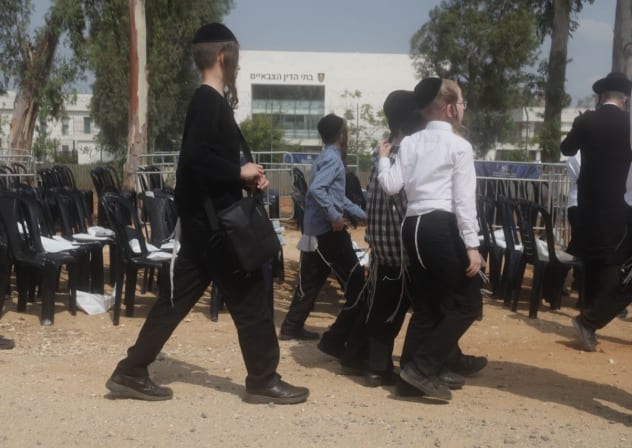
Six of Gush Etzion’s most prominent rabbis visited the torched mosque in Beit
Fajar on Tuesday to apologize for the destruction allegedly caused by Jewish
vandals, and to deliver new Korans to the local imam in place of those burned in
Monday’s pre-dawn arson attack on the West Bank house of worship.
Taking
the books, a local religious leader said he was accepting them in the name of
Palestinian prisoners in Israeli jails.
RELATED:Opinion: Paying for the ‘price-tag’ policyOfficials fear mosque arson will spark more violenceHead of the Har Etzion yeshiva
and nearby Alon Shvut resident Rabbi Aharon Lichtenstein and Efrat’s Chief Rabbi
Shlomo Riskin were among those who heeded the call of Rabbi Menahem Froman, a
Tekoa resident and longtime peace activist, to make the short trip to the mosque
in the nearby village.
“What was done over there was frightful,”
Lichtenstein told The Jerusalem Post, “terrible both morally and
religiously.”
The US on Tuesday harshly condemned the mosque
arson.
“We condemn this attack in the strongest terms and call for the
perpetrators to be brought to justice. We note that Prime Minister [Binyamin]
Netanyahu and Israeli Defense Minister Barak have also condemned the attack and
have called for an investigation,” the US State Department said in a statement responding to
reporters’ questions on the incident.
In Gush Etzion, the rabbis said the
act ran counter to Jewish values.
“We came to apologize and express our
shame in a threefold capacity,” said Lichtenstein – from a personal perspective,
as representatives of Gush Etzion and in the name of the State of
Israel.
“Going there, establishing contact, meeting the Palestinians face
to face was especially meaningful,” Lichtenstein added, noting that the meeting
had been positive and that the whole village, which in past years was considered
hostile, had turned out for the encounter.
“People wanted to hear
something positive,” he said. “I don’t delude myself that a conflict as sharp as
what we have is going to be resolved in a short period of time. However, people
feel that some progress might be made; morally it must be done,” he said. “I
don’t see how we can stand by.”
The driving force behind the initiative
was Froman, who in a conversation with the Post noted that this was already the
third time he had paid such visits to vandalized West Bank mosques, believed to
be the work of extreme Jewish elements exacting retribution.
The words
“price tag” and “revenge” were also scrawled in black Hebrew letters over the
stone doorway in Beit Fajar.
The two previous such occurrences were in
Luban a-Sharkia and Yasuf, both in Samaria, where Froman utilized his good
contacts within the Palestinian Authority to enable his presence on that
sensitive turf.
This time, however, he approached the head of the IDF
Civil Administration in Judea and Samaria, Brig.-Gen. Yoav Mordechai, who
coordinated the visit with the higher echelons of the local Palestinian regime.
Gush Etzion Regional Council head Shaul Goldstein and Efrat Mayor Oded Ravivi
had also wanted to be part of the delegation, but the Palestinians only agreed
to a group of six rabbis.
“This is a religious protest against those who
object to peace,” Froman said of the visit, noting the central significance of
peace in Judaism, expressed in prayer and even as one of the names of
divinity.
“Of course we didn’t commit the arson, but it seems that
somebody from my nation did,” he said.
Besides the rabbis who arrived in
civil administration jeeps under heavy Palestinian security, members of the
Eretzshalom (“landpeace”) movement, dedicated to promoting direct dialogue
between settlers and Palestinians, also managed to arrive
independently.
After the visit, a small clash erupted, with Palestinian
youths throwing rocks at IDF soldiers, who responded with tear gas. There
were no reports of casualties.
Goldstein told the Post that on Monday he
had called Beit Fajar’s mayor to express his sympathy and outrage.
“I
told him that no one knows who did it, and asked him not to immediately accuse
the settlers or Jews at all,” Goldstein said.
However, he added, in the
conversation with the mayor, that an act of arson against a mosque “was a crime,
no matter who did it.”
As of press time, Judea and Samaria Police had
still not released any information on their investigation into the
incident.
Tovah Lazaroff, Ben Hartman, Hilary Leila Kreiger and AP
contributed to this report