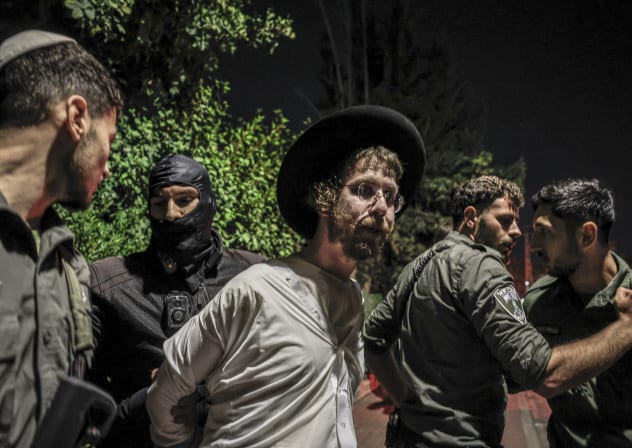
Israeli Arabs and Palestinians broke out in violence on Sunday, as part of Nakba Day protests.
IDF injured two Palestinian rioters at the Erez Gaza border crossing, where dozens of Palestinians protested.
RELATED: IDF on Lebanon alert for Nakba Day
demonstrations Security and Defense: Bracing for mass
protests
Four Palestinians were arrested on Sunday during a Nakba Day protest near Bethlehem. Protests are also underway in Beit Omar and Nebi Salah.
Three Nakba Day demonstrators were arrested in the east Jerusalem neighborhood of Isawiya for throwing stones.
Police forces, with the aid of a helicopter, managed to disperse the
stone-throwers who fled into the village. There were no reports of
injuries in the incident.
In addition, Molotov cocktails were thrown at Hadassah Hospital Mount Scopus, lightly injuring one policeman.
An 18-year-old Israeli man was injured when stones were thrown at his car in the east Jerusalem neighborhood of A-Tur.
About 100 Palestinians clashed with IDF soldiers at the Kalandiya crossing; no injuries were reported.
Nearly 10,000 border police officers were stationed throughout the country in cities with Arab and Jewish populations and areas where conflict was expected in light of 'Nakba Day'.
Police were asked to show restraint and not release live fire, unless there existed a real threat to human life.
Increased security in east Jerusalem and surrounding areas was expected to continue for the next few days.
Tensions
rose in east Jerusalem this weekend following the shooting death of a
Palestinian youth during a riot in the capital’s Silwan neighborhood.
At
police headquarters in Jerusalem on Saturday evening, Insp.-Gen. Yochanan
Danino spoke with intelligence officials and commanders from the Border Police,
the Operations Branch and the Jerusalem district, and drew up final plans for
Sunday.
“We will allow for demonstrations and we will act with restraint.
But we will not allow violent disturbances,” Danino said.
Jerusalem
police and Border Police units remain deployed in force in east Jerusalem, and
are on standby in case of further rioting, spokesman Micky Rosenfeld
said.
Officers are also deployed in larger than normal numbers in the
North, including near Umm el-Fahm and in the surrounding Wadi Ara
region.
Crossings with Judea and Samaria would be temporarily closed to
Palestinians on Sunday, the IDF announced on Saturday night. The closure began
on Saturday at 11:59 p.m. and will be lifted on Sunday at the same
time.
Persons in need of medical attention, humanitarian aid or
exceptional assistance will be permitted to pass for care, with the
authorization of the civil administration.
Meanwhile, the police opened
an investigation into Friday’s shooting in Silwan, which occurred during clashes
with masked Arab youths hurling rocks.
Milad Ayish, 17, from the Ras
al-Amud neighborhood, was taken to Al-Makassed Hospital on the Mount of Olives
on Friday with a bullet wound to his stomach, and died early on
Saturday.
Police asked for permission to carry out an autopsy to
determine where he was wounded and the caliber of the bullet, which would shed
light on where the shot was fired from and what type of weapon was used, but the
request was denied, Rosenfeld said.
The teenager’s father claimed the
bullet was fired from the direction of Jewish homes in Silwan, which are
protected by armed private security guards.
“This was deliberate murder!” Sa’id Ayish, Milad’s
father, told the Hebrew media from the family’s mourning tent on Saturday.
“Martyr posters” of Milad, who was set to graduate from high school in a few
weeks, were put up around east Jerusalem.
It was too soon to draw any
conclusions, police said. “It’s not clear what the injuries were, and how he
sustained them. An investigation is under way,” Rosenfeld said.
On
Friday, clashes were reported in the east Jerusalem neighborhoods of Isawiya,
Ras al-Amud, Silwan and the Shuafat refugee camp.
Hundreds of Arabs
burned flags, threw stones and used slingshots and homemade explosives against
police.
Four border policemen were lightly wounded, with one requiring
hospitalization, while Palestinians said 11 youths were lightly
injured.
Thirty-four people were arrested on Friday for rioting and
planning to throw gasoline bombs.
On Saturday, thousands of Palestinians
took part in a funeral procession for Ayish, marching with the coffin from Ras
al-Amud to Silwan.
Dozens of youths threw rocks at security personnel and
at Jewish homes in Silwan during the procession. Police dispersed the
stone-throwers and arrested six suspected rioters.
In the West Bank,
demonstrations were held in various cities over the weekend, but there was no
extreme violence. Near Ramallah, for example, soldiers dispersed several dozen
Palestinians and left-wing activists who were stoning IDF positions.
“It
was no different than the regular Friday demonstrations,” one IDF officer
said.
The Central Command will stay on high alert throughout Sunday, the
actual ‘Nakba Day,’ in anticipation of larger
demonstrations.
Palestinians in Jordan and Lebanon are also expected to
protest along the borders with Israel.
The IDF significantly boosted
troop levels in the West Bank ahead of ‘Nakba Day’ and commanders prepared their
men for a wide range of scenarios, from low-level protests to attempts to damage
the security barrier.
There are also concerns that terrorists will try to
carry out attacks in the West Bank on Sunday on the sidelines of the
demonstrations.
Following Saturday afternoon’s meeting of police
commanders, Rosenfeld said, “We’re allowing the scheduled marches and gatherings
to take place both in Jerusalem as well as in the North. At the same time, if
there are any disturbances, there are large numbers of officers from different
police units who are ready and capable and will respond
immediately.”
Yaakov Lappin, Melanie Lidman and Yaakov Katz contributed to this report.
|