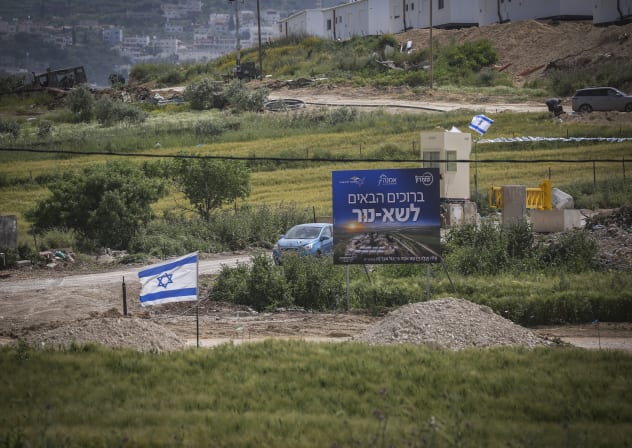
The Knesset Land of Israel Caucus called for the government to adopt
construction in the West Bank as a solution to the housing crisis on Tuesday,
the second day of a three-day marathon Knesset discussion on the National
Housing Committees Bill.
Caucus and coalition Chairman Zeev Elkin (Likud)
explained at a caucus meeting that 42 ministers, deputy ministers and MKs from
the opposition and coalition signed a letter imploring Prime Minister Binyamin
Netanyahu to favor settlement construction.
RELATED: PM: Let’s stop poverty, ensure free market PM: Protests have compelled us to change our priorities
“We hope to get more
signatures and pass 61,” he said. “I am sure our call will be a major part of
the discussion on housing, and Judea and Samaria will be a solution to the
problem, as it was during the previous housing crisis, in the early
90s.”
Sixteen MKs from Likud, Israel Beiteinu, Shas, UTJ, Kadima and
National Union attended the meeting, as did Justice Minister Yaakov Neeman,
Minister Michael Eitan and Science and Technology Minister Daniel Herschkowitz.
Communications and Welfare Minister Moshe Kahlon, Diaspora Affairs Minister Yuli
Edelstein and Minister-without-Portfolio Yossi Peled signed the
letter.
Knesset Speaker Reuven Rivlin told the caucus that, because of
his position, he cannot sign the letter, but expressed support for the
initiative.
“Zionism from its outset was a settlement movement,” Rivlin
explained. “If we stop going on this path, how can we justify the faith that all
of Zion belongs to us?” “We must eradicate the anti- Semitic claim that
settlements are the reason for the housing crisis from our lexicon,” MK Tzipi
Hotovely (Likud) said, calling for Israel to apply Israeli law to the West
Bank.
“We are at the end of a year of major events: a total construction
freeze, then partial construction, and no major government projects in Judea and
Samaria,” MK Arye Eldad (National Union) explained.
“Towns in Judea and
Samaria can – and must – be part of the solution to the housing crisis
throughout the country.”
Eldad demanded that Netanyahu add an article to
the National Housing Committees Bill that would allow for accelerated
construction in the West Bank, as well.
“Tens of thousands of Israelis
can live in Judea, Samaria and Jerusalem,” he added.
MK Otniel Schneller
(Kadima), a former chairman of the Yesha Council, lamented “the great amount of
hatred surrounding this issue.”
“Settlement strengthens all three
components of Israel’s declaration of independence – Zionism, Judaism and
democracy,” he said.
However, the Kadima MK stopped short of specifically
addressing the housing bill, which his party opposes.
Schneller and MK
Yulia Shamalov-Berkovich were punished by Kadima last month for not voting
against the coalition’s anti-boycott bill.
Yesha Council Chairman Danny
Dayan said that in the West Bank, which faced its own housing crisis because of
the construction freeze, “people do not need to pitch tents, because the
community looks out for them. If more people were taken out of Judea and
Samaria, prices would skyrocket all over Israel,” he warned.
Meanwhile,
in the plenum, opposition MKs presented their reservations about the National
Housing Committee Bill, starting at 11:00 a.m. – five hours earlier than usual –
and continuing into the evening.
Labor MKs accused the bill of being
anti-Zionist.
“You took Herzl’s Altneuland and turned it into Orwell’s
Animal Farm,” MK Eitan Cabel (Labor) said. “You forgot what it means to be
Israeli. In this country, you work hard and serve the state, and the state
provides you with basic needs.”
MK Shelly Yacimovich said she “heard the
prime minister talking about a monopoly on the land.”
“Which monopoly is
he talking about? The state?,” she asked. “Next we’ll hear the state has a
monopoly on the army, or the justice system,” she added. “The state holds land
as part of the Zionist vision.”
Many other opposition MKs complained that
the bill does not include construction in Arab towns and
neighborhoods.
“How can the prime minister draft a law forgetting 20
percent of Israel’s citizens?,” MK Shlomo Molla (Kadima) asked.
MK Hanna
Sweid (Hadash) pointed out that Arab towns tend to be small, and therefore, the
requirement for developers to build at least 200 units makes the bill irrelevant
to them. He asked the government to reduce the amount to 100, which would be “a
major improvement.”
Sweid also said that “many ministers and MKs think
that the greatest goal is the Land of Israel, so they draft anti-democratic laws
leading to socioeconomic anarchy.”
The National Housing Committees bill
is one of the central components of Netanyahu’s housing-reform plan. The bill is
meant to circumvent usual construction- planning bureaucracy in order to build
new homes.
The bill would allow for the temporary formation of
national-housing committees, which would work to accelerate the process of
approving building projects in the next year and a half.
There will be
one committee in every region in Israel, which will be responsible for providing
all of the authorizations necessary to begin construction only for projects with
over 200 homes, built mostly on state land and include “accessible housing.”
|